
Japan 7 Day Itinerary for First-Time Visitors
A practical 7 day Japan itinerary for first-time visitors who want Tokyo and Kyoto without turning the trip into a week of station transfers.
At a glance
- Best for
- First-time
- Main decision
- Which bases and transfer days make the route realistic
- Time needed
- 30-45 minutes to compare route options
- Official checks
- Opening hours, transport schedules, weather, reservations
- Related tool
- Budget Calculator
Choose two overnight bases before choosing attractions. For this route, that usually means one Tokyo base and one Kyoto base. Once the bases are clear, every other decision becomes easier: airport access, rail pass value, luggage movement, morning starts, evening meals, and whether a side trip fits. If the itinerary still feels crowded after that, remove a side trip before you remove sleep or transfer time.
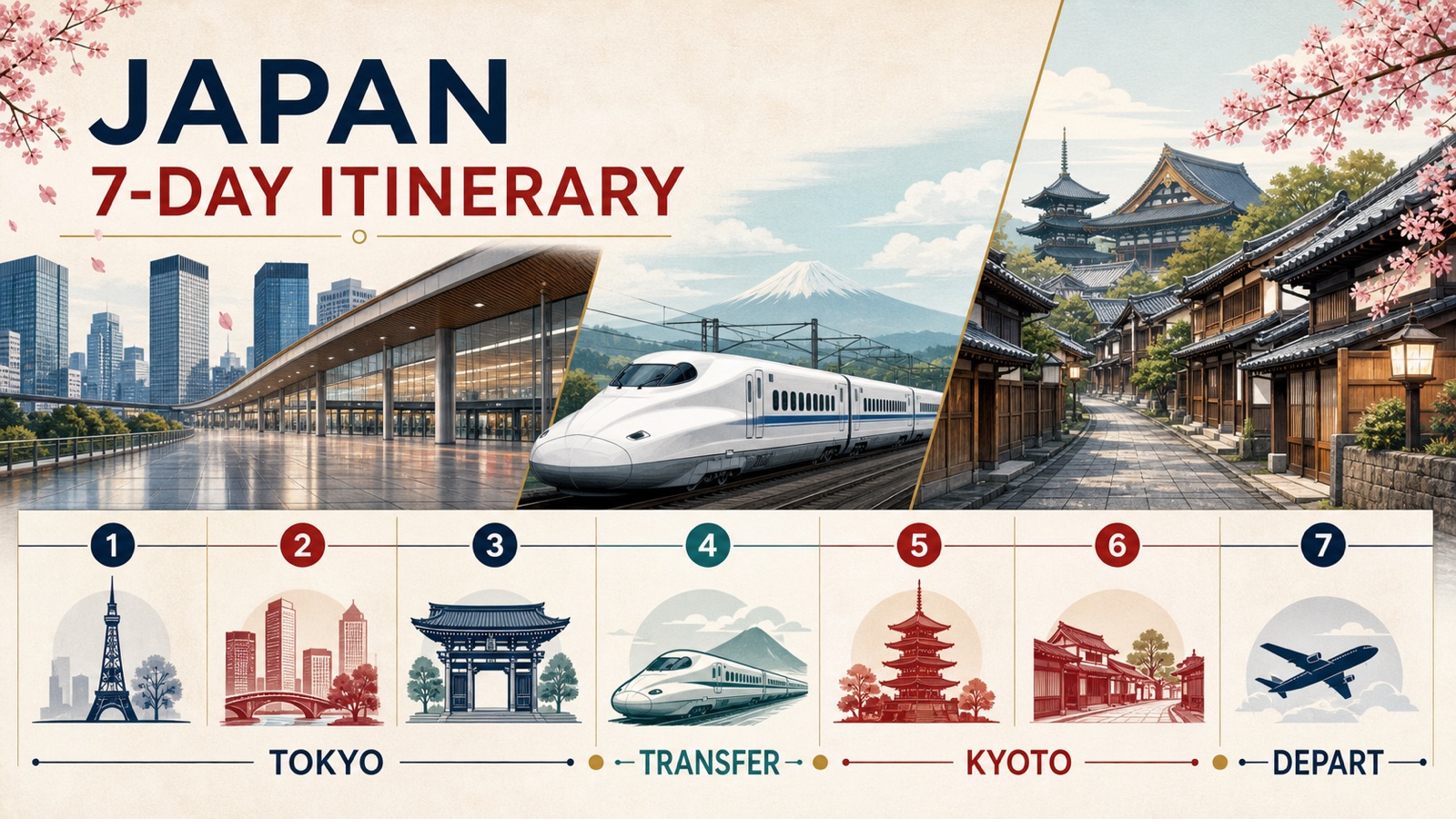
Quick answer
For most first-time visitors, the best 7 day Japan itinerary is a focused Tokyo and Kyoto route with one main transfer day, two calm hotel bases, and no more than one optional side trip. Seven calendar days are not seven full sightseeing days once arrival fatigue, checkout time, luggage, train stations, and departure timing are counted. The route below treats those frictions as real, so it helps travelers choose a trip they can actually enjoy.
Use Tokyo for arrival recovery, big-city neighborhoods, food, shopping, and flexible weather choices. Use Kyoto for early temple starts, historic districts, craft streets, gardens, and slower evenings. Keep Osaka, Nara, Hakone, Nikko, Hiroshima, and theme parks as deliberate choices rather than automatic add-ons. A first trip works better when the traveler leaves Japan with a clear memory of two places than when every day is a hurried transfer to the next famous name.
Who this is for
This itinerary is written for English-speaking travelers planning a first independent Japan trip, especially readers comparing Tokyo, Kyoto, Osaka, and rail pass advice before booking hotels. It assumes the traveler wants a classic route, can use trains, and prefers practical decisions over a list of every possible attraction. It is not built for ski trips, deep regional travel, theme-park-only trips, or travelers who already know Japan well.
If your flights arrive late or leave very early, treat this as a six-day route. If you are traveling with children, older relatives, mobility needs, or very large suitcases, reduce one sightseeing block before adding anything else. The plan is intentionally conservative because the goal of a 7 day Japan itinerary is not to win a checklist. The goal is to make the first route easy enough that the traveler can make good decisions on the ground.
| Traveler type | Use this route if | Adjust before booking |
|---|---|---|
| First-time couple or solo traveler | You want Tokyo plus Kyoto with a clear train transfer and enough variety. | Keep two bases and add only one side trip after hotels are chosen. |
| Family with children | You want a route that avoids a new hotel every night. | Remove one late evening and keep transfer day light. |
| Traveler with large luggage | You want to avoid dragging bags through crowded sightseeing areas. | Check luggage forwarding and oversized baggage rules before choosing trains. |
| Food and shopping focused traveler | You want Tokyo neighborhoods and a Kyoto cultural base without overplanning meals. | Use Osaka as an optional evening only if the return is easy. |
| Rail pass researcher | You are checking whether a national rail pass fits a short route. | Compare the exact Tokyo-Kyoto leg against current official pass prices. |
Six hotel nights: choose your airport version first
Arrival on Day 1 and departure on Day 7 means six nights in Japan. Choose the version below before paying for hotels. A final Tokyo night is a replacement, not a seventh night hidden inside a seven-day trip. These are editorial route suggestions, not guaranteed train connections.
| Flight pattern | Nights 1-3 | Nights 4-6 | What to give up |
|---|---|---|---|
| Arrive Tokyo, depart Kansai | Tokyo: 3 nights | Kyoto: 3 nights | Keep the departure morning for the airport route; an early flight may justify replacing Night 6 with airport-area accommodation |
| Arrive and depart Tokyo | Tokyo: 3 nights | Kyoto: 2 nights; Tokyo: 1 night | Return on Day 6 instead of adding a Kansai side trip |
| Late arrival, limited energy or no appetite for long transfers | One Tokyo hotel for all 6 nights, with nearby excursions chosen around the weather | Save Kyoto for a longer trip rather than compressing it into one exhausted day | |
The Tokyo-return version visits two cities but has three hotel stays: Tokyo, Kyoto, Tokyo again. Ask the first hotel whether it can hold luggage between confirmed stays; this is a hotel-specific service, not an entitlement. If it cannot, price forwarding or carry only what you can manage through stations. A second Tokyo booking need not be the same property if the departure airport makes another area easier.
With six nights, the practical question is which two sightseeing priorities survive the flight pattern. In the open-jaw version, Day 6 can be Kyoto or one nearby outing. In the Tokyo-return version, Day 6 is a rail and check-in day. Do not keep the same Nara, Osaka or Himeji plan on top of it. Keep any final shopping close to the hotel after the return is complete.
Compare the extra airfare for departing Kansai against the Tokyo return train, possible hotel-price difference and lost sightseeing time. Use actual quotes, not the assumption that an open-jaw ticket is always cheaper. If the return fare is already fixed, work with it: shorten the Kyoto block or stay in one region. Use the JR Pass calculation guide for the resulting rail legs and the budget worksheet, replacing nine nights with six.
Step-by-step 7 day action plan
Day 1: arrive, get connected, and keep the first evening small. After immigration, baggage claim, transport into the city, and hotel check-in, most travelers are not ready for a complex cross-city plan. Choose a hotel area that supports tomorrow's route, buy or set up the local transport tools you need, eat near the hotel, and sleep. If energy is good, take a short walk in the neighborhood instead of chasing a famous night view.
Day 2: use an east-side Tokyo day. Asakusa, Ueno, Akihabara, Tokyo Station, Ginza, or a river-side route can work depending on the hotel base and weather. The point is to group nearby places so the day teaches the traveler how Tokyo moves. Avoid crossing the city repeatedly. Use this day to understand train transfers, walking distance, meal timing, and how crowded popular areas feel.
Day 3: use a west-side Tokyo day. Shibuya, Harajuku, Omotesando, Shinjuku, a garden, or an observation view can create a useful contrast with Day 2. If the traveler wants shopping, this is usually a better day than transfer day. If the traveler wants a day trip such as Kamakura, Nikko, or Hakone, compare the weather and energy honestly. On a 7 day itinerary, a day trip should replace a Tokyo block, not sit on top of it.
Day 4: transfer from Tokyo to Kyoto. Treat this as a logistics day with one gentle experience, not a full sightseeing day. Check out, move to the long-distance train, keep tickets handy, and arrive in Kyoto with enough time to check in. If luggage is large, consider forwarding or reserve the right baggage space when required. For the evening, choose a nearby food street, station area, riverside walk, or simple temple district stroll rather than a distant attraction.
Day 5: start Kyoto early. JNTO's Kyoto guidance notes that less busy times such as early morning can improve visits to shrines and historic areas. Use that idea practically: put the most important outdoor or temple district first, then let the afternoon absorb crowds, weather, shopping, tea, crafts, or a rest. Higashiyama, Gion, central Kyoto, Arashiyama, or northern areas can all work, but not all in one day.
Day 6: if flying home from Tokyo, return to Tokyo and check in for the final night. Otherwise, choose deeper Kyoto or one Kansai side trip. If this is the traveler's only Kyoto visit, a second Kyoto day is usually stronger than a rushed Osaka-Nara-Kyoto mix. If the traveler strongly wants Nara, Osaka, Uji, or Himeji, choose one and design the day around it. Keep dinner near the return route and avoid building a late-night transfer into the final night unless the next morning is easy.
Day 7: protect departure and unfinished decisions. If departing from Kansai, keep the morning near the hotel or airport route. If returning to Tokyo for a flight, consider whether the previous night should have been in Tokyo instead. Use leftover time for one close neighborhood, shopping, or a meal, not a far attraction. The last day should reduce risk: checked tickets, correct terminal, reachable luggage, and no route that fails if one train is delayed.
| Day | Base | Main decision | Why it works |
|---|---|---|---|
| 1 | Tokyo | Arrive, connect, eat near hotel, sleep. | It respects airport and jet-lag friction. |
| 2 | Tokyo | East-side classic areas or Tokyo Station/Ginza/Ueno/Asakusa grouping. | Nearby places teach Tokyo without too many transfers. |
| 3 | Tokyo | West-side neighborhoods or one carefully chosen day trip. | It adds contrast while protecting energy. |
| 4 | Kyoto | Main transfer and light evening. | One hotel move keeps the week simple. |
| 5 | Kyoto | Early cultural district plus flexible afternoon. | Kyoto is better when the first important stop is not rushed. |
| 6 | Kyoto or Tokyo | Kyoto or one side trip for Kansai departure; return to Tokyo for a Tokyo departure. | It turns optional ideas into a real choice. |
| 7 | Departure base | Airport route, luggage, and nearby final stop. | It avoids losing the flight day to overplanning. |
Transport, luggage, and cost checks
The transport plan should be written before hotels are final. Choose the arrival airport, the Tokyo base, the Tokyo-to-Kyoto transfer, the Kyoto base, and the departure airport as one connected route. JNTO's transportation pages highlight Japan's broad public transport network, but good service does not remove the need to check actual timetables, last trains, station transfers, and luggage rules for the dates you will travel.
For Shinkansen travel, check train type, seat type, ticket pickup, and rail pass restrictions before departure. JNTO notes that Shinkansen seat types include non-reserved, reserved, and Green Car seats. The Smart EX baggage guide says reservations are required for seats with oversized baggage area when taking baggage with overall dimensions of more than 160 cm and no more than 250 cm on the relevant Tokaido, Sanyo, and Kyushu Shinkansen services. Measure height, width and depth together. The Japanese Smart EX reservation guidance, checked September 5, 2026, specifies more than 160 cm, not exactly 160 cm. Confirm the current conditions for the train and baggage you will use.
Budget planning should start with the large decisions: hotels by season, long-distance rail, airport access, local transport, special tickets, and meals. Do not use one old sample budget as a current price promise. Use the on-site Budget Calculator for a personal estimate, then verify official rail pass and operator prices. A seven-day trip can feel affordable or expensive depending less on the number of sights and more on whether the route creates repeated taxis, hotel moves, and last-minute tickets.
| Planning item | Check before paying | Why it changes the itinerary |
|---|---|---|
| Airport access | Official airport, railway, or bus route for arrival time. | Late arrivals can make a distant hotel area impractical. |
| Tokyo-Kyoto transfer | Official railway booking or timetable and the rail pass rule for your train. | This is the main long-distance leg in the plan. |
| JR Pass | Official Japan Rail Pass price page and exact route value. | A short Tokyo-Kyoto route often needs individual comparison. |
| Large luggage | Smart EX or railway baggage guidance and hotel forwarding options. | Oversized baggage can require reserved space or a lighter transfer day. |
| Local cash and IC card | Current IC card availability and payment options. | Small purchases and city transit are easier when payment is solved early. |
| Hotel base | Map distance from useful stations, not only tourist-area name. | A cheaper room can create daily time loss. |
Common mistakes
The biggest mistake is treating seven days as a miniature version of a three-week Japan trip. Adding Hokkaido, Hiroshima, Mount Fuji, Osaka, Nara, Nikko, and a theme park into one week usually creates the feeling of seeing Japan through train windows. The fix is simple but hard: pick two bases, one transfer, and one optional side trip. Everything else becomes a future-trip idea.
Another common mistake is booking hotels first because a deal looks good. In Japan, a hotel is also a transport decision. A distant or poorly connected room can increase daily walking, crowded transfers, taxi use, and fatigue. The third mistake is buying a rail pass before checking the route. A pass can be useful, but on a compact first trip it should be proven by the actual legs, not bought because a forum post said visitors need one.
Finally, many travelers forget official checks until the week before departure. Opening hours, ticket systems, station construction, weather warnings, seasonal crowds, and baggage rules are exactly the details that can change a short trip. Build the itinerary with enough flexibility that one closed museum, rainy morning, or missed train does not damage the whole week.
| Mistake | What it causes | Better move |
|---|---|---|
| Adding too many cities | More transfers than memorable days. | Use Tokyo and Kyoto as the core and add only one optional side trip. |
| Ignoring arrival fatigue | A weak first day and late start on Day 2. | Keep Day 1 near the hotel and make Day 2 the first real sightseeing day. |
| Buying a pass before route math | Possible overspend or wrong train expectations. | Compare exact legs against official pass prices. |
| Changing hotels for tiny map gains | Lost time at checkout, lockers, and station transfers. | Move hotels only when it solves departure or route friction. |
| Planning Kyoto only in midday | Crowded key areas and rushed temple visits. | Put the most important Kyoto outdoor stop early. |
| Forgetting luggage rules | Stress at stations and train boarding. | Check forwarding and oversized baggage guidance before transfer day. |
What to verify on official sources
Facts checked for this update on July 12, 2026 came from JNTO, official JR Pass information, and Smart EX/JR railway guidance. Even so, readers should verify dynamic details close to travel because prices, opening hours, ticket systems, construction, severe weather guidance, and railway rules can change. The itinerary should point travelers to the right official checks rather than pretending one article can freeze every current detail.
Before booking, verify passport and visa needs for your nationality, Visit Japan Web and customs procedures if you plan to use them, airport access for the actual arrival time, long-distance rail ticket rules, hotel cancellation terms, luggage forwarding acceptance limits, and attraction opening days. Before departure, recheck weather, route disruptions, reserved tickets, airport terminal, and any high-demand entry system.
| Official source to check | Use it for | When to check |
|---|---|---|
| JNTO planning pages | Basics, customs, connectivity, luggage, safety, and destination planning. | At the start and again before departure. |
| Official railway or booking pages | Current timetables, ticket rules, seat reservations, and train categories. | Before buying rail tickets or passes. |
| Official Japan Rail Pass site | Current pass prices, validity, and special ticket rules. | Before buying a pass. |
| Smart EX or railway baggage pages | Oversized baggage reservations and onboard baggage rules. | Before choosing train seats. |
| Official attraction or local government pages | Opening days, closures, reservation systems, and crowd controls. | When placing a stop on a specific date. |
| Official weather and safety sources | Typhoon, heat, earthquake, or transport disruption checks. | During the final week and on travel days. |
Related tools and site links
Use the Japan Trip Tools Budget Calculator before locking hotels, because hotel season and the Tokyo-Kyoto transfer shape the realistic cost range. Use the JR Pass checker after you know the exact long-distance legs, not before. Use the Region Finder only if you are deciding whether Tokyo plus Kyoto is enough; if the route already feels full, the answer is usually to save another region for a later trip.
The best next internal guide depends on the constraint. If time is the problem, compare the Japan 10 Day Itinerary and decide whether a longer trip is needed. If money is the problem, read the JR Pass Worth It guide and the Japan Travel Budget for 10 Days. If hotel base is the problem, read Where to Stay in Tokyo First Time before reserving the first room.
- Use /tools/budget-calculator/ to price hotels, food, long-distance rail, local transit, activities, shopping, and reserve money.
- Use /tools/jr-pass-calculator/ after the route is written, especially if you add a side trip or return to Tokyo.
- Use /tools/luggage-planner/ if you will carry checked bags or move between Tokyo and Kyoto by train.
- Use /transport/ for airport transfer, rail, IC card, luggage, and Shinkansen decisions.
- Use /where-to-stay/ before booking the Tokyo or Kyoto base.
If you only do one thing
Choose two overnight bases before choosing attractions. For this route, that usually means one Tokyo base and one Kyoto base. Once the bases are clear, every other decision becomes easier: airport access, rail pass value, luggage movement, morning starts, evening meals, and whether a side trip fits. If the itinerary still feels crowded after that, remove a side trip before you remove sleep or transfer time.
Use next on Japan Trip Tools
- Japan 10 Day Itinerary — Compare whether three extra days make the same route more realistic.
- Tokyo Kyoto Osaka 10 Day Itinerary — Use this when Osaka is a serious part of the plan.
- Is the JR Pass Worth It? — Check the rail pass decision against the exact route.
- Japan Travel Budget for 10 Days — Build a more realistic spending range before booking.
- Where to Stay in Tokyo First Time — Choose a first base that supports the route.
Sources and image licensing
Plan your next step
FAQ
Is 7 days enough for Japan?
Seven days is enough for a focused first Japan trip, usually Tokyo plus Kyoto or one strong region. It is not enough for a relaxed full-country route, so the itinerary should limit hotel moves and side trips.
Should I visit Tokyo and Kyoto in 7 days?
Yes, Tokyo and Kyoto are the strongest first-time pair for many travelers because they offer a clear contrast. The route works best with one main transfer day and no more than one optional Kansai side trip.
Should I add Osaka to a 7 day Japan itinerary?
Add Osaka only if it solves a real goal such as food, nightlife, a theme park, or Kansai Airport positioning. For many travelers, Osaka is better as an evening from Kyoto than as another hotel move.
Is the JR Pass worth it for a 7 day Tokyo and Kyoto trip?
Not automatically. Compare the exact long-distance rail legs and current official Japan Rail Pass prices before buying. A simple Tokyo-Kyoto route may not justify a national pass.
Where should I stay for this 7 day Japan route?
Stay in one well-connected Tokyo area and one Kyoto area that supports early starts. Pick hotels by route friction, station access, and luggage handling, not by neighborhood fame alone.
Can I do Nara, Osaka, or Hakone in this itinerary?
You can include one of them if you remove another block. In seven days, a side trip should replace a city day rather than sit on top of an already full plan.
When should I book hotels and trains?
Book hotels after the route and airport plan are set. Book trains or passes only after checking official timetables, pass rules, seat needs, and any baggage requirements for your travel dates.
How many nights do I need for a seven-day Japan trip?
Six nights if you arrive on Day 1 and leave on Day 7. Use Tokyo three nights and Kyoto three nights for a Kansai departure. For a Tokyo return flight, use Tokyo three, Kyoto two, and Tokyo one; the final Tokyo night replaces a Kyoto night.