
Haneda to Tokyo Transfer: Monorail, Keikyu, Bus, Taxi, or Hotel Strategy
A practical Haneda to Tokyo transfer guide for first-time visitors choosing between Keikyu, Tokyo Monorail, airport bus, taxi, and first-night hotel areas.
At a glance
- Best for
- First-time
- Main decision
- Which base reduces time, cost, and luggage friction
- Time needed
- 20-30 minutes before booking hotels
- Official checks
- Hotel location, cancellation rules, room size, station access
- Related tool
- Where To Stay Hub
Before booking your first Tokyo hotel, run the airport-to-hotel route for your actual arrival time and luggage level. If Keikyu or Tokyo Monorail reaches the hotel with one simple transfer and a short walk, use rail. If the hotel has a direct bus stop and you have large bags, compare bus seriously. If all public routes are awkward and you arrive late, budget taxi or choose a different first-night area.
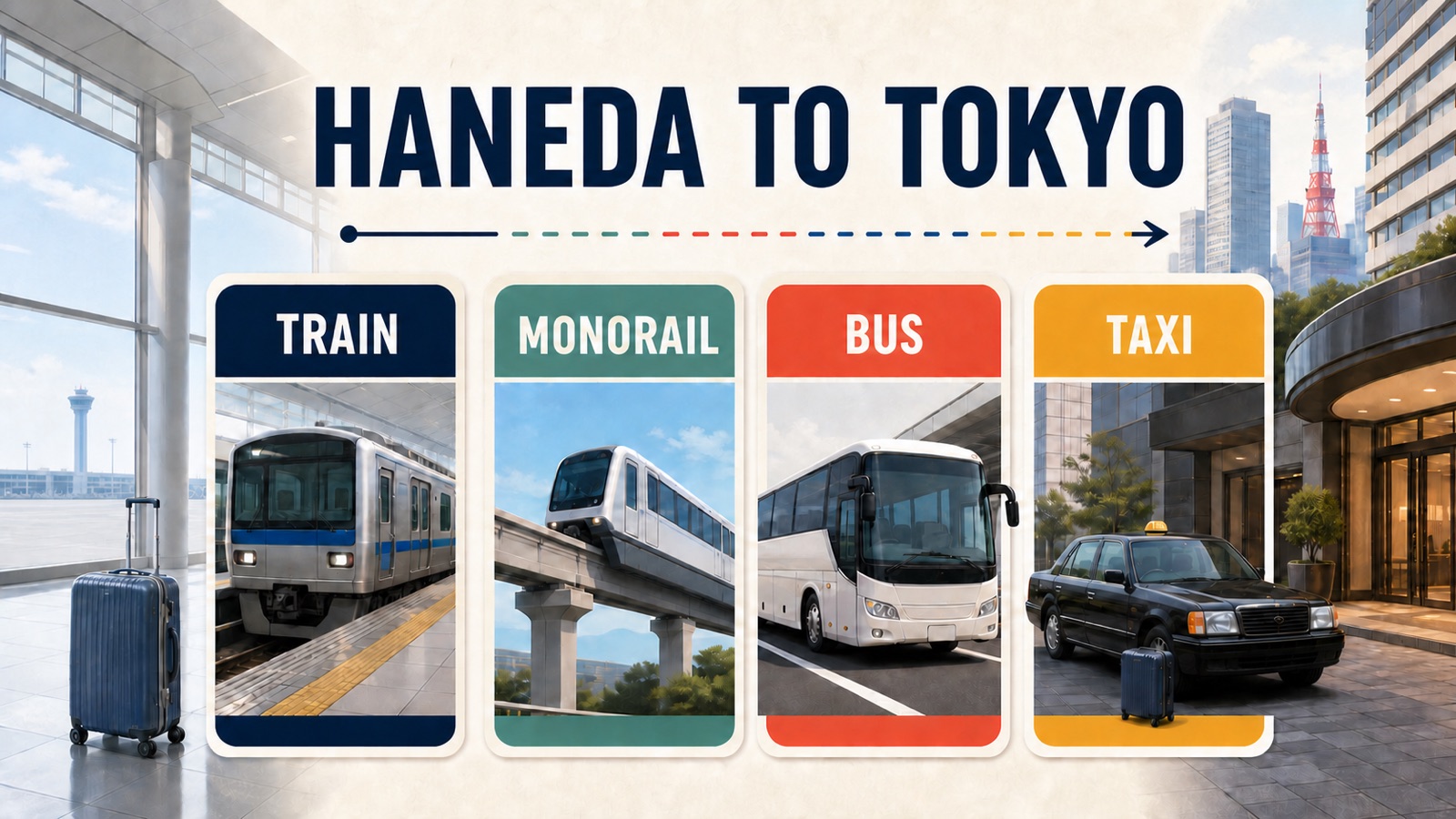
Quick answer: the easiest Haneda to Tokyo transfer
For most first-time visitors, the easiest Haneda to Tokyo transfer is the route that reaches your hotel area with the fewest stressful decisions, not simply the route that looks fastest on a map. Choose Keikyu if your hotel is near Shinagawa, Sengakuji, Higashi-ginza and other Toei Asakusa Line areas, Asakusa, or Yokohama. Choose Tokyo Monorail if Hamamatsucho and the JR Yamanote Line make the cleanest connection. Choose an airport bus if it stops at your hotel or a nearby major terminal and you have heavy luggage. Choose taxi only when comfort, late arrival, children, mobility needs, or several bags justify the cost.
The official Haneda Airport access page checked on 2026-07-16 says the airport is directly connected to the Keikyu Line and Tokyo Monorail, and it gives broad train and monorail estimates such as about 15 minutes to Shinagawa, about 20 minutes to Hamamatsucho, about 30 minutes to Tokyo Station, about 45 minutes to Shibuya, and about 50 minutes to Shinjuku. Tokyo Monorail's own English page also promotes quick transfers from Terminal 3 and average service around every five minutes. Treat those figures as planning estimates, then check the operator route search for your terminal, date, time, and hotel station.
If this is your first night in Japan, keep the plan boring. Land, clear immigration, collect bags, get cash or an IC setup if needed, reach the hotel, eat nearby, and sleep. Haneda is close enough to Tokyo that travelers often become overconfident and book a cross-city dinner or timed attraction. The better transfer plan saves your attention for the first full day.
Who this Haneda guide is for
Use this page if you are landing at Haneda and choosing a first Tokyo hotel, or if you already booked a hotel and need to decide between Keikyu, Tokyo Monorail, bus, and taxi. It is written for English-speaking visitors who care about luggage, station complexity, late arrivals, children, older travelers, and the first-night stress that official route searches do not always explain.
This is not a live timetable. Airport access, fares, bus schedules, taxi stands, late-night services, and station exits can change. Official Haneda, Keikyu, Tokyo Monorail, bus, and taxi pages were checked for this update on 2026-07-16, but you should verify your exact arrival time after flights and hotels are fixed.
| Traveler situation | Best first filter | Why it matters |
|---|---|---|
| Hotel near Shinagawa or Yokohama | Check Keikyu first | It can remove a transfer and keeps the route rail-based. |
| Hotel near Hamamatsucho, Tokyo Station, Ueno, or Yamanote stops | Compare Tokyo Monorail plus JR | The monorail is frequent and connects into central JR loops. |
| Hotel near a limousine-bus stop | Check airport bus before dismissing it | A slightly slower bus can be easier with suitcases. |
| Late arrival or children | Check final trains, buses, and taxi backup | The best daytime route may not be the best route after a delay. |
| Very tight budget | Use rail and avoid taxi | Haneda rail is usually the budget baseline, but the hotel station still matters. |
Haneda transfer decision table
Start with the route type, then test your exact hotel. Haneda has good access, but station transfers can still be awkward after a long flight. A good route has a clear terminal station, a manageable transfer, and a final walk you can handle with bags.
| Option | Best for | Main tradeoff |
|---|---|---|
| Keikyu Line | Shinagawa, Sengakuji, Asakusa-line areas, Yokohama, and some east-central hotels | Destination boards matter; confirm whether the train goes toward your line or needs a transfer. |
| Tokyo Monorail | Hamamatsucho, Yamanote Line connections, Tokyo Station via JR, and travelers who want frequent rail service | You still need a JR or subway transfer for many hotels. |
| Airport bus | Hotels or districts served directly, families, larger bags, and travelers who dislike station transfers | Schedules are less flexible than rail and road conditions can add time. |
| Taxi or fixed-fare taxi | Late arrival, mobility needs, children, multiple suitcases, or a group splitting cost | Cost is the main tradeoff; tolls and fixed-fare coverage must be checked. |
| Airport-area hotel | Very late arrival, early domestic connection, or a group that wants zero first-night risk | You lose central Tokyo evening time but protect sleep and recovery. |
Choose by Tokyo hotel area
Your hotel area should decide the transfer, not the airport brand. Haneda is close, but the wrong hotel can still create an avoidable transfer through a busy station. Before booking, test airport to hotel, hotel to your first full-day area, and hotel to your next long-distance rail point.
| Hotel area | First transfer to compare | Practical note |
|---|---|---|
| Shinagawa | Keikyu | Often the cleanest rail target from Haneda; useful if you later take the Tokaido Shinkansen. |
| Hamamatsucho / Daimon | Tokyo Monorail | Good for monorail simplicity, JR Yamanote access, and some business hotels. |
| Tokyo Station / Marunouchi / Ginza | Monorail plus JR, or Keikyu/Toei route depending on exact station | A hotel that says Tokyo can still be several subway stops from your arrival line. |
| Shinjuku / Shibuya | Rail with one transfer, bus if it stops near the hotel, taxi as backup | The official Haneda page gives broad estimates, but station exits and luggage decide comfort. |
| Asakusa / Ueno | Keikyu/Toei Asakusa route or monorail plus JR | Asakusa can be easier by through-service rail; Ueno often depends on JR transfer quality. |
| Yokohama | Keikyu | Good if your first night is outside central Tokyo or you are positioning for Kanagawa. |
Choose the terminal, line and final connection in that order
Start with the flight's actual terminal. International flights can use Terminal 2 or Terminal 3; do not take a train to Terminal 3 simply because your flight is international. Haneda's international-arrival guide provides both terminal paths. Check the airline's flight record again before travel. This terminal check was reviewed September 5, 2026.
Keikyu has Haneda Airport Terminal 1-2 Station and Haneda Airport Terminal 3 Station. Tokyo Monorail has separate Terminal 1, Terminal 2 and Terminal 3 stations. Choose the departure point matching the terminal you actually use; do not transfer terminals merely to follow somebody else's directions. For a genuine flight connection, consult the airport's inter-terminal guidance rather than assuming a shuttle runs all night.
| Hotel target | Route to check | Important distinction |
|---|---|---|
| Shinagawa | Keikyu toward Shinagawa | Check the train destination; not every airport departure is bound for central Tokyo |
| Higashi-ginza or Asakusa | A suitable Keikyu service through to the Toei Asakusa Line | This is not through service to Tokyo Metro's Ginza Line |
| Hamamatsucho | Tokyo Monorail | Tokyo Station and Ueno require an onward connection, not a direct monorail ride |
| Shinjuku or Shibuya | Rail with an onward connection, or a bus serving a useful stop | Compare the complete hotel journey and its last usable service |
Keikyu's official route and fare search, checked September 5, 2026, identifies the Toei Asakusa through service. Higashi-ginza is a station in the Ginza area; it is not the same station or line as Ginza. Enter the exact station from your hotel's directions, inspect any changes in the result and confirm the destination display before boarding.
For an early flight, work backwards
Use the airline's required airport-arrival and bag-drop times, not a generic rule from a blog. Subtract the complete hotel-to-terminal journey plus the margin you choose for disruption. As an arithmetic example, an airline-required 05:30 terminal arrival, a hypothetical sixty-minute door-to-terminal journey and a thirty-minute margin imply leaving at 04:00. This is not evidence that public transport exists at 04:00. Check the first service and every connection; if none fits, arrange a suitable taxi or airport-area hotel for the final night.
For arrival, reverse that process: first clear the airport, then select a departure you can reach without running. Compare a direct hotel bus against rail if bags or mobility make the last transfer difficult. Price taxis by the applicable zone or meter conditions and vehicle capacity, not only the number of people splitting the fare. Keep the hotel address and reception contact available offline so a delayed flight does not leave you deciding everything at the taxi stand.
Late arrival and luggage strategy
For a daytime arrival with one suitcase, rail is usually the default. For a late arrival with two bags, a stroller, or a tired family, the default changes. A direct airport bus to a hotel entrance can beat a faster rail route that requires stairs, a long underground transfer, and a final 15 minute walk.
If your flight lands late, verify the last practical train and bus after adding realistic arrival processing time. Do not use scheduled landing time as station departure time. If you are arriving after a long-haul flight, also avoid booking a hotel whose cheapest access route depends on a complex final transfer you have never used before.
Large luggage changes the value of every option. Keikyu and Tokyo Monorail stations are airport-connected, but your destination station may not be as easy. Bus luggage handling can be calmer, while taxi can be worth it for a group. If the next day begins with a Shinkansen, a Shinagawa or Tokyo Station-area hotel may save more energy than a trendier neighborhood.
Common mistakes
The first mistake is asking which route is best without naming the hotel area. Haneda to Tokyo is not one route; it is a set of different routes to Shinagawa, Hamamatsucho, Shinjuku, Shibuya, Ueno, Asakusa, Ginza, Yokohama, and dozens of smaller stations.
The second mistake is optimizing for the cheapest fare while ignoring the final walk. A low fare can become a bad value if you carry bags through a difficult transfer or pay for a taxi from the wrong station. The third mistake is assuming the same route works at night. Train frequency, bus schedules, taxi queues, and fatigue all change after delays.
The fourth mistake is booking the first dinner across town. Haneda is close enough to tempt you, but first-night energy is unreliable. The fifth mistake is ignoring the return flight. If you depart from Haneda early, the best first-night hotel may not be the best last-night hotel; plan both separately.
What to verify on official sources
Verify your terminal, train route, bus stop, taxi stand, and last usable departure on official pages after your flight time is fixed. Haneda Airport's official train and monorail page is the best starting point for airport layout and major-station estimates. Keikyu and Tokyo Monorail operator pages are better for the final timetable, destination display, train type, and fare search.
For buses, verify the exact stop, service day, ticketing method, and final bus on the Haneda airport or bus operator page. For taxis, verify whether fixed fare applies to your ward or city, whether tolls are extra, and where app-dispatched taxis board. For travelers needing elevators or barrier-free routes, verify station accessibility rather than assuming every transfer is easy.
- Check Haneda Airport train and monorail access for terminal layout and major-station estimates.
- Check Keikyu or Tokyo Monorail route search for the exact date, time, destination, and fare.
- Check airport bus pages for stop location, ticket purchase, and last service.
- Check taxi fixed-fare coverage, tolls, app pickup location, and late-night conditions.
- Check your hotel route from the final station exit, not only from the station name.
If you only do one thing
Before booking your first Tokyo hotel, run the airport-to-hotel route for your actual arrival time and luggage level. If Keikyu or Tokyo Monorail reaches the hotel with one simple transfer and a short walk, use rail. If the hotel has a direct bus stop and you have large bags, compare bus seriously. If all public routes are awkward and you arrive late, budget taxi or choose a different first-night area.
Related tools and next planning links
Use the Airport Transfer Finder after you know your terminal, hotel area, and luggage level. Use the Luggage Planner if you are connecting Haneda arrival with a next-day Shinkansen, Disney day, or hotel change. Use the IC Card Checklist before assuming you can handle every fare decision at the gate.
Next, compare Where to Stay in Tokyo First Time, Narita to Tokyo Transfer, Tokyo IC Card Practical Guide, Japan 7 Day Itinerary, and First-Time Japan Travel Guide. Those pages turn the airport decision into hotel, payment, and first-day choices.
Use next on Japan Trip Tools
- Narita to Tokyo Transfer — Compare Tokyo airport arrivals before choosing flights or first-night hotels.
- Where to Stay in Tokyo First Time — Match hotel bases to airport routes and daily plans.
- Tokyo IC Card Practical Guide — Prepare payment and local train decisions after arrival.
- First-Time Japan Travel Guide — Connect airport arrival with the whole first-trip sequence.
- Japan 7 Day Itinerary — Place the arrival night into a compact route.
Sources and image licensing
- Haneda Airport Passenger Terminal train and monorail access (checked 2026-07-16)
- Haneda Airport Passenger Terminal express bus and route bus access (checked 2026-07-16)
- Haneda Airport Passenger Terminal taxi access and flat-rate taxi notes (checked 2026-07-16)
- Tokyo Monorail quick transfers from Haneda (checked 2026-07-16)
- Keikyu Haneda Airport Access route and fare search guide (checked 2026-07-16)
Plan your next step
FAQ
Is Haneda easier than Narita for Tokyo?
Often yes, because Haneda is closer to central Tokyo and has strong rail access. The better airport still depends on flight price, hotel area, arrival time, luggage, and whether the route reaches your hotel cleanly.
Should I take Keikyu or Tokyo Monorail from Haneda?
Choose Keikyu when Shinagawa, Sengakuji, Asakusa-line stations, Yokohama, or your hotel route fits better. Choose Tokyo Monorail when Hamamatsucho and a JR transfer make the cleanest path.
Is the airport bus from Haneda worth it?
It can be worth it when the bus stops at your hotel or a nearby terminal and you have heavy luggage. It is less useful when the stop is far from the hotel or the schedule does not fit your flight.
Is taxi from Haneda to Tokyo worth it?
Taxi can be worth it for late arrivals, children, mobility needs, several suitcases, or a group sharing the fare. Check fixed-fare coverage and toll rules before budgeting it.
Where should I stay for an easy Haneda arrival?
Shinagawa, Hamamatsucho, Tokyo Station, parts of Ginza, and some Asakusa-line areas can work well, but the exact station exit matters more than the neighborhood name.
Can I use an IC card from Haneda?
Rail routes generally support IC-card style local payment, but tourist card availability and mobile setup can change. Check current airport and operator pages before relying on a specific card product.
What should I do if my Haneda flight lands late?
Check the last practical train and bus after adding arrival-processing time. If public transport becomes risky, use a taxi backup, airport-area hotel, or a hotel with a simpler late route.
When should I recheck official sources?
Recheck after booking flights and hotels, again before departure, and immediately if the airline changes terminal, arrival time, or baggage expectations.
Does Keikyu run directly onto the Ginza Line?
No. Keikyu through services use the Toei Asakusa Line, including suitable services to Higashi-ginza. Tokyo Metro Ginza Line is different. Enter the exact hotel station and check whether your chosen departure requires a change.