
Japan 14 Day Itinerary: First-Time Route With Tokyo, Kyoto, Osaka, and Hiroshima
A practical 14 day Japan itinerary for first-time visitors, with route order, hotel bases, rail decisions, cost pressure, official checks, and backup options.
At a glance
- Best for
- First-time
- Main decision
- Which bases and transfer days make the route realistic
- Time needed
- 30-45 minutes to compare route options
- Official checks
- Opening hours, transport schedules, weather, reservations
- Related tool
- Budget Calculator
Before booking anything, write the itinerary as hotel nights, not as cities. Tokyo four nights, Kyoto four, Hiroshima two and Osaka three is the thirteen-night Kansai-departure version. For Tokyo departure, replace the last Osaka night with Tokyo; do not add a fourteenth night. If your version has seven or more hotel bases, cut it before you pay.
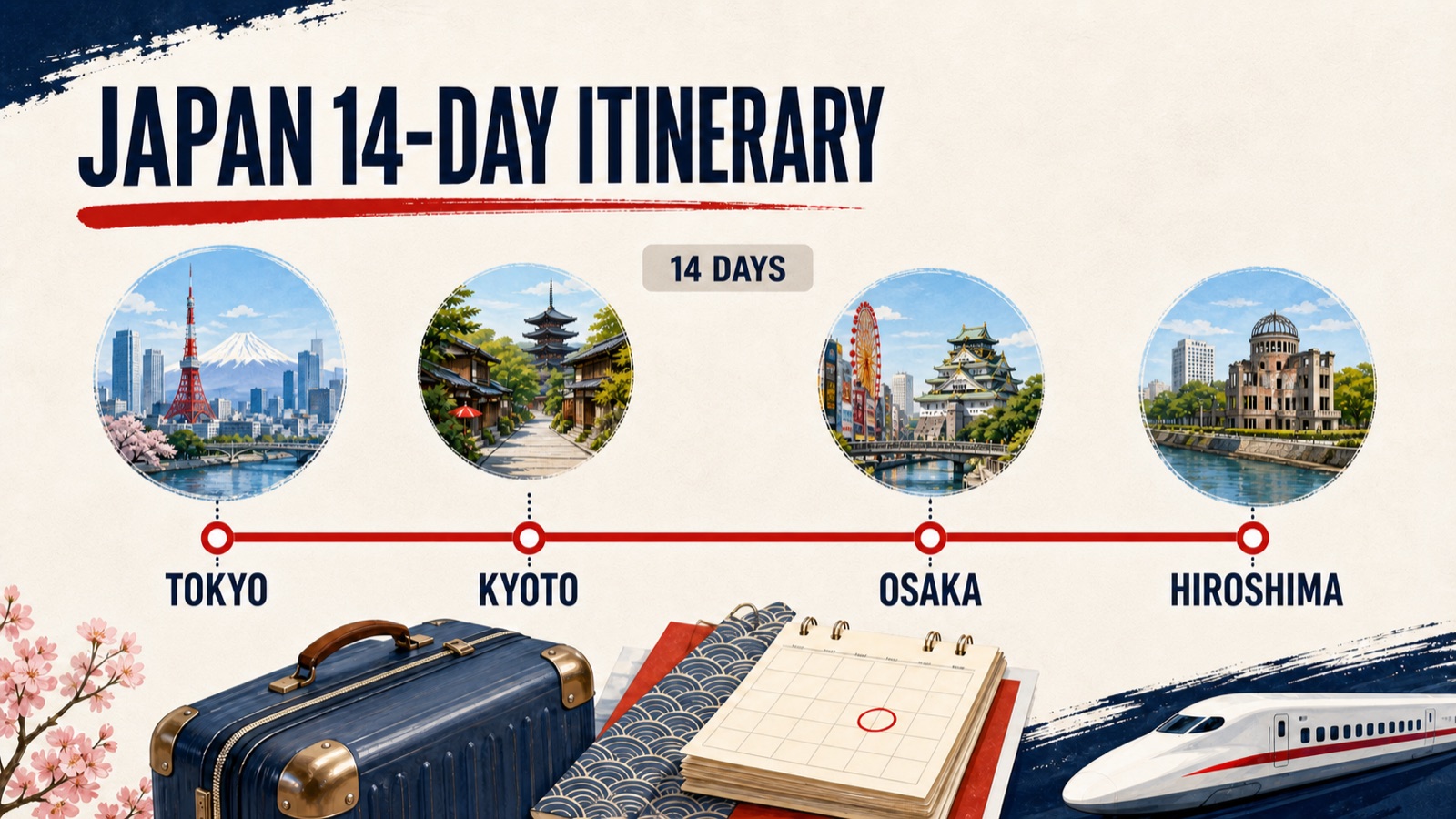
Quick answer: the 14-day route most first-time visitors should start from
The best 14-day Japan itinerary for most first-time visitors is not a race across the whole country. Start with four nights in Tokyo, four in Kyoto, two in Hiroshima and three in Osaka, in that order. These thirteen nights leave you in Kansai before a Day 14 flight. For a Tokyo departure, replace the final Osaka night with Tokyo and return on Day 13. Hakone is optional and replaces a Tokyo night rather than adding one.
This page is written for a real search question: how to build a two-week Japan route that feels complete without turning every other day into a checkout, station transfer, and luggage problem. It uses official tourism and transport sources checked on 2026-07-12, but it avoids pretending that ticket prices, train times, attraction hours, weather, or crowd controls are permanent. Use the route as the structure, then verify current operations on the linked official pages before booking.
The core decision is simple: 14 days gives you enough time for Tokyo, Kyoto, Osaka, Nara, and Hiroshima/Miyajima, but it does not give you enough time to also do Hokkaido, Kyushu, Okinawa, the Japanese Alps, and every theme park comfortably. Protect the main route first. Add one extra region only when the flight path, season, and group energy make it genuinely easier.
| Best for | Route shape | Main tradeoff |
|---|---|---|
| First-time visitors | Tokyo, Kyoto, Hiroshima and Miyajima, then Osaka; Nara as a Kyoto-based option | Four main hotel bases; optional Hakone replaces a Tokyo night |
| Families or slower travelers | Tokyo, Kyoto, Osaka, Nara, Hiroshima and Miyajima, with Hakone removed | Fewer hotel changes and more recovery time |
| Food and nightlife travelers | Tokyo, Kyoto, Osaka, Hiroshima and Miyajima, with Osaka given one extra night | Less mountain scenery but better evenings and easier meals |
| Rail-focused travelers | Tokyo to Kansai to Hiroshima, then depart Kansai or return Tokyo with a buffer | Strong Shinkansen spine, but seat reservations and luggage planning matter |
Who should use this itinerary
Use this itinerary if it is your first Japan trip, you have around 13 hotel nights, and you want the classic route plus one meaningful western extension. It works best for travelers who prefer frequent trains, walkable city days, historic districts, food markets, temples, neighborhoods, and one or two reflective days rather than a theme-park-only trip.
It also works for couples, solo travelers, and families with older children who can manage several rail days. Families with small children should remove the Hakone or Fuji overnight unless they specifically want an onsen stay and can forward luggage. Groups with mobility needs should make the hotel-base decision before choosing attractions because station exits, stairs, bus waits, and luggage storage can matter more than the distance on a map.
Do not use this exact version if your main goal is skiing, Okinawa beaches, a deep Hokkaido road trip, Kumano Kodo, Shikoku pilgrimage towns, or a heavy theme-park schedule. Those are valid Japan trips, but they need a different route. The biggest two-week mistake is trying to combine every region into one trip because the map makes the country look small.
Thirteen nights with the departure city protected
This suggested route arrives in Tokyo on Day 1 and leaves Kansai on Day 14. It has exactly thirteen nights: Tokyo four, Kyoto four, Hiroshima two and Osaka three. Hiroshima comes before the final Osaka stay, so the international flight does not depend on a same-day journey from western Japan.
| Days | Sleep base and nights | Main plan |
|---|---|---|
| 1-4 | Tokyo, 4 nights | Arrival recovery, one east-side day, one west-side day and a flexible day |
| 5-8 | Kyoto, 4 nights | Transfer on Day 5; two Kyoto-area days; choose Nara, Uji or more Kyoto for the remaining day |
| 9-10 | Hiroshima, 2 nights | Move west on Day 9 with a modest city plan; use Day 10 for Miyajima if ferry and weather conditions suit |
| 11-13 | Osaka, 3 nights | Return to Kansai on Day 11; give Day 12 one priority; keep Day 13 flexible and near the departure route |
| 14 | No additional hotel night | Travel to Kansai Airport for the flight; do not add a distant final attraction |
If your flight leaves from Tokyo
Use Osaka for Nights 11 and 12, then travel to Tokyo on Day 13 and sleep there. The allocation becomes Tokyo four + Kyoto four + Hiroshima two + Osaka two + Tokyo one, still thirteen nights. Remove the Day 13 Osaka activity rather than squeezing it in before the return. For an early flight, choose the final hotel using the airport's first usable connections or stay near the correct terminal.
If Hakone is essential
Replace Tokyo's fourth night with one Hakone night, then continue to Kyoto on Day 5. That means Tokyo three + Hakone one + Kyoto four + Hiroshima two + Osaka three for Kansai departure. This is a different Day 4, not a free extra stop. Check the actual Hakone-to-onward-train route and ryokan arrival requirements before paying. Do not treat Hakone and the Fuji Five Lakes as interchangeable hotel locations simply because both can offer Fuji views.
On the Hiroshima block, arrange the city visit and Miyajima around operating conditions. The JR Miyajima Ferry operator page is the source for service notices and timetable checks, not an assurance that a particular sailing will operate. Two nights let you reconsider the order if weather is poor; they do not justify a late ferry connection followed immediately by an international-flight transfer.
For a slower version, remove Hiroshima and redistribute those two nights to the existing Tokyo or Kansai stays. There is no obligation to add another region. The route should retain value if one outdoor day is lost. Compare your exact intercity legs using the rail-pass ledger and enter thirteen, not fourteen, hotel nights in the budget worksheet.
Key decision table: choose the right version before booking hotels
The best 14-day Japan itinerary is the one that matches your airports and travel style. A two-week trip looks generous on paper, but it can become tight once arrival fatigue, checkout time, large stations, meals, laundry, rain, heat, and shopping luggage are included.
Make these decisions before buying rail passes or non-refundable hotels. They control the whole trip more than a list of attractions does.
| Decision | Choose this if | Avoid this if |
|---|---|---|
| Add Hakone or Fuji overnight | You want an onsen night, can arrive before dinner, and can send or minimize luggage | The group hates hotel changes, weather is poor, or your flight route already creates a long final transfer |
| Depart from Kansai | Flights are similar in price and schedule, and your route ends in Osaka, Kyoto, or Hiroshima | Your return ticket is already fixed from Tokyo or the Kansai option adds a bad layover |
| Include Hiroshima and Miyajima | You want a meaningful western extension and can give it two days | You only have one free day after Kyoto and Osaka or cannot handle another long rail leg |
| Use Osaka as a base | You want easier food nights, Nara access, shopping, nightlife, or a lower-pressure final Kansai base | Your priority is quiet temple mornings and you dislike late urban energy |
| Buy a nationwide rail pass | Your verified long-distance JR trips inside the pass window beat point-to-point tickets and the pass rules fit your trains | You mainly stay in Tokyo/Kansai or need Nozomi-heavy flexibility that the pass does not solve |
Hotel-base plan that keeps the route from falling apart
For Tokyo, choose the hotel area by airport access and daily route rather than reputation alone. Shinjuku works for west-side Tokyo, nightlife, and some day trips. Ueno or Asakusa can work well for Narita access, older Tokyo, and calmer evenings. Tokyo Station, Ginza, and Nihonbashi are useful when early Shinkansen movement matters. The right base is the one that gives your tired group a simple return path after dinner.
For Kyoto, first-time travelers usually do best with Kyoto Station, downtown Kyoto, or the Gion/Higashiyama edge. Kyoto Station simplifies arrival, luggage, and day trips. Downtown improves food and evening movement. Gion and Higashiyama can be atmospheric, but they require more care around crowd behavior, taxi dependence, and luggage movement. Kyoto official guidance is especially important because residential streets, temple approaches, and private lanes are not just photo backdrops.
For Osaka, Namba is stronger for food and nightlife, while Umeda/Osaka Station is stronger for rail connections and some onward movement. If you are using Osaka before Hiroshima or Kansai Airport, station access may beat atmosphere. If Osaka is your food and shopping anchor, a Namba or Shinsaibashi base may make evenings easier.
For Hiroshima, choose between Hiroshima Station and the Peace Memorial Park area. Station-side hotels simplify Shinkansen arrival and the next move. Peace Park-side hotels make the city day calmer and may reduce backtracking before the Miyajima day. Either can work; the wrong choice is the one that makes your luggage cross the city twice.
Step-by-step booking order
First, lock the international flights and decide whether you can use an open-jaw route: arrive Tokyo and depart Kansai, or the reverse. Open-jaw is often cleaner for two weeks because it removes one long backtrack. If the fare difference is small, the time saved can matter more than the ticket price.
Second, choose the number of hotel bases. The default hotel order is Tokyo, Kyoto, Hiroshima, then Osaka. A Tokyo-return version adds a final Tokyo check-in by replacing the last Osaka night. If that looks like too many checkouts, remove the optional Hakone/Fuji night first. Do not remove recovery time from Kyoto or Tokyo just to keep every name on the map.
Third, check the Shinkansen spine. Tokyo to Kyoto or Shin-Osaka, Kansai to Hiroshima, and Hiroshima back to Kansai or Tokyo are the rail legs that shape the trip. JR Central and official reservation pages should be checked close to booking, especially during peak periods when seat rules or crowding notices can change.
Fourth, attach timed experiences. This may include a museum, theme park, special restaurant, tea ceremony, temple stay, or reserved attraction. Keep timed activities away from long transfer mornings unless the ticket is the reason for that day. A train delay, missed hotel bag handoff, or late lunch should not destroy a non-refundable evening.
Fifth, run the luggage plan. Decide which hotel changes are carry days, which are luggage-forwarding days, and which can use hotel storage or station lockers. Luggage is not a small detail on a 14-day route. It controls which station exits, meal stops, sightseeing windows, and shopping plans are realistic.
Rail, pass, and luggage plan
Japan's rail network makes this itinerary possible, but the rail pass decision should be calculated rather than assumed. A 14-day nationwide pass can look natural for a 14-day trip, yet it is only useful when the exact JR legs and pass rules justify it. The classic Tokyo, Kansai, and Hiroshima route may be close enough to require a proper calculation, but many travelers still do better with point-to-point Shinkansen tickets plus local IC cards.
JR Central's official English pages are the right place to start for Tokaido and Sanyo Shinkansen service information, reservations, and peak-period notices. The official Japan Rail Pass site explains pass coverage and purchase flow. Check both before buying. If your route depends on Nozomi trains, busy holiday periods, oversized luggage, or same-day flexibility, the details matter more than a generic pass recommendation.
For luggage, use a simple rule: carry small bags on city-to-city rail days only when you can move through stations, reach the hotel, and still enjoy the first afternoon. Forward larger bags when a transfer day includes Hakone, multiple trains, a shrine or museum stop, or a shopping plan. Keep one overnight kit with medicine, passport copies, chargers, and clothes in case forwarded bags arrive later than expected.
| Rail decision | Check this | Planning action |
|---|---|---|
| Nationwide JR Pass | Official pass price, eligible trains, exchange/pickup rules, and seat reservations | Compare against point-to-point Shinkansen legs before buying |
| Point-to-point tickets | Travel date, luggage size, seat availability, and station pickup or online ticket rules | Use when the route has fewer long JR legs or needs Nozomi flexibility |
| Open-jaw flights | Whether Kansai departure removes a long final rail day | Price flights against hotel night, rail time, and fatigue, not ticket fare alone |
| Luggage forwarding | Hotel acceptance, cutoff times, destination address, and backup clothes | Use for Hakone/Fuji, Kyoto arrival days, and shopping-heavy transfers |
| Peak periods | JR Central crowding notices and all-reserved Nozomi periods | Reserve earlier and avoid placing a long transfer before a fixed ticket or flight |
Cost-pressure table: where the money usually goes
This page does not publish fixed trip prices because exchange rates, hotel seasons, rail fares, attraction tickets, and pass rules change. Instead, use the cost-pressure table to spot the categories that make a two-week route expensive. Then check current official or operator pages before paying.
For many travelers, hotels and long-distance rail decide the budget more than daily food. Theme parks, special restaurants, luggage delivery, taxis, and last-minute room changes can push the total up quickly. A slower route with fewer bases can be cheaper even when one hotel night looks more expensive.
| Cost area | Why it changes the budget | How to control it |
|---|---|---|
| Hotels | Tokyo, Kyoto, Osaka, and Hiroshima can vary heavily by season, neighborhood, room size, and event dates | Book bases after route order is stable and compare station access, not just nightly price |
| Long-distance rail | Tokyo-Kansai-Hiroshima legs are major costs and may or may not justify a pass | Calculate the exact JR legs and pass window before purchase |
| Local transport | Subway, bus, taxi, and airport movements add up when hotels are poorly placed | Choose hotel areas that reduce cross-city transfers |
| Food | Japan can be affordable day to day, but destination meals, queues, and tired late dinners create waste | Plan easy meals near hotel bases on transfer days |
| Activities | Museums, theme parks, observatories, tea, guided experiences, and special transport can be meaningful but should not crowd every day | Choose one paid anchor per heavy day and keep backups simple |
| Luggage and shopping | Forwarding, lockers, extra suitcases, and tax-free packing affect both cost and time | Reserve shopping for stable base days and final hotel nights |
Better alternatives for specific travelers
If you are traveling with children, remove the optional Hakone or Fuji overnight and spend the extra night in Tokyo, Kyoto, or Osaka. The route will look less ambitious but feel better. Use Nara, Osaka Aquarium, parks, character shopping, easy food halls, and shorter neighborhood days instead of a long checklist.
If you are traveling in winter, keep the same Tokyo-Kansai-Hiroshima spine unless snow is the main goal. Add Hokkaido only by building a different itinerary. A casual one-night Hokkaido add-on is usually poor value because flights, winter weather, airport transfers, and luggage create more friction than the map suggests.
If you are traveling for food, give Osaka one more night and keep Kyoto mornings lighter. Use Hiroshima for okonomiyaki and Miyajima pacing, but avoid making every meal a reservation. The best food version of this route leaves room for markets, department-store food halls, station meals, convenience-store breakfasts, and spontaneous neighborhood dinners.
If you are traveling as a couple, the optional Hakone or Fuji night can be worthwhile if you arrive early enough for a ryokan dinner and have a weather-proof backup. If you cannot arrive before dinner or do not want another checkout, use Kyoto or Tokyo for the slower night instead.
If you are traveling with older relatives or mobility limits, choose fewer bases and stronger station access. Tokyo, Kyoto, Osaka, and Hiroshima can still work, but Hakone/Fuji, bus-heavy Kyoto days, and tight Miyajima returns need more caution. Official accessibility and transport pages should be part of the booking process, not an afterthought.
Common mistakes to avoid
The first mistake is treating 14 calendar days as 14 full sightseeing days. Arrival day, departure day, laundry, weather, jet lag, ticket pickup, luggage forwarding, and station transfers all take time. A good route uses the extra days to make the trip easier, not just to add more cities.
The second mistake is booking hotels before route order. A cheap Kyoto hotel can become expensive if it adds a hard station transfer every morning. A famous Tokyo neighborhood can be the wrong base if your arrival airport, day trips, and first-night food all point elsewhere. Hotel value is route value.
The third mistake is buying a rail pass before checking actual legs. The words 14-day itinerary and 14-day pass sound like they belong together, but the correct answer depends on the verified route, train types, pass rules, seat reservations, and whether an open-jaw flight removes a long return leg.
The fourth mistake is putting Hiroshima or Miyajima into one rushed day from Kyoto or Osaka. It can be done physically, but it often weakens the reason to go. Hiroshima deserves respectful time, and Miyajima is better when ferry timing, tide, walking, meals, and return trains are not treated as leftovers.
The fifth mistake is ignoring Kyoto crowd behavior. Official Kyoto guidance asks visitors to respect local life, streets, transport, and cultural areas. A good itinerary does not just avoid crowds for comfort; it also avoids making private lanes, temple approaches, buses, and residential streets worse for the people who live there.
Official verification checklist before you pay
Use this checklist after drafting the route and before paying for flights, hotels, passes, timed tickets, or non-refundable activities. The sources listed below were checked on 2026-07-12. Recheck them again close to travel because weather, maintenance, reservation rules, event calendars, and transport notices can change.
Verify country-wide planning basics on JNTO, then confirm each city and transport leg with the relevant official or operator page. For this itinerary, the essential checks are JNTO planning and rail guidance, JR Central Shinkansen information, the official Japan Rail Pass site, GO TOKYO, Kyoto City Official Travel Guide, OSAKA-INFO, Nara official travel, Hiroshima official information, Miyajima access, and JR Miyajima Ferry operations.
After those checks, save the pages you will need on travel days: airport access, first hotel address in Japanese and English, Shinkansen reservation or ticket details, Kyoto transport map, Nara return route, Hiroshima hotel access, Miyajima ferry page, weather alerts, and the final airport route. A two-week itinerary should not depend on searching for every official page again while standing in a station.
- Check the latest weather, heat, typhoon, snow, or earthquake guidance before outdoor-heavy days.
- Check railway notices before Tokyo-Kansai-Hiroshima long-distance moves.
- Check attraction opening days and ticket rules before assigning a fixed day.
- Check hotel luggage storage and forwarding acceptance before using bags-free sightseeing.
- Check Kyoto responsible-travel and crowd guidance before adding early temple or Gion plans.
- Check Miyajima ferry and access pages before relying on a late return.
If you only do one thing
Before booking anything, write the itinerary as hotel nights, not as cities. Tokyo four nights, Kyoto four, Hiroshima two and Osaka three is the thirteen-night Kansai-departure version. For Tokyo departure, replace the last Osaka night with Tokyo; do not add a fourteenth night. If your version has seven or more hotel bases, cut it before you pay.
Then run one stress test: what happens if it rains, a train is crowded, a locker is full, or one traveler gets tired on a transfer day? If the answer is that the whole day collapses, simplify the base, move the timed ticket, or remove the optional region. The best 14-day Japan itinerary is the one you can still enjoy when one assumption fails.
Related tools and next steps
Use the Japan Trip Planner to turn the route into nights and bases, the Budget Calculator to test hotel and rail pressure, the JR Pass Calculator before buying any pass, the Airport Transfer Finder for the first and last day, and the Luggage Planner before adding Hakone, Miyajima, or shopping-heavy transfer days.
For reading order, start with the first-time Japan planning guide, compare the 7-day and 10-day itinerary pages if you need a shorter version, read the Tokyo-Kyoto-Osaka itinerary if you may skip Hiroshima, then use the Tokyo and Kyoto hotel-area pages before booking rooms.
Use next on Japan Trip Tools
- First-Time Japan Travel Guide — Use this before locking the two-week route.
- Japan 7 Day Itinerary — Use this if the trip is cut in half.
- Japan 10 Day Itinerary — Use this if Hiroshima or Hakone needs to be removed.
- Tokyo Kyoto Osaka 10 Day Itinerary — Use this for the classic route without Hiroshima.
- Where to Stay in Tokyo First Time — Choose the first hotel base before building daily plans.
- Where to Stay in Kyoto First Time — Choose the Kyoto base by luggage, food, and transport.
- Is the JR Pass Worth It? — Calculate before buying a pass for the two-week route.
- Hiroshima and Miyajima Two-Day Meaningful Itinerary — Use this to expand the western block.
Sources and image licensing
- Japan National Tourism Organization: Plan Your Trip
- Japan National Tourism Organization: Itineraries
- Japan National Tourism Organization: Traveling by Rail
- JR Central: Official English Service Information
- JR Central: Tokaido and Sanyo Shinkansen Peak-Period Nozomi Notice
- Official Japan Rail Pass
- GO TOKYO Official Tokyo Travel Guide
- Kyoto City Official Travel Guide
- Kyoto City Official Travel Guide: Getting Around Kyoto
- OSAKA-INFO Official Osaka Tourism Guide
- Official Nara Travel Guide: Nara Park Area
- JNTO: Hiroshima Peace Memorial Park
- Miyajima Tourist Association: Access to Miyajima
- JR Miyajima Ferry
Plan your next step
FAQ
Is 14 days enough for Japan for a first trip?
Yes. Fourteen days is enough for a strong first route covering Tokyo, Kyoto, Osaka, Nara, and Hiroshima or Miyajima. It is not enough to comfortably add every major region, so keep Hokkaido, Kyushu, Okinawa, or the Japanese Alps for a different version unless the route is redesigned around them.
Should I buy a 14-day JR Pass for a 14-day Japan itinerary?
Do not buy it automatically. Compare the exact long-distance JR legs, pass coverage, train types, reservation rules, and whether an open-jaw flight removes a long return trip. A pass can work for some Tokyo-Kansai-Hiroshima routes, but point-to-point tickets can be better for others.
Should I stay in Hakone on a 14-day first Japan trip?
Stay in Hakone only if you want an onsen or Fuji-area pause, can arrive before dinner, and have a luggage plan. Skip it if you prefer fewer hotel changes, are traveling with small children, or need a simpler Tokyo-Kyoto-Osaka-Hiroshima route.
Is Hiroshima and Miyajima worth adding to a two-week Japan itinerary?
Yes, if you can give the area about two days and avoid rushing it as a single leftover day. Hiroshima deserves respectful pacing, and Miyajima works better when ferry timing, walking, meals, and return transport are planned.
Is it better to fly home from Osaka or return to Tokyo?
If flight price and timing are reasonable, departing from Kansai can make the route cleaner because it removes a long backtrack. If you must depart Tokyo, keep the final night in Tokyo or move Hiroshima earlier so the airport day is not fragile.
How many hotel bases should a 14-day Japan trip have?
The default route uses four bases: Tokyo, Kyoto, Hiroshima and Osaka. Hakone adds a base by replacing a Tokyo night. A final return to Tokyo adds a check-in by replacing the last Osaka night. Keep thirteen nights total unless you extend the trip.
Should Osaka be a day trip from Kyoto or a separate base?
For a 14-day trip, Osaka often deserves at least one or two nights if food, nightlife, shopping, USJ, or easier Kansai rail movement matter. If you want quiet temple mornings and fewer hotel changes, Kyoto can remain the main Kansai base.
Can I add Hokkaido to this 14-day itinerary?
You can, but it becomes a different trip. Hokkaido adds flights or long rail movement, larger distances, weather risk, and different hotel logic. For most first-time visitors, keep Hokkaido for a second trip or replace Hiroshima and Hakone with a dedicated northern block.
Where should I sleep before the last day of a two-week Japan trip?
Use the departure region. The revised Kansai route finishes with three Osaka nights after Hiroshima. For a Tokyo flight, replace the last Osaka night with a Tokyo night and travel back on Day 13. Both versions have thirteen hotel nights.