
Tokyo Museum Rainy-Day Planner: Ueno or Roppongi?
Choose one Tokyo museum district for a rainy day, compare Ueno with Roppongi, check exhibition calendars, and build a low-transfer indoor route.
At a glance
- Best for
- First-time
- Main decision
- Which bases and transfer days make the route realistic
- Time needed
- 30-45 minutes to compare route options
- Official checks
- Opening hours, transport schedules, weather, reservations
- Related tool
- Budget Calculator
check the official exhibition and closure calendar for your first-choice museum and one nearby backup.
Quick answer
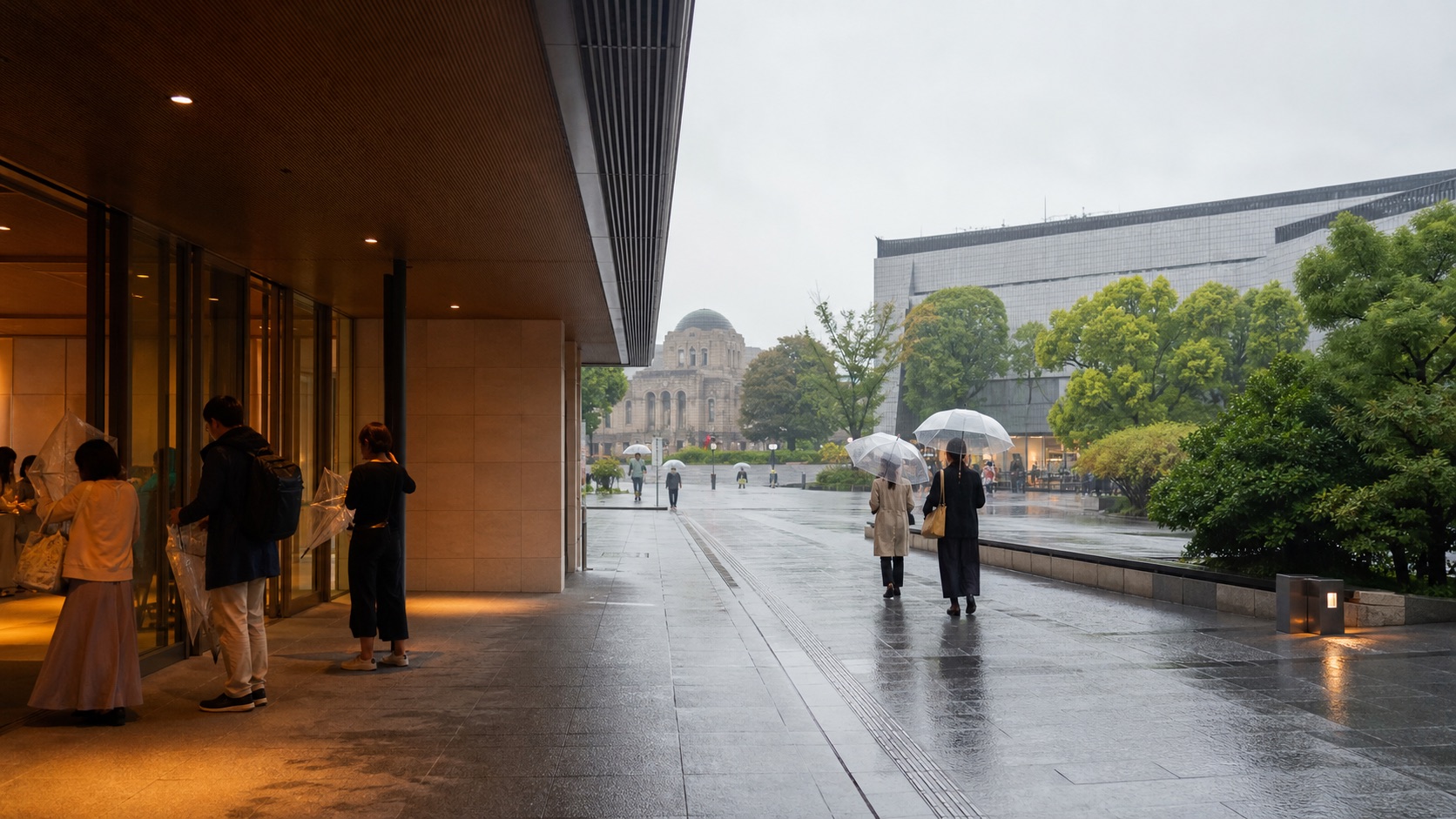
Choose Ueno for the easiest all-day museum cluster, traditional Japanese collections, science, Western art, and a major station beside the park. Choose Roppongi for contemporary and design-focused exhibitions, striking architecture, dining, and a later urban evening. Do not combine both districts by default. A rainy day works better when you choose one cluster and verify two exhibitions before leaving the hotel.
GO TOKYO's official rainy-day guide identifies Ueno Park and Roppongi as two areas where museums and galleries can fill a day. The useful choice depends on current exhibitions, regular closing days, ticket availability, walking exposure, and the interests of the group.
If you only do one thing: check the official exhibition and closure calendar for your first-choice museum and one nearby backup.
Who should use this planner
This guide is for visitors moving an outdoor Tokyo day because of rain, heat, cold, poor visibility, or fatigue. It helps families, art lovers, history visitors, science travelers, and groups with different interests choose a district instead of searching for isolated attractions across the city.
A museum day is not automatically weatherproof. Some queues, gardens, ticket offices, and transfers are outside. Special exhibitions can sell out, while a museum may close for installation, maintenance, or a regular weekly holiday. Use this page as a decision framework, not a schedule.
| Choose | Best for | Main check |
|---|---|---|
| Ueno | Japanese art, archaeology, science, Western art, families | Which national museum and exhibition is open |
| Roppongi | Contemporary art, design, architecture, dining | Special-exhibition ticket and each venue's separate closure |
| Single museum only | Young children, accessibility, or deep interest | Collection scope, rest areas, and re-entry |
| Different indoor district | No suitable current exhibition | Do not force a museum day merely because it rains |
Choose Ueno for variety and simple access
GO TOKYO describes Ueno Park as a major cluster of museums within easy walking distance of Ueno Station. The district can support Japanese and Asian art at the Tokyo National Museum, Western art at the National Museum of Western Art, and natural history and science at the National Museum of Nature and Science, among other venues.
Ueno is a strong family choice because one district offers different subjects without a cross-city transfer. It is also convenient for travelers based near the Yamanote Line, Ginza Line, Hibiya Line, or northern Tokyo rail gateways. Use the Park Exit when current station guidance supports it and check step-free routes if needed.
The weakness is outdoor exposure across the park. In heavy rain, choose two adjacent museums rather than crossing the entire precinct repeatedly. Bring a compact umbrella and use the museum's umbrella-storage system.
Choose Roppongi for contemporary art and an urban evening
GO TOKYO presents the Art Triangle Roppongi as the National Art Center, Tokyo, the Suntory Museum of Art, and the Mori Art Museum within walking distance. The National Art Center does not have a permanent collection, so the current exhibition calendar is essential. The other venues also operate separate programs and tickets.
Roppongi suits travelers who want architecture, design, contemporary exhibitions, shopping, and dinner in one district. It can also extend into the evening more naturally than a park-based day. The tradeoff is that the three museums are not one building, and hills, underground passages, and wet streets still require navigation.
Use Roppongi Station or Nogizaka Station according to the chosen first museum, not simply the district name.
Build the day from exhibitions, not museum names
Step 1: choose the subject. Japanese history, science, Western art, contemporary art, design, or architecture should drive the district.
Step 2: open the official calendar. Verify the exact date, exhibition, timed ticket, last admission, closure, language support, and photography rules.
Step 3: choose one anchor. Give the main museum enough time. A large national collection can absorb half a day.
Step 4: choose one nearby backup. It should work without a difficult transfer and should appeal to the same group.
Step 5: add food and rest. Museum cafes can be crowded or have separate hours. Identify an indoor or covered alternative.
Ticket and closure checks matter more on rainy days
Rain can push many visitors indoors at once. Special exhibitions may require timed admission or advance purchase, while permanent collections may use a different ticket. A museum can be open while one gallery is closed for installation. Read the official page for the exact exhibition rather than relying on a tourism summary.
Regular closing days often shift around national holidays, and year-end or maintenance closures vary. Last admission can be earlier than building closing. Save the ticket code offline and confirm whether re-entry, lockers, strollers, and large luggage are allowed.
Do not buy multiple timed tickets with impossible transfer margins. One excellent exhibition plus a flexible backup is better than three rushed reservations.
Plan for families and accessibility
For children, choose the museum by attention span and interactive value, not adult ambition. The National Museum of Nature and Science can be a strong fit for science and dinosaurs, while a focused art visit may work when the family picks a small number of objects or a child program. Verify current family facilities and ticket rules on the museum site.
For mobility needs, check the station exit, park gradient, lifts, accessible entrances, wheelchairs, seating, and restrooms. Rain makes outdoor surfaces more difficult. A single venue connected to dining may be better than a theoretical cluster.
Large luggage should be left at the hotel or a confirmed locker. Museum lockers can have size limits and may not accept suitcases.
Keep the weather swap simple
Do not rewrite the whole Tokyo itinerary because of one rainy morning. Swap the museum district with an outdoor day later in the trip, then preserve existing dinner reservations and hotel geography where possible. If rain is light, a short covered-market or underground-shopping segment can bridge the museum and dinner.
Observation decks are not guaranteed bad choices in rain, but visibility controls their value. A museum gives more predictable value when low cloud removes the view. Monitor official weather and attraction notices rather than deciding from a generic monthly climate chart.
Manage umbrellas and wet clothing
Use the umbrella stand, locking rack, or plastic-cover system provided at the entrance; do not carry a dripping umbrella through galleries. Keep a small cloth or bag for wet items, and avoid placing damp coats against walls, cases, or other visitors. If the group is soaked after a long outdoor transfer, pause near the entrance before joining a timed exhibition. This small reset protects the collection, makes the visit more comfortable, and reduces the chance of rushing through the first galleries.
Common mistakes and better fixes
| Common mistake | Better action |
|---|---|
| Crossing Tokyo for several famous museums | Choose Ueno or Roppongi as one cluster. |
| Assuming the permanent collection is the main event | Read the current exhibition calendar. |
| Ignoring regular closure days | Verify the exact date on each museum site. |
| Booking timed tickets too close together | Use one anchor and a flexible backup. |
| Carrying luggage to the museum | Use hotel storage or a confirmed large locker. |
What to verify on official sources
Check the museum's own site for the exact exhibition, date, ticket, timed entry, closure, last admission, photography, bags, family facilities, accessibility, and language support. Use GO TOKYO to compare districts and access, then use each venue as the final authority.
Recheck on the morning of a weather swap. A saved plan is not evidence that a temporary exhibition or building is open.
Related tools and next steps
- Trip Planner — swap the museum cluster with an outdoor day.
- Tokyo region guide — keep the backup near the rest of the itinerary.
- Tokyo three-day recovery itinerary — rebuild a disrupted first trip.
- Where to stay in Tokyo — reduce transfer load on wet days.
Official sources
- GO TOKYO: rainy-day activities and museum districts (checked 2026-08-30)
- GO TOKYO: Ueno museum district (checked 2026-08-30)
- GO TOKYO: Roppongi art district (checked 2026-08-30)
Plan your next step
FAQ
Is Ueno or Roppongi better for a rainy museum day?
Choose Ueno for broad national collections and science; choose Roppongi for contemporary art, design, architecture, dining, and a later urban evening.
Can I visit both Ueno and Roppongi museums in one day?
You can, but it usually adds unnecessary transfer time. One cluster with a verified anchor and nearby backup is more resilient.
Do Tokyo museums require advance tickets?
Some special exhibitions use timed or advance tickets while other collections do not. Check the exact exhibition on the museum's official site.
Are Tokyo museums open on Mondays?
Closure days vary and can shift around holidays. Never apply one Monday rule to every museum; verify the exact date.
Can I bring a suitcase into a Tokyo museum?
Do not assume so. Lockers and cloakrooms have limits, so use hotel storage or a confirmed large station locker.
What if the rain stops during the museum day?
Keep the anchor museum, then use the nearby park, architecture, or dining district rather than crossing Tokyo for the original outdoor plan.