
Narita to Tokyo Transfer: Train, Bus, Taxi, or First-Night Hotel?
A practical Narita to Tokyo transfer guide for choosing Narita Express, Keisei Skyliner, Access Express, airport bus, taxi, or an airport hotel by Tokyo hotel area.
At a glance
- Best for
- First-time
- Main decision
- Which base reduces time, cost, and luggage friction
- Time needed
- 20-30 minutes before booking hotels
- Official checks
- Hotel location, cancellation rules, room size, station access
- Related tool
- Where To Stay Hub
Choose your first Tokyo hotel by the Narita arrival route before comparing room aesthetics. If the hotel is near Tokyo, Shinagawa, Shibuya, Shinjuku, or Yokohama, start with Narita Express. If it is near Ueno or Nippori, start with Keisei Skyliner. If it is near Tokyo Station or Ginza and luggage simplicity matters, compare bus. If none of those routes is clean for your arrival time, change the hotel or book an airport-area first night.
Quick answer: the best Narita to Tokyo transfer
Construction dates to check: September 4-6 and November 6-8, 2026. JR East lists Narita Express route changes for these dated work periods. Affected services turn at Tokyo rather than continuing to Shinjuku or Ofuna; check the train-specific table, since adjacent evening and morning services vary. For a western Tokyo hotel, plan an onward connection or compare another airport route. This is not a continuous September-to-November closure. JR East construction notice, checked September 5, 2026.
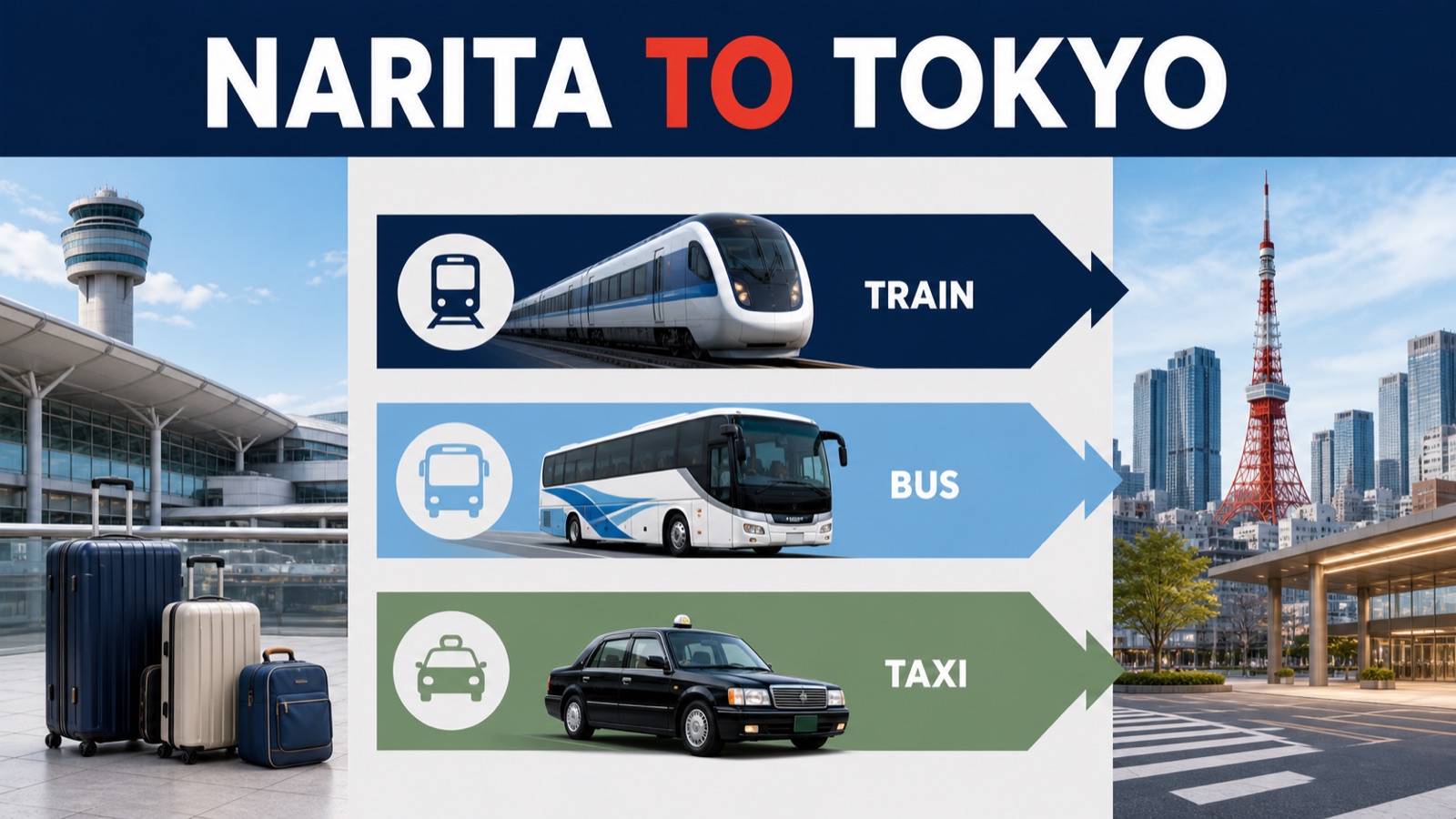
The best Narita to Tokyo transfer depends on where you sleep, how late you land, and how much luggage you can handle through stations. Choose Narita Express if Tokyo, Shinagawa, Shibuya, Shinjuku, Yokohama, or a JR-connected hotel makes the reserved-seat route useful. Choose Keisei Skyliner if Ueno, Nippori, or a north/east Tokyo transfer is the cleanest target. Consider Keisei Access Express or other regular rail when it gives a direct route without the limited-express surcharge. Choose bus if Tokyo Station, Ginza, a hotel stop, or luggage simplicity matters more than rail speed. Choose taxi or an airport hotel only when late arrival, mobility needs, family logistics, or disruption risk justify it.
Narita Airport's official rail page checked on 2026-07-16 lists access through the Narita Sky Access line, Keisei line, and JR line. It shows Narita Express serving Tokyo, Shinagawa, Shibuya, Shinjuku, Yokohama, and other major stations, while Keisei Skyliner serves Nippori and Keisei Ueno, with some trains also stopping at Aoto and Shin-Kamagaya. JR East's Narita Express page, last updated March 14, 2026 and checked for this article on 2026-07-16, says the fastest Narita Airport to Tokyo Station train takes 53 minutes. TYO-NRT's official site says its Tokyo Station to Narita Airport bus can be as fast as 65 minutes and lists a one-way ticket at 1,500 yen, excluding late-night and early-morning services and with road-condition warnings.
Those official numbers are useful, but they are not the whole decision. A 53 minute train to Tokyo Station is not easy if your hotel is a long subway transfer away. A cheap bus is not a bargain if you miss the last convenient service after a delayed flight. A taxi can be simple, but Narita is far enough that it must be treated as a deliberate comfort purchase, not a casual default.
Who this Narita guide is for
Use this page if you are landing at Narita and need to choose between Narita Express, Keisei Skyliner, Access Express, airport bus, taxi, and an airport hotel. It is especially useful if this is your first Japan trip, your hotel is not booked yet, or you are trying to decide whether a cheaper flight into Narita is still worth it compared with Haneda.
This page is a planning decision guide, not a live operations board. Rail timetables, bus schedules, ticket campaigns, taxi fares, airport counter hours, road conditions, and late-night rules change. Official airport and operator sources used here were checked on 2026-07-16; verify your exact service after your flight date, terminal, hotel, and arrival time are known.
| Traveler situation | Best first filter | Avoid this mistake |
|---|---|---|
| Hotel near Tokyo, Shinagawa, Shibuya, Shinjuku, or Yokohama | Check Narita Express first | Do not ignore the final station exit and hotel walk. |
| Hotel near Ueno, Nippori, Asakusa, or east/north Tokyo | Check Keisei routes first | Do not assume Tokyo Station is the natural target. |
| Hotel near Tokyo Station or Ginza with bus access | Compare TYO-NRT and other buses | Do not rely on bus timing without checking road and late-service notes. |
| Late international arrival | Check final rail/bus plus airport-hotel backup | Do not plan from scheduled landing time alone. |
| Family or heavy luggage | Prioritize few transfers and arrival certainty | Do not choose a route that saves money but creates a difficult transfer. |
Narita transfer decision table
Start with the destination side of Tokyo. Narita is far enough from the city that the wrong target station can erase the advantage of a fast airport service. Your best route is usually the one that reaches the hotel area with one clear transfer or no transfer at all.
| Option | Best for | Main tradeoff |
|---|---|---|
| Narita Express | Tokyo, Shinagawa, Shibuya, Shinjuku, Yokohama, reserved seats, JR-connected hotels, and travelers with luggage | Can cost more than regular rail and may not be best for Ueno or Asakusa hotels. |
| Keisei Skyliner | Ueno, Nippori, east or north Tokyo, and travelers comfortable transferring at Nippori or Ueno | You may still need JR, subway, or taxi for the final hotel leg. |
| Keisei Access Express / regular rail | Asakusa-line or direct-route travelers who value lower cost over premium speed | Train type and destination boards matter; some routes are slower or less comfortable with bags. |
| Airport bus / TYO-NRT | Tokyo Station, Ginza, selected bus stops, and travelers who prefer luggage under the bus | Road conditions and late-night exceptions can change the real value. |
| Fixed-fare taxi | Families, mobility needs, very late arrivals, or groups choosing comfort over budget | Narita fixed fares are expensive and tolls or surcharges can apply. |
| Airport hotel | Very late arrival, early onward flight, or a group that wants to avoid a risky first night | You postpone Tokyo arrival until the next morning. |
Choose by Tokyo hotel area
Do not ask only, "How do I get from Narita to Tokyo?" Ask, "How do I get from Narita to this hotel after this flight with these bags?" Tokyo is multi-centered. A route to Ueno is excellent for one hotel and poor for another. A route to Tokyo Station can be perfect for Marunouchi and awkward for western Shinjuku.
| Hotel area | First transfer to compare | Practical note |
|---|---|---|
| Tokyo Station / Marunouchi | Narita Express or airport bus | Good for first-night simplicity and later Shinkansen plans; compare final hotel walk. |
| Shinjuku / Shibuya | Narita Express, then bus or local alternatives only if they stop close | Reserved-seat rail can reduce transfer stress for western Tokyo. |
| Ueno / Nippori | Keisei Skyliner or Keisei routes | Often the strongest Narita fit; confirm whether the hotel is near JR, Keisei, or subway exits. |
| Asakusa / Oshiage / east Tokyo | Keisei Access Express or Skyliner plus transfer | Direct or low-transfer routes may beat a Tokyo Station detour. |
| Ginza / Nihombashi | Airport bus, Narita Express plus local transfer, or Keisei/Toei route | Exact hotel station decides the winner. |
| Yokohama | Narita Express or bus if service fits | Good for some itineraries, but verify service frequency and final arrival time. |
Step-by-step action plan
Step 1: confirm terminal and expected arrival window. Narita's official rail page notes that Terminal 1 is a five minute walk from Narita Airport Station, while Terminals 2 and 3 use Airport Terminal 2-3 Station, with Terminal 3 farther from the station. That terminal detail matters if you are comparing a tight train or bus.
Step 2: choose your Tokyo target before choosing the operator. If your target is Tokyo, Shinagawa, Shibuya, Shinjuku, or Yokohama, check Narita Express. If your target is Ueno or Nippori, check Keisei Skyliner. If your target is Asakusa, Nihombashi, Higashi-Ginza, or another through-service area, check whether Keisei Access Express or a Toei Asakusa-line connection is cleaner.
Step 3: compare bus only against your real hotel. TYO-NRT can be a strong budget and luggage option for Tokyo Station and related stops, but its official page warns that late-night and early-morning services are excluded from the headline ticket note and that road conditions can increase travel time. Other airport buses can be excellent if they serve a hotel stop, but poor if the stop is far away.
Step 4: price taxi honestly. Narita Airport's official taxi page checked on 2026-07-16 lists fixed-fare taxi zones from Narita to Tokyo, notes that advance reservations are not required, and says highway tolls are additional. It also notes late-night and early-morning surcharges from 22:00 to 5:00. If you choose taxi, choose it as a comfort and risk-control decision, not because you forgot to plan.
Step 5: build a fallback. If the flight is delayed, immigration is slow, or the last convenient service is missed, your backup should already be clear: wait for the next route, take taxi, sleep near Narita, or adjust the first morning. A first-time trip should not depend on one perfect airport transfer.
Match the airport transfer to your first hotel
Build the journey from the hotel backwards. Copy the hotel's nearest usable station and exit, then compare two airport routes that reach it. Count the final train change and walk, not just the advertised airport express time. A reserved seat to the wrong part of Tokyo is not necessarily easier than regular rail to the right neighborhood.
| Your first-night plan | First comparison | Practical next action |
|---|---|---|
| Hotel within walking distance of Keisei Ueno | Skyliner to Keisei Ueno versus a regular Keisei route | Check the walk from Keisei Ueno, not a pin for JR Ueno |
| Hotel in western Shinjuku | Narita Express to Shinjuku versus an airport bus with a useful nearby stop | Check the exact train's operating section and the hotel-side exit before buying |
| Hotel near Tokyo Station | Narita Express versus TYO-NRT | Compare the station-side walk, service time and luggage policy, then buy the simpler complete journey |
| Hotel near Asakusa | A suitable Keisei/Toei through service versus Skyliner plus a connection | Check the displayed destination and any required change; not every departure is your direct service |
Time-budget example, not an airport processing estimate: if you assume 90 minutes between landing and being ready to board, 20 minutes waiting, 60 minutes travelling and 15 minutes reaching the hotel, the total is 185 minutes, or 3 hours 5 minutes. A scheduled 18:00 landing then becomes approximately 21:05 at the hotel under those assumptions. Replace every number with your own plan; immigration, baggage delivery, queues and traffic may take longer. Do not book a non-refundable dinner against the train's published ride time alone.
The TYO-NRT operator page, rechecked September 5, 2026, lists JPY 1,500 one way, excluding early-morning and late-night services. Two adults therefore start with JPY 3,000 for that standard airport-bus leg, before any onward transport. This is not a door-to-door taxi comparison or a promise that the next bus has seats.
If your flight arrives late
- Check the last usable departure from your terminal, including the final connection to your hotel. A train still running from the airport is insufficient if the onward connection has ended.
- Check hotel check-in limits and how to contact reception after a delay.
- Choose a fallback before departure: an airport-area hotel with a usable late transfer, or a taxi within your budget. Do not assume a hotel shuttle runs all night.
- After collecting luggage, check the actual clock and current service status again before buying. If the plan no longer works, use the fallback rather than racing through the terminal.
Terminal 3 does not have its own rail station. Narita Airport's rail-access page directs Terminals 2 and 3 passengers to Airport Terminal 2-3 Station. Follow terminal signs and allow for the walk with your bags. Save the hotel address offline alongside your chosen station; the train ticket alone is not the whole arrival plan.
Common mistakes
The first mistake is choosing the fastest airport service to the wrong side of Tokyo. A fast ride to Ueno is not ideal for every Shinjuku hotel, and a direct ride to Tokyo Station is not ideal for every Asakusa hotel. Match the service to the hotel area.
The second mistake is ignoring the terminal and walking time. A published train time does not include immigration, baggage, ticket purchase, walking to the station, or moving from the final station exit to the hotel. The third mistake is treating buses as either always slow or always easy. Bus value depends on stop location, schedule, and road conditions.
The fourth mistake is buying a pass or premium ticket before the whole route is stable. The fifth mistake is landing late and assuming the day is still usable. A clean first-night transfer is a travel win; forcing sightseeing after a long flight usually makes the next morning worse.
What to verify on official sources
Verify rail routes on Narita Airport, JR East, and Keisei official pages after your flight date is fixed. Check whether your train starts from Terminal 1 or Terminal 2-3 station, whether the service stops at the station you expect, whether a ticket or seat reservation is needed, and whether a campaign fare is still valid.
Verify bus routes on Narita Airport, TYO-NRT, or the relevant bus operator page. Check boarding point, ticket counter or purchase method, Tokyo-side stop, late-night exception, and road-condition warnings. Verify taxi zones on the Narita Airport taxi page if you plan to use fixed fare, because tolls, surcharges, zone boundaries, and actual charges matter.
- Check Narita Airport rail access for station and terminal details.
- Check JR East Narita Express for current stops, ticket rules, and luggage facilities.
- Check Keisei for Skyliner, Access Express, route maps, and transfer station details.
- Check TYO-NRT or bus operator pages for fare notes, late-night exceptions, and road-condition guidance.
- Check Narita Airport taxi pages for fixed fare zones, tolls, late-night surcharges, and boarding areas.
If you only do one thing
Choose your first Tokyo hotel by the Narita arrival route before comparing room aesthetics. If the hotel is near Tokyo, Shinagawa, Shibuya, Shinjuku, or Yokohama, start with Narita Express. If it is near Ueno or Nippori, start with Keisei Skyliner. If it is near Tokyo Station or Ginza and luggage simplicity matters, compare bus. If none of those routes is clean for your arrival time, change the hotel or book an airport-area first night.
Related tools and next planning links
Use the Airport Transfer Finder after you know your terminal, hotel area, arrival time, and luggage level. Use the Luggage Planner if your first full day includes a hotel change, Shinkansen, Disney, or side trip. Use the Budget Calculator if the choice is between a cheaper Narita flight and a more expensive Haneda flight, because the airport transfer is part of the real fare.
Next, compare Haneda to Tokyo Transfer, Where to Stay in Tokyo First Time, First-Time Japan Travel Guide, Tokyo IC Card Practical Guide, and Japan 10 Day Itinerary. Those pages help you turn the arrival route into hotel and first-day decisions.
Use next on Japan Trip Tools
- Haneda to Tokyo Transfer — Compare both Tokyo airport arrivals before choosing flights.
- Where to Stay in Tokyo First Time — Pick a hotel area that matches the airport route.
- Tokyo IC Card Practical Guide — Prepare local train payment after the airport transfer.
- First-Time Japan Travel Guide — Connect Narita arrival with the full first-trip plan.
- Japan 10 Day Itinerary — Place the arrival city into the broader route.
Sources and image licensing
- Narita International Airport rail access (checked 2026-07-16)
- Narita International Airport public bus access (checked 2026-07-16)
- Narita International Airport taxi and fixed-fare taxi information (checked 2026-07-16)
- JR East Narita Express official guide (checked 2026-07-16)
- Keisei Skyliner traffic access official guide (checked 2026-07-16)
- Airport Bus TYO-NRT official guide (checked 2026-07-16)
Plan your next step
FAQ
Is Narita Express or Skyliner better?
Under normal operations, compare Narita Express for Tokyo, Shinjuku or Yokohama and Keisei routes for Ueno or Nippori. During the September 4-6 and November 6-8, 2026 construction periods, affected Narita Express services turn at Tokyo. Check the dated JR East notice and your final hotel connection before choosing.
Is the Narita airport bus worth it?
It can be worth it for Tokyo Station, Ginza, selected stops, or luggage simplicity. Check the official schedule, stop location, late-night rules, and road-condition notes before relying on it.
Should I take a taxi from Narita to Tokyo?
Taxi is a comfort or risk-control option, not the budget default. Narita fixed-fare taxi zones can still be expensive, and tolls or late-night surcharges may apply.
Should I stay near Narita on the first night?
Consider an airport-area hotel if you land very late, expect a slow arrival process, have children or large luggage, or do not need to be in central Tokyo early the next morning.
What is the easiest Tokyo area from Narita?
Under normal operations, compare Narita Express for Tokyo, Shinjuku or Yokohama and Keisei routes for Ueno or Nippori. During the September 4-6 and November 6-8, 2026 construction periods, affected Narita Express services turn at Tokyo. Check the dated JR East notice and your final hotel connection before choosing.
Can I buy Narita transfer tickets after arrival?
Often yes, but ticket method depends on the service. Some limited express, bus, pass, and campaign products have specific purchase rules, so verify with the operator before travel.
Is a cheaper Narita flight always worth it?
Not always. Compare the fare difference against transfer cost, arrival time, first-night hotel convenience, luggage stress, and the value of your first evening.
When should I recheck official sources?
Recheck after booking flights and hotels, shortly before departure, and again if your flight time, terminal, baggage, or first-night plan changes.
Does Narita Express always run directly to Shinjuku?
No. Check the operating section of your particular train. JR East lists construction-related changes for September 4-6 and November 6-8, 2026; affected trains operate to or from Tokyo instead of continuing to Shinjuku or Ofuna. Check the dated operator notice and arrange the onward journey before boarding.