
Where to Stay in Tokyo First Time: Best Areas by Route, Airport, and Travel Style
A practical Tokyo hotel-area guide for first-time visitors choosing between Shinjuku, Shibuya, Tokyo Station, Ginza, Ueno, Asakusa, Shinagawa, and calmer alternatives.
At a glance
- Best for
- First-time
- Main decision
- Which bases and transfer days make the route realistic
- Time needed
- 30-45 minutes to compare route options
- Official checks
- Opening hours, transport schedules, weather, reservations
- Related tool
- Budget Calculator
Before booking a Tokyo hotel, test three routes: airport to hotel, hotel to your most important full-day plan, and hotel to your next city or departure airport. If any of those routes looks fragile with luggage or tired travelers, choose another base or another hotel exit.
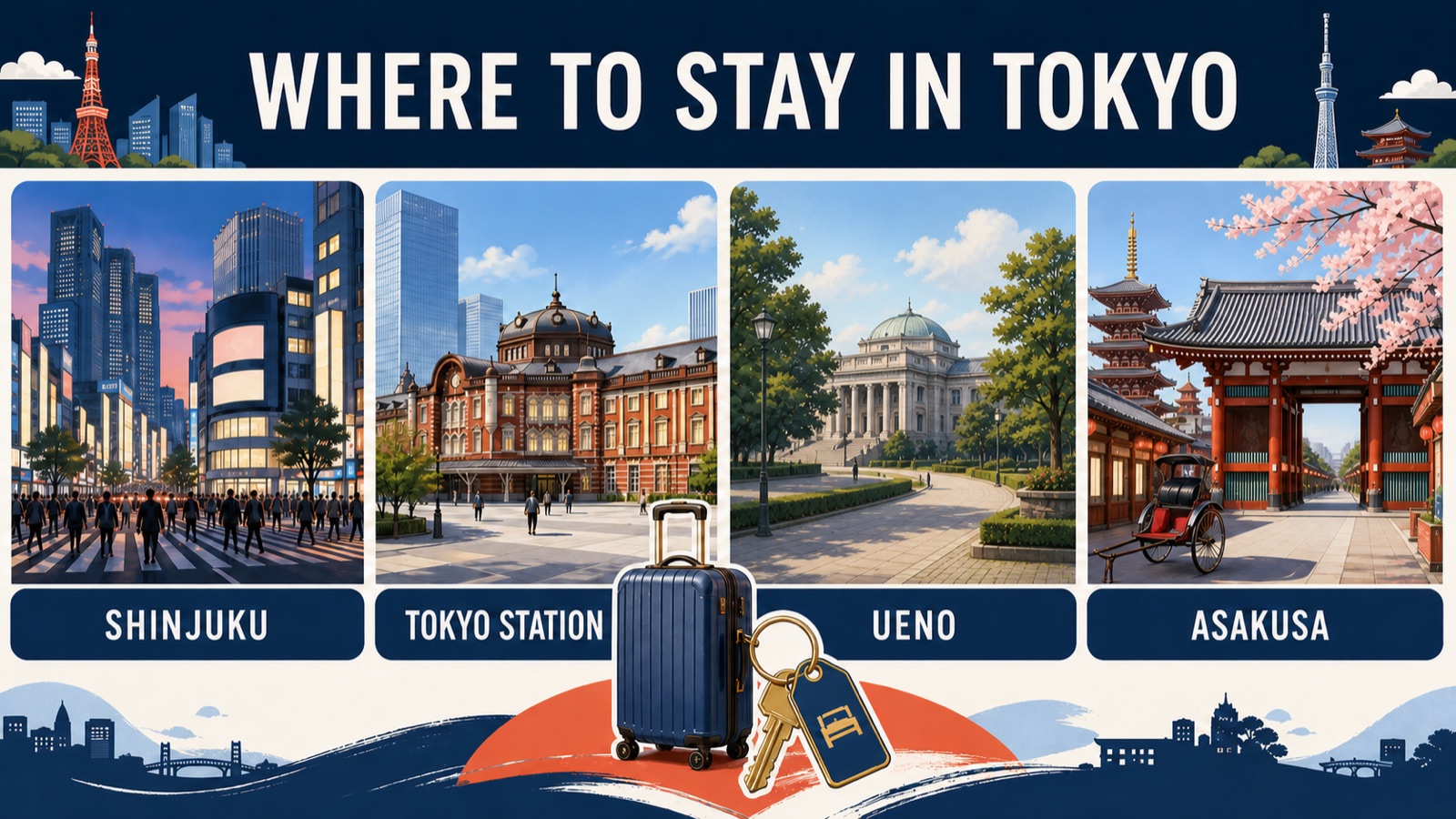
Quick answer: the best Tokyo area is the one that matches your route
For a first trip, the best place to stay in Tokyo is not automatically Shinjuku, Shibuya, Ginza, or Asakusa. It is the hotel area that makes your arrival, daily sightseeing, meals, luggage, and next-city transfer easiest. Tokyo is too large for one universal answer, and a famous neighborhood can be the wrong base if it adds repeated transfers or a hard station exit every night.
A practical short list is simple. Choose Shinjuku or Shibuya if nightlife, west-side energy, shopping, and late food matter. Choose Tokyo Station, Marunouchi, or Ginza if you want order, rail access, airport links, and easier onward movement. Choose Ueno or Asakusa if east-side culture, museums, traditional atmosphere, and Narita access fit the route. Choose Shinagawa if Haneda, Shinkansen access, or a quieter transport-first base matters more than neighborhood charm.
Official Tokyo and JNTO sources checked on 2026-07-14 support the core planning facts: Tokyo Station is a major national rail hub with airport access; Shinjuku is large, busy, and highly connected; Ueno is a transport hub near museums and Ueno Park; Asakusa has Tokyo Metro, Toei, and Tobu access; and Tokyo subway and rail systems involve multiple operators. Use those facts to choose a base, then verify the exact hotel-to-platform route before booking.
Who this Tokyo hotel guide is for
Use this page if you are staying in Tokyo for two to five nights and need to choose a base before booking hotels. It is most useful for first-time visitors who will combine Tokyo neighborhoods with Kyoto, Osaka, Hakone, Nikko, Kamakura, Disney, or another next step. It is also useful if your arrival airport, luggage level, bedtime, children, or early Shinkansen departure matters more than nightlife.
Do not use it as a list of hotels. Hotel quality, room size, price, cancellation rules, and availability change constantly. The decision here is area first, then exact hotel. Once the area is right, compare live hotel pages and official transport routes.
| Traveler type | Best base filter | Watch out for |
|---|---|---|
| First-time classic route | Simple access to daily sights plus an easy transfer to Kyoto or Osaka | Choosing nightlife first when every morning starts across town |
| Family trip | Room size, elevators, calm food options, simple station exits, and shorter walks | Large stations and late transfers with tired children |
| Late arrival | Direct or simple airport route and food near the hotel | A cheap hotel that needs multiple transfers after a long flight |
| Rail-heavy itinerary | Tokyo Station, Shinagawa, Ueno, or another base that fits the actual rail direction | Paying for a famous neighborhood that adds a morning transfer |
| Nightlife and shopping trip | Shinjuku, Shibuya, Ginza, or nearby areas with easy late return | Forgetting last-train timing and station complexity |
Tokyo area decision table
Use this table as a first pass. The right answer depends on your airport, route, and daily plans. A hotel that is technically central can still be wrong if the station is hard with luggage or if every attraction requires a transfer. A quieter base can be better than a famous one when it removes friction from arrival day and onward travel.
After choosing a likely area, test three routes: airport to hotel, hotel to your first full-day plan, and hotel to the station or airport on departure morning. If all three feel manageable with luggage and tired travelers, the area is probably a good fit.
| Area | Best for | Tradeoff |
|---|---|---|
| Shinjuku | Nightlife, restaurants, shopping, west-side Tokyo, many rail lines, and a big-city first impression | Very busy station environment; choose hotel exit carefully |
| Shibuya | Youth culture, shopping, Harajuku and Omotesando access, west-side evenings, and energetic travelers | Can feel crowded and less calm after long sightseeing days |
| Tokyo Station / Marunouchi | Shinkansen, business-style order, Ginza and Nihonbashi access, and simpler onward travel | Less neighborhood-like for travelers who want nightlife at the door |
| Ginza | Shopping, polished streets, food, central access, and travelers who value order over late-night chaos | Often pricier; check whether the hotel is really close to the line you need |
| Ueno | Museums, Ueno Park, Ameyoko, east-side Tokyo, and some Narita-friendly routing | Not as polished as Ginza or Marunouchi; evening style is different |
| Asakusa | Traditional atmosphere, Sensoji, Sumida River, east-side sightseeing, and a slower first Tokyo base | Some cross-city days take longer; check transfers to west-side plans |
| Shinagawa | Haneda, Shinkansen, south-side routing, and transport-first travelers | Less iconic as a sightseeing neighborhood for a first Tokyo stay |
| Akasaka / Roppongi edge | Comfort hotels, dining, museums, and a more adult central base | Can be expensive and may not simplify airport or Shinkansen movement |
Compare two actual hotels, not just neighborhood names
Shortlist two areas, then compare one real hotel in each for the same dates, occupancy and cancellation terms. A district name is only a first filter. The useful unit is the room plus its station exit, airport connection and route to your planned days.
| Test | Record for each hotel | Reject or reconsider when |
|---|---|---|
| Arrival | Terminal, service, final station, exit and hotel walk | The last connection is earlier than your realistic airport exit time |
| Daily travel | Return route for each of your first three sightseeing days | All three require repeated cross-city changes you wanted to avoid |
| Next city | The actual station on your reserved or proposed intercity service | You chose a nearby station that does not serve that train |
| Room and access | Permitted occupancy, beds, suitcase space and elevator route | The price assumes fewer occupants or the accessible route is unverified |
| Evening return | Walk from the dinner area and reception's late check-in rules | Every evening requires a taxi that is absent from the budget |
What is a better location worth?
Suppose Hotel A is JPY 2,000 more per room per night for four nights: the premium is JPY 8,000. If Hotel B adds a hypothetical JPY 300 per person each way on three sightseeing days for two adults, that is JPY 3,600 in extra fares. Hotel A still costs JPY 4,400 more after that comparison. If B also adds twenty minutes each way, it consumes two hours across those three days. Decide whether saving those two hours and the transfers is worth JPY 4,400 to your group. These are illustrative assumptions, not fares or prices for named Tokyo hotels.
Do not add fares twice when the journey is already covered by a ticket you would buy anyway. Do not compare a refundable room with a non-refundable room as if location were the only difference. Add breakfast, accommodation tax where applicable and other compulsory charges using the actual booking breakdown.
A transport-first shortlist
For Haneda followed by Kyoto or Osaka, start by testing Shinagawa: GO TOKYO's Shinagawa guide, checked September 5, 2026, confirms its Keikyu and Tokaido Shinkansen connections. This does not mean Shinagawa serves every Shinkansen route; match your actual train before choosing it. For a Narita arrival and east-side days, test a hotel near the relevant Ueno or Asakusa station against one near Tokyo Station. Use the airport guide to distinguish Keisei Ueno from JR Ueno and check current disruptions.
For three west-side days and late evenings, a hotel on the correct side of Shinjuku or Shibuya may justify a less direct arrival. For a family needing elevators and larger rooms, those requirements outrank a small fare saving. Once one hotel passes the arrival, daily-route and departure tests, keep the Tokyo stay together unless moving solves a specific flight or activity constraint.
Airport, rail, and luggage table
Airport access is not only about minutes. It is about number of transfers, luggage handling, ticket purchase, platform location, and whether food is available when you arrive. A base that saves one transfer after a long flight can be worth more than a cheaper room farther away.
Tokyo Station and Shinagawa often make sense when onward Shinkansen movement matters. Ueno and Asakusa can make sense for east-side Tokyo and some Narita patterns. Shinjuku can work well for west-side Tokyo, but the station is large and the exact hotel exit matters. Always check the operator page for current routes and the hotel map before booking.
| Planning issue | Area logic | Action before booking |
|---|---|---|
| Narita arrival | Ueno, Asakusa, Tokyo Station, or areas with simple rail or bus links may reduce arrival stress | Check the exact route to the hotel, not only the nearest station name |
| Haneda arrival | Shinagawa, Tokyo Station/Ginza side, Asakusa line areas, and direct bus options can be convenient | Check whether the route is still simple at your landing time |
| Shinkansen departure | Tokyo Station or Shinagawa can reduce morning transfer risk | Know which station your train actually uses and how long hotel checkout takes |
| Late nights | Shinjuku, Shibuya, Ginza, and nearby central areas can make evenings easier | Check last-train timing and the walk back from the station |
| Large luggage | Smaller station exits and closer hotels can beat famous but complex bases | Inspect elevator access, station exits, and hotel luggage storage |
| Children or older travelers | Calmer food options and shorter station walks matter more than nightlife | Prioritize room size, elevators, breakfast, and simple returns |
Area-by-area practical notes
Shinjuku is powerful because it combines many rail lines, shopping, dining, nightlife, and west-side access. GO TOKYO also makes clear that the station area is intense and busy. Book here when that energy is the point, and reduce stress by choosing a hotel near the correct side of the station for your plans.
Shibuya is strong for travelers who want modern Tokyo, fashion, music, youth culture, Harajuku, Omotesando, and lively evenings. It is less ideal if the group wants calm, large rooms, or a simple first night after a long flight. Ginza and Tokyo Station feel more orderly. GO TOKYO describes Tokyo Station as a major rail hub with national connections, and Ginza works well when shopping, food, and central access matter more than nightlife.
Ueno and Asakusa are often underrated for first trips. Ueno puts museums, Ueno Park, Ameyoko, and transport close together. Asakusa gives a more traditional atmosphere around Sensoji and has Tokyo Metro, Toei, and Tobu access. These areas can be excellent when your trip leans east, but they may add time to repeated west-side evenings.
Shinagawa is not the most romantic first answer, but it can be the correct one for Haneda access, Shinkansen movement, and travelers who want a transport-first base. Akasaka and the Roppongi edge suit some comfort travelers who want dining, museums, and a more adult central feel, but they should be chosen for specific route reasons, not because they sound central.
Common mistakes
The first mistake is booking the cheapest room with a Tokyo address. Tokyo is large, and a low nightly rate can create extra fares, long rides, poor food options, and tired evenings. The second mistake is choosing Shinjuku or Shibuya because everyone mentions them. They are excellent for the right traveler, but not for every family, late arrival, early departure, or quiet-food traveler.
The third mistake is ignoring station exits. A hotel can be close to a station but far from the line, exit, or elevator you need. The fourth mistake is changing Tokyo hotels without a strong reason. Splitting a short Tokyo stay can waste check-in time unless the second base solves an airport, Shinkansen, Disney, or specific neighborhood problem.
The fifth mistake is booking by attraction list before deciding evening rhythm. If the group wants calm dinners and early mornings, a nightlife district may wear them down. If the group wants late food and bars, a business district can feel inconvenient after 10 PM. The sixth mistake is forgetting that Tokyo Metro, Toei, JR, private railways, buses, and airport operators do not all behave like one single system.
What to verify on official sources
Before booking, verify the airport route from your actual terminal to the hotel area, the station exit and elevator path, the onward rail station if you are leaving Tokyo by Shinkansen, and whether the area still works for your first three full days. Use official tourism and operator pages for area orientation, then use current route search or operator pages for live timing.
Shortly before travel, verify late-night or early-morning access, planned construction or service changes, luggage forwarding acceptance, hotel check-in and storage rules, and weather. If your arrival is late, also verify food nearby. Tokyo is easy when the base matches the route; it is exhausting when the hotel requires a complicated transfer every day.
- Check airport route by terminal, time of day, and luggage level.
- Check the station exit closest to the hotel, not only the nearest station.
- Check whether the hotel is better for JR, Tokyo Metro, Toei, or a private railway.
- Check first-night food if arriving after a long flight.
- Check room size and elevator access for families and large luggage.
- Check cancellation rules before locking a hotel during busy dates.
If you only do one thing
Before booking a Tokyo hotel, test three routes: airport to hotel, hotel to your most important full-day plan, and hotel to your next city or departure airport. If any of those routes looks fragile with luggage or tired travelers, choose another base or another hotel exit.
A first Tokyo base should remove friction from the trip. It does not need to be the trendiest neighborhood, and it does not need to be the cheapest listing. It needs to make the real days easier.
Related tools and next planning links
Use the Airport Transfer Finder after narrowing the area, because Narita and Haneda can push the same traveler toward different bases. Use the Budget Calculator once you have a room shortlist, because hotel location can change local transport and taxi risk. Use the Japan Trip Planner to see whether your Tokyo days are mostly west, east, central, family-focused, or day-trip heavy.
For reading order, compare Narita to Tokyo Transfer, Haneda to Tokyo Transfer, Japan 7 Day Itinerary, Japan 10 Day Itinerary, and Japan Travel Budget for 10 Days. Those pages connect the hotel area to arrival, route, rail, and cost decisions.
Use next on Japan Trip Tools
- Narita to Tokyo Transfer — Match hotel area to Narita arrival options.
- Haneda to Tokyo Transfer — Check the other main Tokyo airport route.
- Japan 7 Day Itinerary — Place Tokyo hotel nights inside a short route.
- Japan 10 Day Itinerary — Connect Tokyo base choice to Kyoto and Osaka movement.
- Japan Travel Budget for 10 Days — Test how hotel area changes total trip cost.
- First-Time Japan Travel Guide — Use the wider booking order before paying.
Sources and image licensing
- JNTO Tokyo Destination Guide (checked 2026-07-14)
- GO TOKYO Shinjuku Guide (checked 2026-07-14)
- GO TOKYO Shibuya Guide (checked 2026-07-14)
- GO TOKYO Tokyo Station and Marunouchi Guide (checked 2026-07-14)
- GO TOKYO Ginza Guide (checked 2026-07-14)
- GO TOKYO Ueno Guide (checked 2026-07-14)
- GO TOKYO Asakusa Guide (checked 2026-07-14)
- GO TOKYO Shinagawa and Tennozu Guide (checked 2026-07-14)
- GO TOKYO Tokyo Subway Guide (checked 2026-07-14)
Plan your next step
FAQ
What is the best area to stay in Tokyo for first-time visitors?
There is no single best area. Shinjuku, Shibuya, Tokyo Station, Ginza, Ueno, Asakusa, and Shinagawa can all work depending on airport, route, luggage, nightlife, and onward travel.
Is Shinjuku a good place to stay in Tokyo?
Yes, if you want nightlife, restaurants, shopping, and west-side rail access. It can be tiring if you dislike crowds or choose a hotel on the wrong side of the station for your plans.
Is Ueno better than Shinjuku for a first Tokyo stay?
Ueno can be better for museums, Ueno Park, Ameyoko, east-side Tokyo, and some Narita-friendly routing. Shinjuku is better for nightlife, west-side Tokyo, and a busier city feel.
Should I stay near Tokyo Station?
Tokyo Station or Marunouchi is strong for Shinkansen, central order, Ginza and Nihonbashi access, and onward movement. It may feel less neighborhood-like than Shinjuku, Shibuya, Ueno, or Asakusa.
Where should families stay in Tokyo?
Families should prioritize room size, elevators, simple station exits, nearby food, and shorter transfers. A calmer central or east-side base can be better than a nightlife district.
Which Tokyo area is best for Narita Airport?
Ueno, Asakusa, Tokyo Station, and some east or central areas can be convenient, but the right answer depends on the exact rail or bus route to your hotel and arrival time.
Which Tokyo area is best for Haneda Airport?
Shinagawa, Tokyo Station/Ginza side, Asakusa line areas, and some direct bus areas can work well. Always check current routes from your terminal to the hotel.
Should I split hotels during a Tokyo stay?
Usually not for a short first stay unless the second hotel solves a real problem such as an early flight, Disney stay, Shinkansen departure, or a completely different route focus.
How can I compare a cheaper Tokyo hotel with a better-located one?
Compare total room costs for identical dates and occupants, then add only the extra transport the cheaper location creates. Record transfer time separately. Check cancellation terms, room capacity and the usable station exit before choosing on price.