
Japan Travel Budget for 10 Days: Hotels, Rail, Food, and Reserve Money
A practical 10 day Japan budget guide that separates hotels, rail, food, local transport, accommodation taxes, activities, shopping, and reserve money before booking.
At a glance
- Best for
- First-time
- Main decision
- Which spending range fits the route
- Time needed
- 15-30 minutes for a planning pass
- Official checks
- Opening hours, transport schedules, weather, reservations
- Related tool
- Japan Costs And Tips
Build a one-page budget with six rows before booking anything: hotels, long-distance rail, local transport and airport transfers, food, activities, and shopping plus reserve. Put official values beside the rows where official values exist, and put live booking checks beside the rows that change by date.
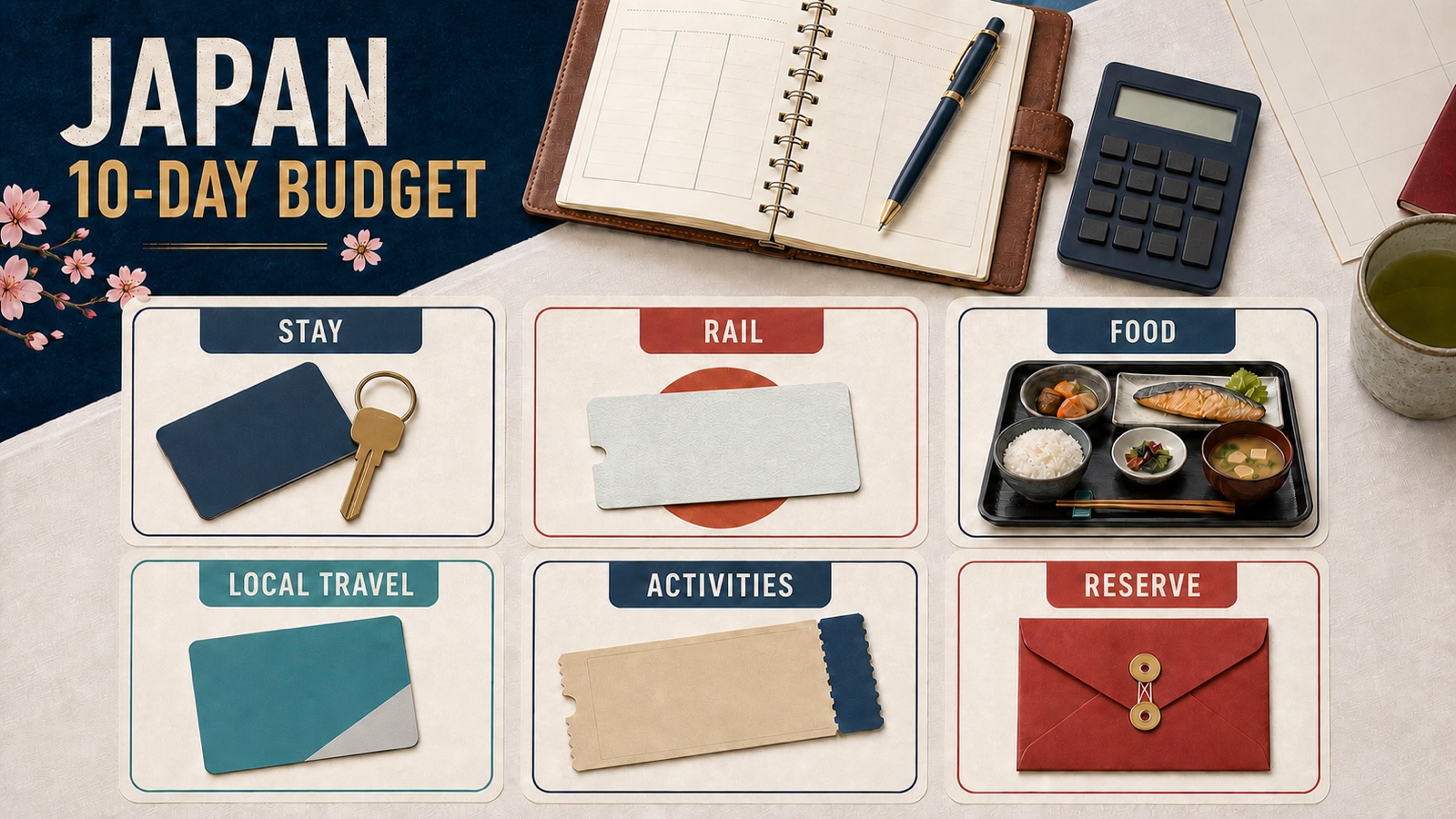
Quick answer: what a 10 day Japan budget should include
A useful 10 day Japan travel budget is not a single average copied from another trip. It is a category plan: hotels, long-distance rail, local transport, airport transfers, food, activities, shopping, taxes, luggage, and reserve money. Build it after the route is stable, because Tokyo-only, Tokyo-Kyoto-Osaka, and Tokyo-Kyoto-Osaka-Hiroshima versions have very different rail and hotel pressure.
For a first-time 10 day route, start with the costs you can verify on official pages, then fill the flexible categories from live booking and menu research. Official sources checked on 2026-07-14 confirm current JR Pass prices, Tokyo subway tourist ticket prices, Tokyo, Kyoto, and Osaka accommodation-tax rules, International Tourist Tax changes, and tax-free shopping checks. Hotel nightly rates, restaurant bills, event tickets, exchange rates, and airline fares still need live verification at booking time.
The most common budgeting error is pricing attractions and food first while leaving hotels and rail vague. Reverse that order. If your hotel base is far from the daily route, you may spend the savings on local fares, taxis, luggage friction, and lost time. If your rail plan is overbuilt, a pass can cost more than individual tickets. If your shopping plan is serious, reserve time and money for customs and tax-free rules instead of treating souvenirs as leftover cash.
Who this budget guide is for
Use this page if you are building a 10-day, nine-night Japan trip and need a realistic cost structure before booking hotels or rail. It is written for travelers comparing a classic Tokyo, Kyoto, and Osaka route, with optional day trips or one longer add-on. It is also useful if your group has mixed travel styles: one person wants casual meals and efficient hotels, another wants paid views, shopping, theme parks, or a ryokan night.
This page is not a live price quote. It does not replace hotel booking sites, official railway booking pages, attraction ticket pages, or your bank exchange rate. It gives you a defensible order of operations so you know what to verify before paying.
| Traveler situation | Use this page for | Do next |
|---|---|---|
| First-time Tokyo-Kyoto-Osaka trip | Separate hotels, rail, local transport, food, activities, and reserve money | Draft nights and hotel bases before pricing rail |
| Family or group trip | Catch room-size, luggage, taxi, and meal-cost pressure early | Price the room total per night, not only per-person estimates |
| Budget-conscious traveler | Find which costs are controllable and which are fixed by route | Use official pass and subway ticket pages before relying on old fare notes |
| Comfort traveler | Decide where paying more reduces stress rather than just adding luxury | Compare hotel location, laundry, breakfast, and station access |
| Shopping-focused traveler | Plan tax-free rules, packing, airport time, and cash reserve | Check NTA and customs guidance before the final shopping day |
The 10 day budget decision table
Start with this table before choosing a number. The goal is to identify the line items that can break the budget. Some are official and current as of the review date; others must be checked live because Japan travel prices change by date, city, room type, event, and exchange rate.
A classic 10 day first trip usually fails financially in one of three places: hotel totals during busy dates, long-distance rail added after the route is already too ambitious, or a shopping and activity budget that was never separated from daily food.
| Cost line | Budget pressure | Practical action |
|---|---|---|
| Hotels | Tokyo, Kyoto, and Osaka prices vary by date, room size, cancellation rule, breakfast, and distance from stations | Compare total stay cost including taxes and fees, then test the station-to-hotel walk with luggage |
| Long-distance rail | Tokyo-Kansai is a major line item; extra Hiroshima, Kyushu, Tohoku, or Hokuriku legs can change the pass decision | Price exact legs before buying any JR Pass or regional pass |
| Local transport | Poor hotel placement creates repeated subway, JR, bus, and taxi costs | Check whether a subway ticket, IC card, or simple point-to-point use fits the actual days |
| Food | Convenience stores and casual restaurants control cost; theme parks, ryokan meals, markets, and special dinners raise it | Plan easy meals near hotels on transfer days and reserve special meals separately |
| Activities | Paid views, museums, gardens, theme parks, tours, and event seats do not behave like normal daily spend | Anchor only the paid days that matter and keep nearby days lighter |
| Shopping and tax-free | Souvenirs, cosmetics, snacks, electronics, extra baggage, and customs checks can consume the reserve | Put shopping in its own line and verify NTA tax-free rules before departure |
| Reserve money | Weather, fatigue, missed trains, full lockers, taxis, medicine, laundry, and luggage forwarding are normal trip costs | Keep a reserve that is not already assigned to food or shopping |
Official costs and rules checked on 2026-07-14
Use official values only as fixed checkpoints, not as a complete budget. The Japan Rail Pass official price page lists ordinary adult online prices of JPY 50,000 for 7 days, JPY 80,000 for 14 days, and JPY 100,000 for 21 days. The same page also lists higher overseas agency prices for purchases made on or after 2026-10-01. This matters because a 10 day trip does not automatically need a 14 day pass, and a city-heavy route may not need a national pass at all.
Tokyo Metro lists Tokyo Subway Ticket prices for overseas visitors and some domestic visitors outside the Tokyo area: JPY 1,000 for 24 hours, JPY 1,500 for 48 hours, and JPY 2,000 for 72 hours for adults. That can help on subway-heavy Tokyo days, but it is not a universal Tokyo transport answer because JR lines, airport rail, buses, taxis, and private railways may sit outside the decision.
For accommodation tax, Tokyo, Kyoto, and Osaka use different thresholds. Tokyo Metropolitan Government tax guidance lists JPY 100 per person per night for room charges from JPY 10,000 to less than JPY 15,000, and JPY 200 from JPY 15,000, with no tax below JPY 10,000. Kyoto City lists a per-person, per-night tax from JPY 200 at stays under JPY 6,000 up to JPY 10,000 at stays of JPY 100,000 or more. Osaka Prefecture lists the post-2025-09-01 rates from JPY 200 at JPY 5,000 to less than JPY 15,000, JPY 400 at JPY 15,000 to less than JPY 20,000, and JPY 500 at JPY 20,000 or more.
For departures from Japan on or after 2026-07-01, the Japan Tourism Agency and National Tax Agency materials state that the International Tourist Tax rate is JPY 3,000 per departure, with transitional rules for eligible tickets issued before the increase. The National Tax Agency also publishes current tax-free shopping notices. If your trip includes serious shopping, check those pages before final packing and airport timing.
| Official item | Current planning fact | Budget meaning |
|---|---|---|
| JR Pass | Official prices and purchase-channel rules are current but route-dependent | Do not buy until exact long-distance legs are priced |
| Tokyo Subway Ticket | Adult 24, 48, and 72 hour tourist ticket prices are published by Tokyo Metro | Useful only when the day is subway-heavy |
| Accommodation tax | Tokyo, Kyoto, and Osaka use different per-person, per-night thresholds | Add it after choosing hotel cities and room price band |
| International Tourist Tax | JPY 3,000 per departure applies from 2026-07-01 in principle | Check whether your ticket falls under transitional rules |
| Tax-free shopping | NTA requires export and customs-related checks; refund-method rules change from 2026-11-01 | Protect airport time and keep goods accessible when required |
Step-by-step budget plan before booking
Step 1: write the route as nights, not attractions. For example, Tokyo four nights, Kyoto three nights, and Osaka two nights, with any airport-hotel night replacing one of those nine nights is easier to price than a list of famous places. Step 2: choose hotel bases by route value. A cheaper room outside the daily path can create extra transfers and taxis.
Step 3: price long-distance rail using exact legs. Put Tokyo to Kyoto or Shin-Osaka, any Hiroshima or extra regional leg, and the return to the departure airport into one list. Step 4: decide whether local Tokyo days are subway-heavy enough for a Tokyo Subway Ticket, or whether simple IC card use is cleaner. Step 5: add food by day type: transfer day, normal city day, special meal day, market day, theme park day, and ryokan or hotel-breakfast day.
Step 6: add paid activities as individual anchors. Do not hide a theme park, observation deck, guided tour, museum bundle, or festival seat inside a generic daily allowance. Step 7: add shopping, luggage, laundry, lockers, taxis, medicine, and reserve money. Step 8: recheck official pages shortly before travel because fares, passes, tax rules, opening days, and ticket systems can change after your first draft.
A worked budget for two adults and nine nights
A trip arriving on Day 1 and departing on Day 10 normally has nine hotel nights. Our example uses four nights in Tokyo, three in Kyoto and two in Osaka. An overnight flight before arrival is not a Japan hotel night. If you add an airport hotel, replace an existing night or explicitly extend the trip.
These are editable planning assumptions, not market averages or live quotations. The example is for two adults sharing one room, with breakfast included in the food allowance. It excludes international flights, travel insurance, shopping and any departure tax already included in the airfare. Replace the room and rail allowances with actual quotes for your dates before treating the result as a booking budget.
| Category | Assumption and calculation | Two-adult total |
|---|---|---|
| Hotels | 9 nights x JPY 18,000 per room, not per person | JPY 162,000 |
| Long-distance rail | JPY 20,000 allowance per adult x 2; replace with the exact route quotation | JPY 40,000 |
| Airport and local transport | JPY 12,000 allowance per adult x 2; excludes the rail row above | JPY 24,000 |
| Food | 10 days x JPY 4,000 per adult x 2 | JPY 80,000 |
| Paid activities | JPY 10,000 allowance per adult x 2 | JPY 20,000 |
| Connectivity, laundry and luggage | One shared trip allowance | JPY 10,000 |
| Accommodation tax provision | Provisional JPY 5,000; replace with the hotel's itemized amount | JPY 5,000 |
| Subtotal | Sum of the seven rows above | JPY 341,000 |
| Unallocated reserve | 10% of JPY 341,000, an example choice rather than a requirement | JPY 34,100 |
| Illustrative trip fund | Subtotal plus reserve | JPY 375,100 |
This works out to JPY 187,550 per adult for the shared example, before the exclusions. It does not mean every visitor needs that amount. A solo traveler cannot simply halve the hotel bill. A family cannot simply multiply the adult figure by the number of children: room capacity, children's fares and attraction tickets need separate quotes.
Change the expensive assumptions first
If the same room costs JPY 25,000 instead of JPY 18,000, nine nights add JPY 63,000 to the subtotal. Keeping a 10% reserve adds another JPY 6,300, so the trip fund rises by JPY 69,300. Cutting food by JPY 1,000 per person per day saves only JPY 20,000 before recalculating the reserve. This is why comparing real hotel dates and room totals usually deserves attention before trimming snacks.
If your flight leaves from Tokyo instead of Kansai, replace the rail allowance with quotes that include the return journey and change the final night's hotel. Do not add both an Osaka room and a Tokyo room for the same night unless you intentionally pay for overlapping bookings. If breakfast or dinner is included with a hotel, remove the corresponding meal allowance rather than paying for it twice in the spreadsheet.
Keep a second column for already paid. The total trip cost includes prepaid rooms and tickets, but the money still needed on arrival does not. Retain a separate reserve available through your chosen payment methods; the trip fund is not a recommendation to carry that amount in cash.
For local rail, the Tokyo Subway Ticket page, rechecked September 5, 2026, lists adult 24/48/72-hour tickets at JPY 1,000/1,500/2,000. Compare only Metro and Toei journeys inside the ticket window. If you buy one, replace the covered pay-as-you-go fares in your local-transport row; do not add both. JR and airport services are separate decisions.
Common mistakes
The first mistake is using someone else's daily average without matching their route, room style, dates, group size, and rail legs. A solo traveler staying in compact rooms near Ueno is not the same budget as a family needing larger rooms in Kyoto during a busy period.
The second mistake is treating the JR Pass as a default Japan cost. The official price is easy to find, but the value depends on eligible rides, route timing, train choices, purchase channel, and whether an open-jaw flight removes a long return. The third mistake is ignoring accommodation tax because the nightly amount looks small. On a multi-city trip with multiple travelers, it belongs in the hotel total.
The fourth mistake is underestimating low-friction spending. Lockers, luggage forwarding, laundry, taxis after late meals, umbrellas, medicine, phone charging gear, and a final airport meal are not luxuries when the trip is actually happening. The fifth mistake is putting all flexible money into shopping before checking tax-free rules, customs timing, and baggage limits.
What to verify on official sources
Before paying, verify the current JR Pass and regional pass pages, the exact rail legs you plan to ride, the Tokyo Subway Ticket page if you expect subway-heavy days, the airport transfer operator for your arrival and departure times, and the hotel tax rules for each city where you sleep. For Kyoto and Osaka, use current city or prefectural accommodation-tax pages because thresholds have changed recently.
Before departure, verify attraction opening days, timed-ticket rules, weather warnings, luggage forwarding cutoff times, tax-free shopping rules, and the International Tourist Tax rule that applies to your ticket. Save the source pages or screenshots you need for travel day, especially if your plan includes a tight transfer, a high-demand attraction, or tax-free goods in checked baggage.
- Check hotel totals by room and stay, not only nightly headline rates.
- Check rail from current operator or official pass pages, not old blog examples.
- Check city accommodation tax after you know room price band and number of people.
- Check tax-free shopping rules before packing purchases for the airport.
- Check airport transfer time on the actual arrival or departure day.
- Check exchange rate and card fees with your bank before using foreign currency estimates.
If you only do one thing
Build a one-page budget with six rows before booking anything: hotels, long-distance rail, local transport and airport transfers, food, activities, and shopping plus reserve. Put official values beside the rows where official values exist, and put live booking checks beside the rows that change by date.
Then stress-test one bad day. If rain, a delayed arrival, a full locker, or tired travelers force a taxi and a simple meal, does the budget still work? If not, improve the hotel base, remove one paid anchor, or reduce one long-distance add-on before you pay.
Related tools and next planning links
Use the Japan Travel Budget Calculator after you have route nights and hotel bases. Use the JR Pass Value Checker only after exact rail legs are known. Use the Airport Transfer Finder for the first and last day, because those days often create hidden costs. Use the Luggage Planner before adding a shopping-heavy day, Hakone, or any hotel change with sightseeing in the middle.
For reading order, start with the Japan 10 Day Itinerary, then compare the JR Pass Worth It guide, Where to Stay in Tokyo First Time, Narita to Tokyo Transfer, and Haneda to Tokyo Transfer. Those pages turn the cost table into actual booking decisions.
Use next on Japan Trip Tools
- Japan 10 Day Itinerary — Estimate the budget against a real route structure.
- Is the JR Pass Worth It? — Check rail pass value before buying.
- Where to Stay in Tokyo First Time — Hotel base is the biggest budget lever in Tokyo.
- Narita to Tokyo Transfer — Airport transfer costs depend on hotel area and arrival time.
- Haneda to Tokyo Transfer — Use the other main Tokyo arrival path when flights change.
- First-Time Japan Travel Guide — Use the booking order before committing money.
Sources and image licensing
- JNTO Guide to Traveling Japan on a Budget (checked 2026-07-14)
- JAPAN RAIL PASS Official Prices (checked 2026-07-14)
- Tokyo Metro Tokyo Subway Ticket (checked 2026-07-14)
- Tokyo Metropolitan Government Guide to Metropolitan Taxes 2025 - Accommodation Tax (checked 2026-07-14)
- Kyoto City Accommodation Tax (checked 2026-07-14)
- Osaka Prefecture Accommodation Tax (checked 2026-07-14)
- Japan Tourism Agency International Tourist Tax leaflet (checked 2026-07-14)
- National Tax Agency Tax-Free Shopping System revision (checked 2026-07-14)
Plan your next step
FAQ
How much should I budget for 10 days in Japan?
The worked example totals JPY 375,100 for two adults sharing a room for nine nights, including a 10% reserve. It is an illustrative calculation, not an average or live quotation. International flights, insurance and shopping are excluded. Replace its room, rail and daily-spending assumptions with your own quotes.
Is the JR Pass worth it for a 10 day Japan trip?
Only after exact legs are priced. A Tokyo-Kyoto-Osaka route may not justify a national pass, while extra Hiroshima, Kyushu, Tohoku, or Hokuriku legs can change the calculation.
What is the easiest Japan cost to underestimate?
Hotels and rail are obvious, but travelers often underestimate local transport, lockers, luggage forwarding, taxis after tired evenings, tax-free shopping logistics, and reserve money.
Should I include accommodation tax in my hotel budget?
Yes. Tokyo, Kyoto, and Osaka use different per-person, per-night accommodation-tax rules. Add them after you know the city, room price band, and number of travelers.
Are Tokyo subway passes always cheaper than IC card travel?
No. Tokyo subway passes can be useful on subway-heavy days, but they do not cover every rail or bus need. Compare the actual day plan before buying.
How should families budget differently?
Families should budget by room total, simple transfers, meal rhythm, luggage, laundry, and taxi risk. Per-person backpacker averages usually understate family costs.
Do tax-free shopping savings reduce the trip budget?
Treat tax-free shopping as a shopping and airport-logistics decision, not free money. You still need cash flow, packing space, customs compliance, and time at departure.
When should I recheck official prices?
Recheck before buying rail passes, booking non-refundable hotels, buying fixed attraction tickets, shopping tax-free, and again shortly before departure for transport and weather-sensitive plans.
Does a 10-day Japan trip mean ten hotel nights?
Not usually. Arrival on Day 1 and departure on Day 10 means nine nights. Count the check-in and check-out dates of each booking. Replace a city night if you move to an airport hotel; add another night only if you extend the trip.