
First-Time Japan Travel Guide: What to Decide Before You Book
A practical first-time Japan travel guide for travelers who need a booking order, not a random list of famous places.
At a glance
- Best for
- First-time
- Main decision
- Which spending range fits the route
- Time needed
- 15-30 minutes for a planning pass
- Official checks
- Opening hours, transport schedules, weather, reservations
- Related tool
- Japan Costs And Tips
Write a one-line route before booking anything: arrival airport, first base, second base, departure airport, and number of nights in each place. If that line does not make sense, no attraction list will fix the trip. Once the route line works, every other first-time decision becomes easier: hotels, rail pass, luggage, cash, paperwork, day trips, and backup plans.
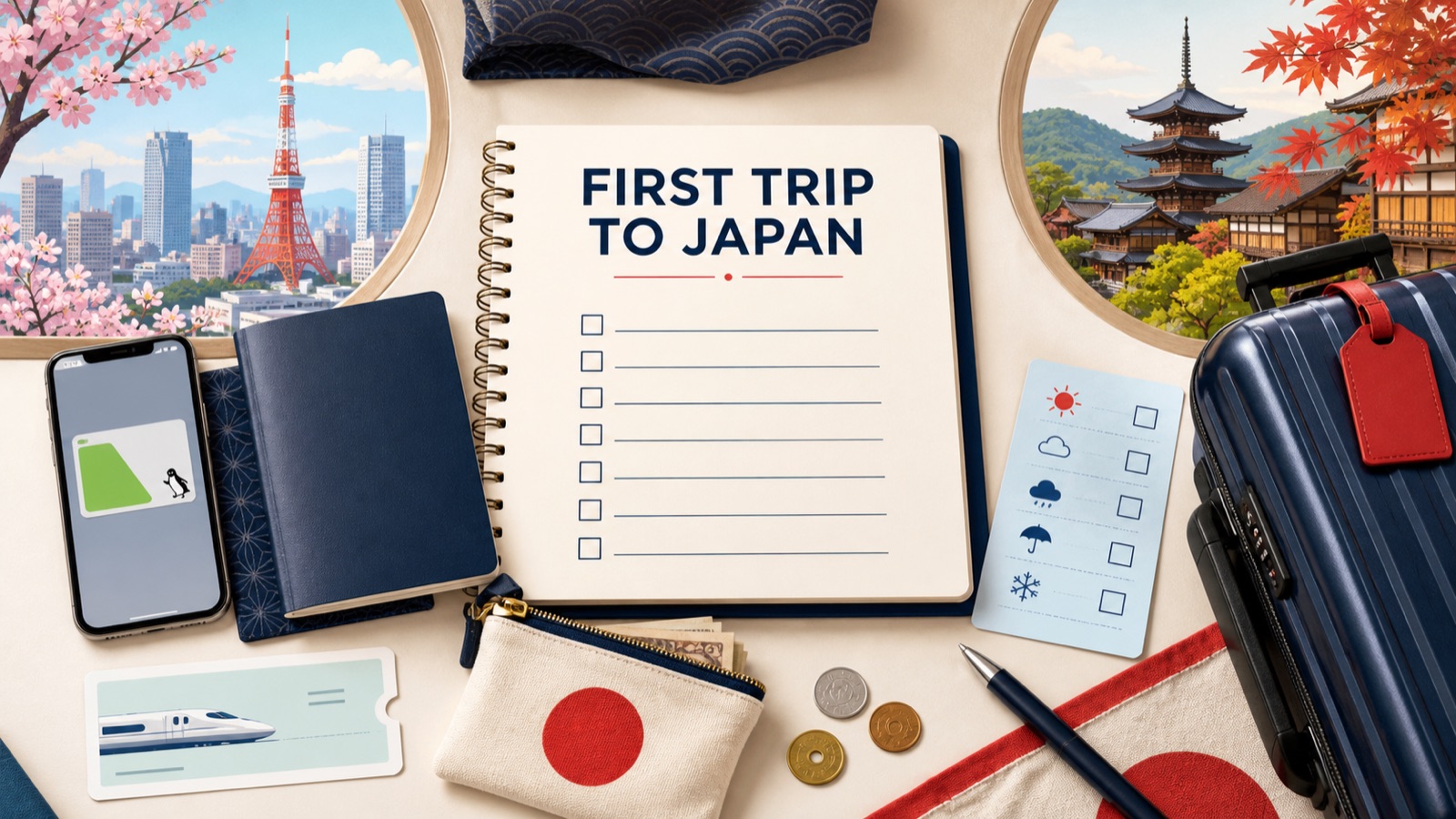
Quick answer
First-time Japan planning is easier when you make decisions in the right order: trip length, arrival and departure airports, overnight bases, long-distance transport, hotel areas, budget, luggage, entry paperwork, connectivity, and only then daily attractions. Most weak first trips fail because travelers choose famous places first and try to force the route around them.
For many English-speaking first timers, the safest starting point is Tokyo plus Kansai, with Tokyo for arrival and neighborhoods and Kyoto or Osaka for the second base. That does not mean every traveler needs the same route. It means the first draft should be simple enough to test against official transport pages, hotel maps, budget range, luggage limits, and the traveler's actual energy.
Who this is for
This guide is for travelers before the booking stage: people asking where to start, how long to stay, whether to buy a rail pass, where to sleep, how much cash to carry, and what official pages to check. It is written for tourists who want practical next steps without needing to understand every railway company or every region on day one.
It is not a substitute for official immigration, customs, medical, railway, airline, or attraction pages. Those sources control current rules. The role of this guide is to put the checks in a useful sequence so a first-time traveler does not miss something obvious.
| If you are | Start with | Do not start with |
|---|---|---|
| Planning your first independent trip | Trip length, airports, and overnight bases. | A list of every viral place. |
| Choosing between Tokyo, Kyoto, and Osaka | Route shape and hotel base logic. | A single neighborhood recommendation out of context. |
| Comparing rail passes | Exact long-distance legs and official pass prices. | A generic claim that all tourists need a pass. |
| Worried about logistics | Entry procedures, luggage, IC cards, cash, and connectivity. | Detailed restaurant reservations before the route is stable. |
| Traveling with family or heavy bags | Hotel access, transfer days, and luggage forwarding. | Back-to-back day trips. |
First-time decision table
Use this table as the booking order. A good first trip is not built by optimizing every single detail. It is built by making the few decisions that prevent the biggest problems: bad airport positioning, too many hotel moves, unrealistic rail assumptions, missing cash, poor luggage planning, and forgetting official paperwork checks.
| Decision | Default for many first trips | Verify before paying |
|---|---|---|
| Trip length | 7 to 10 days for Tokyo plus Kansai. | Flight arrival and departure times, not just calendar dates. |
| Route | Two main bases before adding side trips. | Official railway and airport access for the actual dates. |
| Hotels | Station access and route fit over cheapest map location. | Cancellation terms, room size, and late arrival policy. |
| Rail pass | Buy only if exact legs beat the pass cost and rules. | Official Japan Rail Pass price and validity pages. |
| Payments | Credit card plus some cash plus IC card or mobile transit option. | Current IC card availability and card acceptance for planned stops. |
| Luggage | Pack for train transfers and consider forwarding. | Official baggage limits and delivery/storage acceptance conditions. |
| Entry and customs | Use official Visit Japan Web or official paper/electronic declaration guidance. | Digital Agency and Japan Customs pages close to departure. |
Step-by-step action plan
Step 1: write your usable days. If you land at night, that is not a full sightseeing day. If you fly out in the morning, the previous night matters more than another attraction. This one correction prevents many overloaded itineraries.
Step 2: choose route shape before hotels. A first-time route might be Tokyo only, Tokyo plus Kyoto, Tokyo plus Kyoto and Osaka, or one region such as Kyushu or Hokkaido. Do not book a cheap hotel until you know whether that hotel makes the daily route easier or harder.
Step 3: check long-distance transport. Use official railway, airport, or operator pages for the main legs. If considering a rail pass, compare the exact legs with current official pass prices. As checked on July 12, 2026, official JR Pass pricing and agency purchase dates are published on the Japan Rail Pass site; readers should verify the current page before buying.
Step 4: plan money and payment. JNTO's cashless payment guidance notes that cashless options are expanding but some places can still require cash, especially outside major urban settings. Plan to use cards where accepted, carry some cash, and decide how you will handle local transport payments through IC cards, tickets, or mobile options.
Step 5: solve luggage before transfer days. JNTO's luggage guidance describes hands-free travel and notes that services have limits by size, weight, contents, and destination. Build a lighter transfer day if you will carry suitcases, and check official railway baggage guidance if your luggage may be oversized.
Step 6: complete official entry and safety checks. The Digital Agency describes Visit Japan Web as a service for arrival procedures and tax-free shopping service online, and Japan Customs points travelers to electronic declaration through Visit Japan Web. Before travel, save official emergency numbers and know where to find the JNTO visitor hotline and safety information.
Common mistakes
Mistake one is planning attractions before logistics. A famous temple, food street, or observation deck is not useful if it sits on the wrong side of a transfer day. Mistake two is assuming Japan's strong transport system means every route is easy. Public transport is excellent, but station walking, transfers, last trains, luggage, and weather still matter.
Mistake three is buying the wrong pass or too many passes. A pass is not a badge of good planning; it is a tool that either matches the route or does not. Mistake four is ignoring payment and paperwork until the final week. A traveler who has a stable route, cash plan, IC card plan, Visit Japan Web/customs check, and hotel access plan is already ahead of many first timers.
Mistake five is trusting old online details for current rules. Prices, entry systems, tax-free shopping, ticket releases, baggage policies, and attraction operations can change. Use this guide for the sequence, then use official pages for the final facts.
| Mistake | Why it hurts | Fix |
|---|---|---|
| Booking hotels too early | The route may force daily backtracking. | Choose overnight bases after airports and main rail legs. |
| Overusing day trips | The trip becomes mostly transfers. | Add one side trip only after core days feel protected. |
| Treating a rail pass as automatic | You may overpay or choose trains incorrectly. | Compare exact legs with official pass rules. |
| No cash or IC card plan | Small purchases and transport become slower. | Prepare cards, cash, and transit payment before arrival. |
| Ignoring luggage | Transfer days become stressful. | Use forwarding, lockers, or lighter bags where appropriate. |
| Skipping official checks | Old advice can miss current rules. | Verify dynamic facts close to travel. |
What to verify on official sources
Facts for this update were checked on July 12, 2026 from JNTO, the Digital Agency, Japan Customs, and official transport or rail pages. The reader should still verify official pages again before travel because the exact requirements can depend on nationality, airline, route, ticket type, date, luggage, weather, and operator rules.
Use official sources for anything that affects legality, money, safety, or a fixed-time booking. That includes passport and visa status, entry and customs procedures, rail pass pricing and validity, train reservations, airport access, local safety alerts, weather disruption, medical help, tax-free shopping, and attraction reservations.
| Official check | Use the source for | Best timing |
|---|---|---|
| Digital Agency Visit Japan Web | Arrival procedure and online service guidance. | After flights are booked and again before departure. |
| Japan Customs | Electronic customs declaration and accompanied articles information. | Before flying and on arrival if needed. |
| JNTO planning pages | General planning, customs, connectivity, safety, luggage, and destination context. | At the first planning pass. |
| Official railway and pass pages | Pass prices, validity, train categories, reservations, and baggage rules. | Before buying rail products. |
| Airport and transport operators | Late-night access, bus/train routes, terminals, and disruption notices. | When choosing hotel base and before travel day. |
| Official attraction pages | Opening days, closures, ticket release, and reservation rules. | Before placing a stop on a fixed date. |
Related tools and site links
Use Japan Trip Tools in the same order as the decisions. Start with the Trip Planner or itinerary hub if the route is still unclear. Use Where to Stay after the route has two or three likely bases. Use the Budget Calculator before booking refundable hotels. Use the JR Pass checker only after the long-distance legs are known. Use Airport Transfer and Luggage Planner when the trip has late arrival, early departure, children, mobility needs, or large suitcases.
Useful next guides on this site include Japan 7 Day Itinerary, Japan 10 Day Itinerary, Is the JR Pass Worth It, Japan Travel Budget for 10 Days, Narita to Tokyo Transfer, Haneda to Tokyo Transfer, and Where to Stay in Tokyo First Time. The point is to move from a general first-time guide into the exact decision that blocks booking.
- Start at /plan/ if you need the overall planning hub.
- Use /itineraries/ to compare 7 day, 10 day, and Tokyo-Kyoto-Osaka route shapes.
- Use /where-to-stay/ once the overnight bases are almost decided.
- Use /transport/ for airport transfers, rail pass checks, IC cards, Shinkansen, and luggage.
- Use /tools/budget-calculator/ before treating a route as affordable.
If you only do one thing
Write a one-line route before booking anything: arrival airport, first base, second base, departure airport, and number of nights in each place. If that line does not make sense, no attraction list will fix the trip. Once the route line works, every other first-time decision becomes easier: hotels, rail pass, luggage, cash, paperwork, day trips, and backup plans.
Use next on Japan Trip Tools
- Japan 7 Day Itinerary — Use this for a compact first Tokyo and Kyoto route.
- Japan 10 Day Itinerary — Compare whether more days make the first trip calmer.
- Is the JR Pass Worth It? — Check pass value after the route is known.
- Japan Travel Budget for 10 Days — Build a realistic spending range before booking.
- Narita to Tokyo Transfer — Plan the first arrival leg before choosing hotel area.
- Where to Stay in Tokyo First Time — Choose the first hotel base with less route friction.
Sources and image licensing
Plan your next step
FAQ
How many days should a first trip to Japan be?
Seven to ten days is a realistic first range for Tokyo plus Kansai. A shorter trip should use fewer bases, while a longer trip can add one region or a more relaxed side trip.
What should I book first for Japan?
Book after you know the route shape: flights, overnight bases, and major transport. Hotels should follow the route, not force it.
Do first-time visitors need a JR Pass?
Not always. A JR Pass only makes sense when the exact long-distance train legs and current official pass rules support it.
Should I use Visit Japan Web?
Visit Japan Web is the official Digital Agency service for online arrival procedures and tax-free shopping service. Check the official page before travel and follow the current instructions for your trip.
How much cash should I carry in Japan?
Cards and cashless payments are increasingly common, but JNTO still advises that some places may require cash. Carry some yen and plan a card or IC card setup for transport and small purchases.
Is Tokyo, Kyoto, and Osaka too much for a first trip?
It depends on trip length. In seven days, Tokyo plus Kyoto is usually cleaner. In ten days, Tokyo, Kyoto, and Osaka can work if hotel moves and side trips are controlled.
What official sources should I check before departure?
Check official immigration and customs guidance, JNTO planning and safety pages, railway and airport operators, hotel policies, attraction pages, and weather or disruption notices for your exact dates.