
teamLab Borderless Tokyo: Ticket, Family, and Route Planner
Plan teamLab Borderless at Azabudai Hills with current ticket checks, timed entry, access, dark spaces, family supervision, sensory needs, accessibility, and an easy Tokyo route.
At a glance
- Best for
- First-time
- Main decision
- Which bases and transfer days make the route realistic
- Time needed
- 30-45 minutes to compare route options
- Official checks
- Opening hours, transport schedules, weather, reservations
- Related tool
- Budget Calculator
read the official visitor notices with every member of the group before buying a nonrefundable ticket.
Quick answer
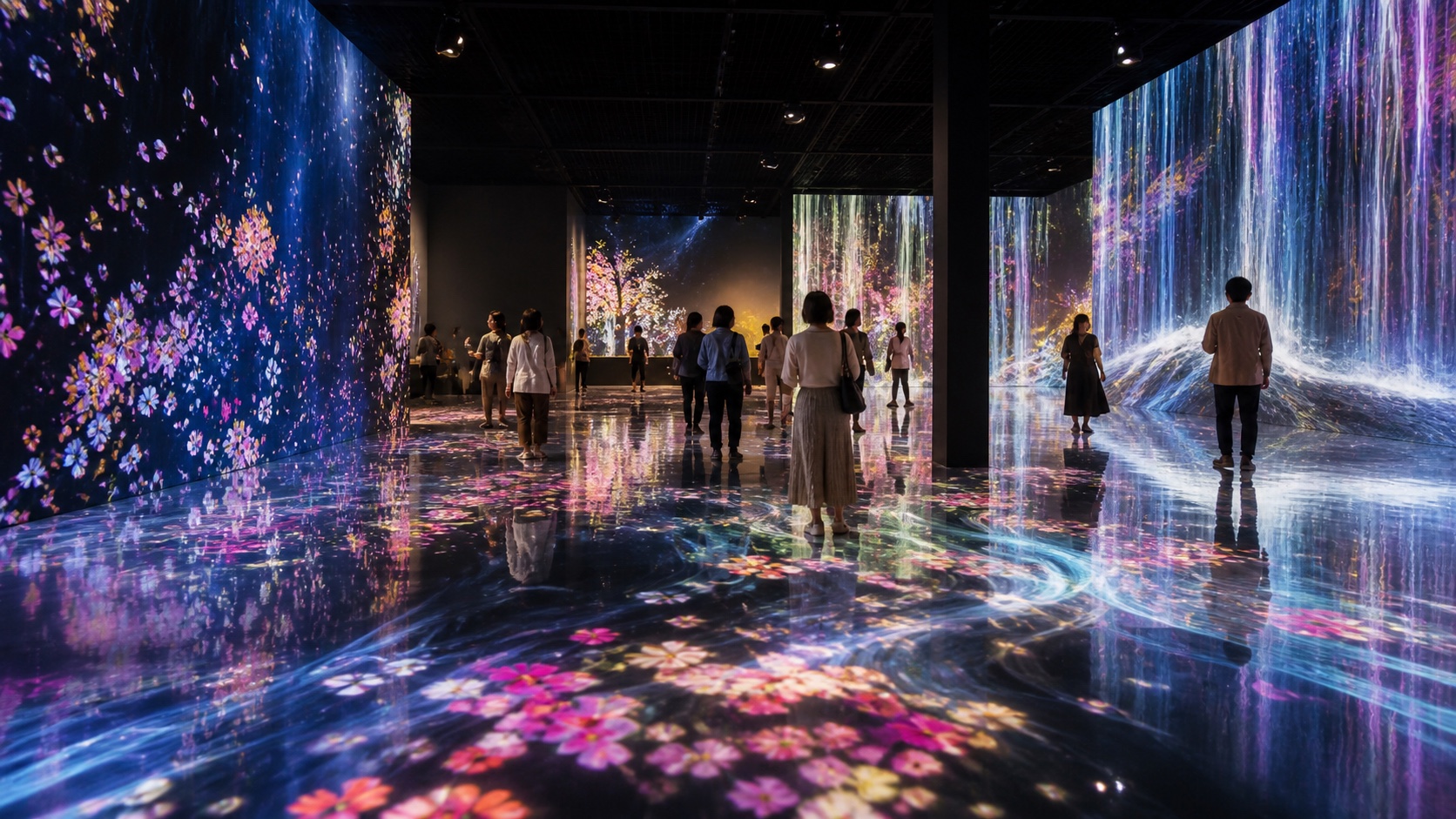
Buy a dated admission ticket from an authorized channel, choose a time that leaves a generous arrival margin, and plan the museum as the main activity in one part of the day. teamLab Borderless is an exploratory digital-art environment rather than a fixed one-way gallery, so the group should agree on supervision and a meeting method before entering. The official site warns of dark areas, uneven footing, low ceilings, flashing light, loud sound, aromas, and mirror floors.
The museum is in Azabudai Hills Garden Plaza B and the official access information points to Kamiyacho and Roppongi-Itchome stations. Tickets, prices, hours, closures, and visitor restrictions are dynamic. The official page is the final source on the travel date.
If you only do one thing: read the official visitor notices with every member of the group before buying a nonrefundable ticket.
Who this planner is for
This guide is for first-time visitors, families, couples, photographers, travelers with sensory or mobility needs, and anyone choosing between teamLab Borderless and other Tokyo attractions. It helps place the museum in a realistic day without promising a fixed list of artworks or a fixed visit length.
The museum's artworks move and change, and some experiences may be unavailable because of crowds, maintenance, season, or safety. Do not use a social-media clip as a map or guarantee.
| Visitor | Main planning need | Official check |
|---|---|---|
| First-time adult | Time margin and exploratory pace | Ticket, hours, final entry, and closure |
| Family with children | Continuous supervision in dark spaces | Child ticket and adult accompaniment rules |
| Sensory-sensitive visitor | Light, sound, aroma, crowd, and exit plan | Current visitor notices and staff support |
| Wheelchair user | Lift access and artwork limitations | Official accessibility details and direct inquiry |
Buy the correct ticket from an authorized channel
The official site currently describes date- and time-specific admission, dynamic adult pricing, limited availability, and specific rules for changes. It also identifies authorized sales channels. Do not copy a price from this guide because the amount and ticket products can change by date and promotion.
Read cancellation and change terms before payment. A ticket bought through a third party follows that seller's conditions, not automatically the official site's modification process. Keep the ticket code offline and check whether every member needs an individual ticket or age document.
A flexible ticket can reduce timing pressure only when it is an official current product and its terms fit the day. It does not remove final-entry or closure rules.
Choose an arrival time that protects the visit
Do not book immediately after an airport arrival, intercity train, hotel change, or timed meal. Add time for station navigation, the Azabudai Hills complex, toilets, ticket loading, and the entry queue. The official site asks visitors to arrive for the admission time and notes that a wait may still occur during busy periods.
Morning can protect the rest of the day, while late afternoon can connect naturally to dinner. The best choice is the one with a low-risk journey and no hard reservation immediately after. The museum does not promise a fixed duration, so avoid a schedule that requires leaving before the group has found its rhythm.
Check the exact station exit and underground route. A district pin is not the entrance.
Understand the Borderless format before entering
The official page explains that artworks move across rooms and that the teamLab app can provide concepts for nearby works and participation in selected experiences. This means the visit is not a checklist with numbered galleries. The group may see different sequences and may unintentionally separate.
Agree that children remain with an adult and that adults do not walk backward while filming. Choose a meeting method that does not depend on perfect mobile reception. If someone needs to leave, ask staff for assistance; the official notice says re-entry is not permitted.
Look before stepping into a dark or reflective space. The image is interactive, but the floor, visitors, and safety instructions remain physical.
Plan for children without overpromising
The official visitor information requires young children to be accompanied and sets an adult-to-child supervision rule. Verify the current wording for your family. Dark rooms, moving projections, mirrors, loud sound, and crowds can be exciting for one child and overwhelming for another.
Explain that the art may be touched or entered only where the space invites it. Running, climbing, and blocking projections can create risk. Use simple clothing and secure shoes. The official site notes mirror floors and provides a wrap-skirt option, but travelers should read the current clothing guidance themselves.
Keep food, naps, and toilets outside the most fragile part of the schedule. The venue has its own rules on eating, drinking, seating, and the tea house.
Plan for sensory and mobility needs
The official site warns of flashing lights, loud sounds, aromas, darkness, unstable footing, and low ceilings. A person with migraines, epilepsy risk, balance concerns, anxiety in crowds, pregnancy-related limitations, or sensory sensitivity should read the current notices and seek medical or venue advice where appropriate.
Wheelchair and stretcher access is described, but the official page also says some artworks may not be passable and that capacity or safety restrictions can apply. Contact the venue with the exact mobility device and support need rather than assuming general elevator access covers every artwork.
Build permission to skip a room or shorten the visit. A complete experience is not measured by entering every space.
| Potential issue | Plan before arrival | Action inside |
|---|---|---|
| Flashing light or loud sound | Read notices and decide personal limits | Ask staff and leave the space early |
| Dark or uneven flooring | Wear stable footwear and keep hands free | Slow down and watch the physical floor |
| Child separation | Assign one adult and meeting rule | Maintain visual contact |
| Mobility limitation | Contact the venue about exact access | Follow staff routing and artwork restrictions |
Pair the museum with one nearby activity
Use Azabudai Hills, Toranomon, Roppongi, or another nearby central-Tokyo stop rather than crossing the city for a second headline attraction. A calm meal, short architecture walk, or verified observation point fits better than another long timed experience.
For an evening ticket, eat an early meal or reserve dinner with enough uncertainty after the visit. For a morning ticket, leave the afternoon flexible until the group knows its energy. Travelers sensitive to immersive media may prefer a quiet park, cafe, or hotel break next.
Do not combine teamLab Borderless and teamLab Planets as if they were adjacent versions of the same stop. They are separate venues in different areas with separate tickets and experiences.
Use the app and camera without losing the visit
The official teamLab app can add context and participation, but download it and charge the phone before arrival. Bring a small power bank if the day's rules permit, keep brightness considerate, and do not stop in a route while reading. The app is a supplement, not a substitute for staff instructions.
Photography can be part of the experience, but read the current camera, flash, tripod, selfie-stick, and commercial-use rules. Hold equipment securely and remain aware of other people. Do not create a long private photo session in a shared interactive space.
Include the group in decisions about photographs. Dark reflective environments can reveal clothing or people in ways they did not expect.
Common mistakes and better fixes
| Common mistake | Better action |
|---|---|
| Using an old price or ticket rule | Read the official ticket page before payment. |
| Booking after a fragile transport connection | Add a generous station and entry margin. |
| Letting children explore separately | Assign continuous adult supervision. |
| Assuming every room is accessible to everyone | Read limitations and contact the venue. |
| Scheduling another timed attraction immediately after | Keep the following block flexible. |
What to verify on the official site
Verify the date, ticket type, authorized seller, price, change and refund terms, hours, closure, final entry, child rules, accessibility, sensory notices, clothing, photography, bags, food, re-entry, app, artwork availability, and route to the entrance. Check again shortly before the visit.
Only the venue can confirm support for a specific disability, medical concern, mobility device, group size, or temporary artwork restriction.
Related tools and next steps
- Trip Planner — protect the timed entry and flexible exit.
- Budget Calculator — use the current ticket price for the exact date.
- Tokyo museum rainy-day planner — compare a conventional museum cluster.
- Tokyo region guide — keep the day geographically coherent.
Official sources
- teamLab Borderless: official venue, tickets, access, and visitor notices (checked 2026-08-30)
- Azabudai Hills: official complex information (checked 2026-08-30)
Plan your next step
FAQ
Do I need an advance ticket for teamLab Borderless Tokyo?
Use the official site to check current dated-entry requirements and availability. Tickets can sell out, and prices and products vary.
How long should I allow for teamLab Borderless?
There is no single guaranteed duration because the visit is exploratory. Protect a half-day block and avoid a hard reservation immediately after.
Is teamLab Borderless suitable for young children?
Many families visit, but adults must supervise continuously. Read current rules for accompaniment, darkness, sound, mirrors, and safety.
Is teamLab Borderless wheelchair accessible?
The official site describes wheelchair access but also notes that some artworks may not be passable. Contact the venue for the exact device and support need.
Can I leave and re-enter teamLab Borderless?
The official visitor notice says re-entry is not permitted. Verify the current rule and use toilets, food, and medication planning accordingly.
Is teamLab Borderless the same as teamLab Planets?
No. They are separate Tokyo venues in different areas with separate tickets, access, artwork, and visitor rules.