
Japan 21 Day Itinerary: Three-Week Route With Tokyo, Kyoto, Osaka, Hiroshima, and Kyushu
A practical 21 day Japan itinerary for travelers who want a three-week route with realistic hotel bases, rail planning, luggage moves, costs, official checks, and alternatives.
At a glance
- Best for
- First-time
- Main decision
- Which bases and transfer days make the route realistic
- Time needed
- 30-45 minutes to compare route options
- Official checks
- Opening hours, transport schedules, weather, reservations
- Related tool
- Budget Calculator
Before booking anything, write the route as hotel nights: Tokyo five, Kyoto four, Osaka three, Hiroshima or Miyajima two, Fukuoka or northern Kyushu four, and two flexible nights for arrival, departure, weather, or one optional stay. If your draft has eight or more hotel bases, cut it before you pay.
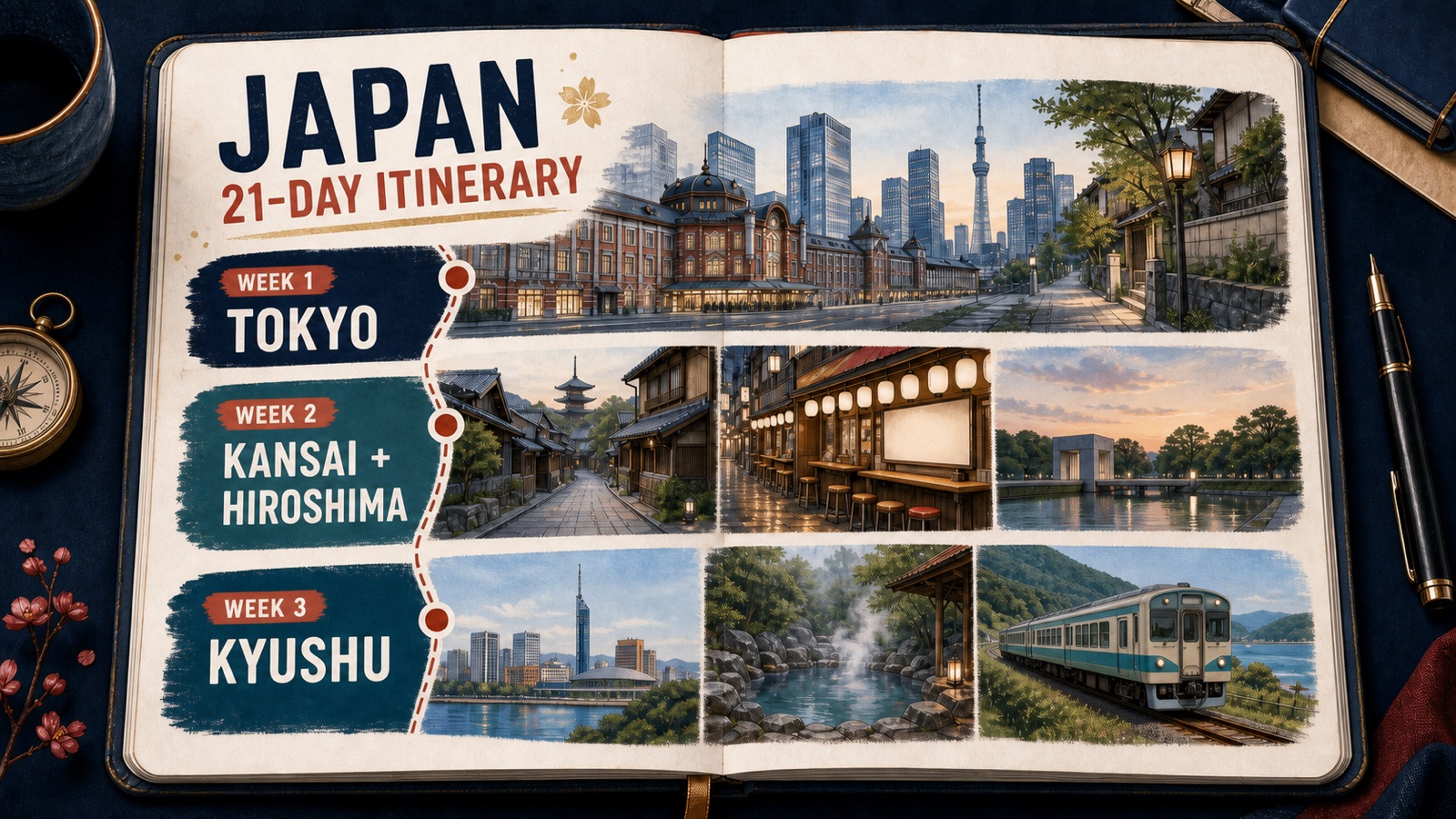
Quick answer: the best 21 day Japan route to start from
A strong 21 day Japan itinerary should feel like a real three-week trip, not a 14 day route with extra errands attached. For most first-time or first-plus-one travelers, start with five nights in Tokyo, four nights in Kyoto, three nights in Osaka, two nights in Hiroshima or Miyajima, four nights based around Fukuoka and northern Kyushu, and two flexible nights for arrival, departure, weather, or one optional rural stay. If your flights allow it, arrive in Tokyo and leave from Fukuoka, Osaka, or another western airport so the trip does not end with a long backtrack.
This page answers a specific search problem: how to use three weeks in Japan without adding so many cities that the extra time disappears into checkouts, station transfers, luggage, and late meals. The route below uses official tourism and transport sources checked on 2026-07-13. It does not pretend that train times, pass value, ferry operations, attraction hours, weather, or crowd controls are fixed. Use it as a booking framework, then verify current details on the linked official pages before paying.
The main decision is whether the third week should deepen western Japan or add a distant region such as Hokkaido or Okinawa. For most travelers, western Japan is the cleaner first answer because Tokyo, Kyoto, Osaka, Hiroshima, Miyajima, Fukuoka, and northern Kyushu sit on a logical rail spine. Hokkaido, Okinawa, and deep alpine routes are excellent, but they usually need a redesigned trip with flights, weather planning, and fewer classic-city days.
| Best for | Route shape | Main tradeoff |
|---|---|---|
| First-time three-week travelers | Tokyo, Kyoto, Osaka, Hiroshima, Miyajima, Fukuoka, northern Kyushu | Very broad coverage while keeping a clear westbound route |
| Slower couples or families | Tokyo, Kyoto, Osaka, Hiroshima, Fukuoka, with fewer day trips | Less variety, better recovery time, simpler luggage days |
| Food-focused travelers | Tokyo, Kyoto, Osaka, Hiroshima, Fukuoka, Dazaifu, Nagasaki or Kumamoto | Strong city food route, less mountain scenery |
| Second-time travelers | Tokyo, Kansai, Setouchi, Kyushu, plus one rural or onsen block | More regional depth, but official transport checks matter more |
Who should use this three-week itinerary
Use this itinerary if you have about 20 hotel nights and want a route that still feels readable when you put it on a map. It is especially useful for travelers who want Tokyo and Kansai, but also want enough time for Hiroshima, Miyajima, Fukuoka, and a taste of Kyushu without turning every morning into a train ride. It works for couples, solo travelers, friends, and families with older children who can manage several rail days.
It is also a good framework if you are deciding whether a 21 day Japan trip should buy a national rail pass, use point-to-point tickets, or combine long-distance tickets with local transport. The answer depends on your exact legs and current pass rules, so this page explains the calculation rather than giving a permanent yes or no.
Do not use this exact route if your main goal is skiing, Okinawa beaches, a Hokkaido self-drive route, Kumano Kodo, a luxury ryokan trip, or theme parks every few days. Those are valid three-week trips, but they need a different structure. The biggest three-week mistake is assuming more days automatically means more regions. A good 21 day itinerary gives each region enough time to justify the transfer.
The 21 day route table
This table assumes a Tokyo arrival and a westbound trip. If your flights are round trip from Tokyo, move the Kyushu block earlier or use the final two days to return to Tokyo with a protected buffer. If your flight leaves from Kansai or Fukuoka, the route becomes easier because you can keep moving west.
The table is built around sleep bases instead of a minute-by-minute sightseeing list. A three-week itinerary needs to settle nights, transfers, luggage, and recovery before it chooses every cafe or shrine.
| Day | Sleep base | Main plan | Official check before booking |
|---|---|---|---|
| 1 | Tokyo | Arrive, reach the hotel, eat nearby, and avoid a major plan after the flight | Airport access, hotel check-in, payment and IC card setup |
| 2 | Tokyo | East-side Tokyo such as Asakusa, Ueno, Tokyo Station, Ginza, or a museum day | GO TOKYO area access and opening days |
| 3 | Tokyo | West-side Tokyo such as Shibuya, Harajuku, Meiji Jingu, Shinjuku, or a garden | Weather, timed tickets, and late return route |
| 4 | Tokyo | Flexible Tokyo day, Kamakura, Nikko, Disney, shopping, or recovery | Operator tickets, weather, and return transport |
| 5 | Tokyo or Hakone/Fuji area | Optional onsen or Fuji-view night only if luggage and weather make sense | Access status, hotel dinner time, luggage forwarding |
| 6 | Kyoto | Move to Kyoto by Shinkansen and keep the afternoon simple | JR Central or Smart EX, seat reservation, luggage plan |
| 7 | Kyoto | Higashiyama, Kiyomizu area, Gion manners, and a lighter afternoon | Kyoto responsible-travel guidance and crowd notes |
| 8 | Kyoto | Arashiyama, northern Kyoto, craft areas, or a garden route | Kyoto transport, opening days, and weather |
| 9 | Kyoto | Nara or Uji day trip, returning to Kyoto for dinner | Nara visitor guidance, temple hours, local transport |
| 10 | Osaka | Move to Osaka, use Namba, Umeda, Dotonbori, or a food-focused evening | OSAKA-INFO, hotel station access, luggage storage |
| 11 | Osaka | Choose one serious day: Himeji, USJ, Osaka neighborhoods, or shopping | Operator tickets, rail timing, and return route |
| 12 | Osaka | Second Kansai day for missed Kyoto, Kobe, Nara, food, or recovery | Weather and whether the route duplicates Day 11 |
| 13 | Hiroshima | Shinkansen west, Peace Memorial Park or museum at a respectful pace | JR notices and Hiroshima official information |
| 14 | Hiroshima or Miyajima | Miyajima day with ferry timing, tide awareness, and a slow return | Miyajima access and ferry operations |
| 15 | Fukuoka | Move to Fukuoka, settle near Hakata or Tenjin, and keep the evening food-first | Fukuoka access, hotel base, yatai/weather rules |
| 16 | Fukuoka | Dazaifu, Itoshima, Yanagawa, Kitakyushu, or a city food day | Official destination and local transport pages |
| 17 | Fukuoka or Nagasaki/Kumamoto | Choose one Kyushu extension instead of chasing the whole island | Rail, bus, or car route and hotel return timing |
| 18 | Fukuoka or onsen base | Onsen, slower food day, or second Kyushu day if transport is stable | Accommodation access, luggage forwarding, weather |
| 19 | Departure region | Return toward Kansai or Tokyo only if flights require it, or stay west if departing there | Shinkansen reservation, airport route, flight timing |
| 20 | Final base | Packing, shopping, missed items, or a quiet neighborhood day | Hotel luggage rules, airport transfer, tax-free packing |
| 21 | Airport | Depart with a light plan and no fragile long-distance transfer | Airport access, flight time, baggage rules |
Key decision table before booking hotels
Three weeks gives you freedom, but the wrong early decision can make the route harder than a shorter trip. Decide these points before booking hotels or rail passes. They control how many hotel moves you can enjoy, whether a pass makes sense, and whether the trip ends cleanly.
The biggest choice is the departure airport. A westbound open-jaw route can save a long return to Tokyo. If round-trip Tokyo flights are much cheaper or already booked, keep the final return simple and do not attach a tight same-day international flight to a long rail transfer.
| Decision | Choose this if | Avoid this if |
|---|---|---|
| Open-jaw departure from Kansai or Fukuoka | The fare and schedule are reasonable and the route ends in western Japan | The layover is poor or round-trip Tokyo saves enough to justify a return day |
| Add Hakone or Fuji overnight | You want an onsen pause and can forward or minimize luggage | Weather is poor, the group dislikes hotel changes, or the route is already transfer-heavy |
| Use Fukuoka as the Kyushu base | You want food, easy rail access, and a simple first Kyushu stop | Your real goal is southern Kyushu, an island route, or a car-based onsen trip |
| Include Hiroshima and Miyajima | You can give the area two days and want a meaningful western stop | You only want fast city food travel and do not have emotional space for the memorial day |
| Buy a national rail pass | Your verified eligible JR legs inside the pass window beat point-to-point tickets and rules fit your trains | The route is mostly Tokyo/Kansai/local travel or you need flexibility the pass does not give |
Hotel-base plan for a three-week trip
For Tokyo, do not split hotels unless the second base solves a real problem. Shinjuku or Shibuya can be useful for west-side energy and some day trips. Ueno, Asakusa, Tokyo Station, Ginza, and Shinagawa can be better when airport access, Shinkansen movement, or calmer evenings matter. The best Tokyo base is not the most famous one; it is the one your tired group can return to easily after dinner.
For Kyoto, choose between Kyoto Station, downtown, and the Gion or Higashiyama edge. Kyoto Station is practical for arrival, luggage, and day trips. Downtown is often easier for food and evening movement. Gion and Higashiyama can feel special, but require more care around private lanes, residential streets, bus crowding, and visitor manners. Kyoto's official responsible-travel guidance should shape the route, not just the etiquette paragraph.
For Osaka, Namba is usually stronger for food, nightlife, and Dotonbori evenings, while Umeda and Osaka Station are stronger for rail links, shopping, and some onward travel. Shin-Osaka is practical for early Shinkansen departures but weaker as an evening base for many visitors. For a three-week trip, the right Osaka base is the one that reduces friction before Hiroshima and Kyushu.
For Hiroshima and Fukuoka, use station access as the first filter. Hiroshima Station simplifies Shinkansen arrival, while the Peace Memorial Park area can make the city day calmer. In Fukuoka, Hakata is the rail hub and Tenjin is often more evening-oriented. Pick one by the route you will actually use on Days 15 to 18.
| Base | Usually works best when | Watch out for |
|---|---|---|
| Tokyo | Airport access, first learning days, shopping, museums, neighborhoods | Too many cross-city days from the wrong side of town |
| Kyoto | Temple mornings, Nara or Uji, slower cultural days | Bus crowding, private lanes, and hotel areas that look close only on a map |
| Osaka | Food nights, Namba or Umeda, Kansai day trips, onward Shinkansen | Changing hotels without gaining evening or rail value |
| Hiroshima | Peace Park, Miyajima, and a meaningful western pause | Rushing both Hiroshima and Miyajima into one leftover day |
| Fukuoka | Kyushu gateway, food, Hakata rail links, airport convenience | Trying to see all of Kyushu from one city without enough time |
Step-by-step booking order
Step 1: lock the flight pattern. If possible, arrive Tokyo and depart Kansai, Fukuoka, or another western airport. If that is not possible, protect the final return to Tokyo as a real travel day. Step 2: write the trip as hotel nights, not attractions. A first draft can be Tokyo five nights, Kyoto four nights, Osaka three nights, Hiroshima two nights, Fukuoka or northern Kyushu four nights, and two flexible nights.
Step 3: price the long rail legs before buying any pass. The key legs are Tokyo to Kyoto or Shin-Osaka, Kansai to Hiroshima, Hiroshima to Fukuoka, and any return toward Tokyo or Kansai. Step 4: decide the luggage strategy. Use forwarding when a transfer day also includes Hakone, crowded stations, shopping, or a rural stop. Step 5: attach fixed tickets only after the route is stable.
Step 6: place weather-sensitive and crowd-sensitive days with backups. Kyoto, Miyajima, outdoor viewpoints, theme parks, and Kyushu day trips need flexibility. Step 7: check official pages again shortly before travel. JR Central peak-period Nozomi notices, Shinkansen reservation rules, ferry operations, attraction calendars, and hotel luggage acceptance can change after you build the first draft.
Rail, pass, and luggage plan
Japan's rail network makes a 21 day westbound itinerary realistic, but the pass decision should be calculated from current rules. JNTO's Shinkansen guidance notes that Nozomi, Hikari, and Kodama serve the Tokaido-Sanyo corridor differently, and that Nozomi is the quickest pattern toward Kansai and beyond. JR Central's 2026 peak-period notice says Nozomi trains operate as reserved-seat-only during the stated crowded periods, so reservations and pass rules are not minor details.
For many three-week travelers, the choice is not simply 21 day pass or no pass. You may compare a national pass, a shorter national pass window, point-to-point Shinkansen tickets, regional passes, domestic flights, and local IC card use. A pass only helps when the eligible rides, dates, train types, and pickup or reservation rules match the route. If your route is mostly city stays with one or two major rail days, individual tickets may be cleaner.
Luggage matters more on a 21 day itinerary than on a shorter trip because shopping, laundry, medicine, souvenirs, and weather gear grow over time. JNTO's luggage guidance describes hands-free travel and station storage as practical options, but you still need to check hotel acceptance, cutoff times, size and weight limits, valuables, and what must stay with you. Keep one overnight kit with medicine, documents, chargers, and clothes whenever bags are forwarded.
| Rail or luggage decision | Check this | Planning action |
|---|---|---|
| National JR Pass | Current price, eligible trains, Nozomi and Mizuho rules, reservation process | Compare against exact long-distance legs before buying |
| Point-to-point tickets | Route dates, seat availability, luggage size, pickup or app rules | Use when flexibility or Nozomi-heavy travel matters more than pass coverage |
| Regional passes | Whether a shorter Kyushu or western Japan block has enough eligible travel | Compare after the main route is fixed, not before |
| Luggage forwarding | Hotel acceptance, cutoff time, destination address, size, weight, and valuables | Use for Hakone, Kyoto arrival, Hiroshima move, and shopping-heavy days |
| Peak periods | JR Central and other operator notices for crowded holiday windows | Reserve earlier and avoid putting long rail before fixed tickets or flights |
Cost-pressure table for 21 days
This page does not give a fixed three-week trip price because exchange rates, hotel seasons, pass rules, rail fares, attraction tickets, and flight patterns change. Instead, use the cost-pressure table to find the categories that usually decide whether the route is comfortable or overbuilt.
Hotels and long-distance travel normally create the largest swings. A three-week trip also makes small daily costs more visible: lockers, local transit, snacks, laundry, luggage forwarding, taxis after tired evenings, and extra bags. A route with fewer hotel bases can cost less in both money and energy even when one hotel looks more expensive per night.
| Cost area | Why it changes the budget | How to control it |
|---|---|---|
| Hotels | Three weeks crosses weekdays, weekends, events, room-size needs, and possible laundry requirements | Book by route value and station access, not nightly price alone |
| Long-distance rail | Tokyo, Kansai, Hiroshima, Fukuoka, and return legs can be major costs | Calculate exact legs before choosing a pass |
| Local transport | Poor hotel placement multiplies subway, bus, taxi, and airport costs | Choose bases that match the daily routes |
| Food | Daily food can stay flexible, but Fukuoka, Osaka, markets, theme parks, and tired late dinners change spending | Plan easy meals near hotels on transfer days |
| Activities | Theme parks, museums, views, guided experiences, ryokan nights, and day trips add up | Limit heavy paid anchors to days with light logistics |
| Luggage and shopping | Forwarding, lockers, extra bags, tax-free packing, and final-day transfers affect both cost and timing | Reserve shopping for stable bases and keep a packing buffer |
Better alternatives for specific travelers
If you are traveling with small children, remove the optional Hakone or Fuji night and reduce the Kyushu extension to Fukuoka plus one easy day trip. Use Tokyo, Kyoto, Osaka, Hiroshima, and Fukuoka as strong bases rather than moving every two nights. The trip will look less ambitious but will feel more like a holiday.
If you are traveling in winter, decide whether snow is the point. If it is, build a Hokkaido or Tohoku trip from the beginning instead of adding one snowy side trip to this western route. If snow is not the point, the Tokyo-Kansai-Hiroshima-Fukuoka spine can still work, with more indoor swaps and fewer rural late returns.
If you are food-focused, keep Osaka and Fukuoka strong. Give Osaka enough evenings for Namba, Umeda, and casual food, and give Fukuoka time for Hakata, Tenjin, yatai decisions, ramen, and one day trip. Do not turn every meal into a reservation. Three weeks is long enough to mix markets, station food, department-store basements, izakaya, and simple convenience-store breakfasts.
If this is your second trip, consider replacing one classic block with Setouchi, Kanazawa, Takayama, southern Kyushu, or Shikoku. Make that replacement honestly. Do not keep every first-trip city and then squeeze the new region into one rushed night.
| Traveler type | Better version | What to cut first |
|---|---|---|
| Families | Fewer hotel bases, more same-base day trips, clear laundry blocks | Optional Hakone/Fuji or a second Kyushu city |
| Food travelers | More Osaka and Fukuoka evenings, fewer temple-heavy days | One outdoor day trip and one minor city transfer |
| Winter travelers | Western city route with indoor backups, or a redesigned northern route | Casual Hokkaido add-on without enough days |
| Second-time visitors | Replace one classic block with Setouchi, Chubu, or deeper Kyushu | Duplicate Tokyo or Kyoto days that do not add new value |
| Mobility-limited travelers | Fewer bases and hotels near usable stations | Bus-heavy Kyoto days and tight ferry or rural returns |
Common mistakes to avoid
The first mistake is counting 21 calendar days as 21 full sightseeing days. Arrival, departure, laundry, weather, luggage forwarding, seat reservations, shopping, and recovery all take time. Three weeks gives you room to make the trip better, not permission to ignore every constraint.
The second mistake is adding Hokkaido, Okinawa, Kyushu, Hiroshima, the Japanese Alps, and every classic city in one route. Japan's map can make this look possible. The lived trip is different: airports, bags, station exits, hotel check-ins, meals, and weather all have friction.
The third mistake is buying a 21 day rail pass because the trip lasts 21 days. The pass window and the trip length are not the same decision. Price the exact eligible rides. Check Nozomi and Mizuho rules, peak-period reservations, local non-JR transport, and whether flying or an open-jaw ticket removes a long return leg.
The fourth mistake is treating Kyoto as a checklist. Kyoto's official responsible-travel guidance asks visitors to respect local life, cultural areas, and future preservation. Build early starts, smaller area clusters, and backup afternoons instead of pushing through residential lanes and crowded buses all day.
The fifth mistake is rushing Hiroshima and Miyajima. Hiroshima deserves respectful pacing, and Miyajima works better when ferry timing, walking, meals, tide awareness, and return transport are not squeezed into leftover hours.
Official verification checklist before you pay
Use this checklist after drafting the route and before paying for flights, hotels, passes, timed tickets, or non-refundable activities. The official sources below were checked on 2026-07-13. Recheck them close to travel because weather, maintenance, reservation rules, ferry operations, event calendars, and transport notices can change.
Start with JNTO planning and getting-around pages, then check JR Central or Smart EX for the Tokaido-Sanyo Shinkansen, JR and operator pages for the western and Kyushu legs, Kyoto responsible-travel pages for etiquette and crowd-sensitive areas, OSAKA-INFO for Osaka planning, Nara official guidance for a Nara day, Hiroshima and Miyajima official pages for the memorial and island block, and Fukuoka or Kyushu official pages before choosing the Kyushu extension.
Save travel-day pages before departure: first hotel address, airport route, Shinkansen reservations, luggage forwarding receipt, Kyoto transport or manners page, Hiroshima hotel access, Miyajima ferry information, Fukuoka base notes, final airport route, and weather or safety alerts.
- Check latest weather, heat, typhoon, snow, or earthquake guidance before outdoor-heavy days.
- Check Shinkansen notices before Tokyo-Kansai-Hiroshima-Fukuoka long-distance moves.
- Check attraction opening days and ticket rules before fixing any day around one paid activity.
- Check hotel luggage storage and forwarding acceptance before bags-free sightseeing.
- Check Kyoto responsible-travel guidance before adding Gion, Higashiyama, or private-lane walks.
- Check Miyajima ferry and access pages before relying on a late return.
- Check Fukuoka and Kyushu transport before choosing Nagasaki, Kumamoto, Beppu, or another extension.
If you only do one thing
Before booking anything, write the route as hotel nights: Tokyo five, Kyoto four, Osaka three, Hiroshima or Miyajima two, Fukuoka or northern Kyushu four, and two flexible nights for arrival, departure, weather, or one optional stay. If your draft has eight or more hotel bases, cut it before you pay.
Then run one stress test: what happens if it rains, a Shinkansen reservation is unavailable, a locker is full, one traveler gets tired, or forwarded luggage arrives later than expected? If the answer is that the whole day collapses, simplify the transfer, move the timed ticket, or remove the optional region. A good 21 day Japan itinerary should still work when one assumption fails.
Related tools and next steps
Use the Japan Trip Planner to convert the route into nights and bases, the Budget Calculator to test hotel and rail pressure, the JR Pass Calculator before buying any pass, the Airport Transfer Finder for the first and last days, and the Luggage Planner before adding Hakone, Hiroshima, Miyajima, or a shopping-heavy transfer.
For reading order, compare the 14 day, 10 day, and 7 day itinerary pages if you are unsure whether three weeks is necessary. Then read the JR Pass value guide, the Shinkansen seat reservation basics, the luggage forwarding guide, and the Tokyo and Kyoto hotel-area pages before booking rooms.
Use next on Japan Trip Tools
- Japan 14 Day Itinerary — compare the shorter classic route before committing to three weeks
- Japan 10 Day Itinerary — use when the trip needs fewer bases and less rail
- Is the JR Pass Worth It? — calculate pass value from actual long-distance legs
- Japan Shinkansen Seat Reservation Basics — check seat and luggage decisions before rail days
- Luggage Forwarding and Hotel Transfer Plan — make hotel changes easier on a long route
- Where to Stay in Tokyo First Time — choose the first base by airport and daily route
- Where to Stay in Kyoto First Time — choose between station access, downtown, and Higashiyama
- Fukuoka Food and Day Trip Base Guide — plan the Kyushu gateway days
Sources and image licensing
- Japan National Tourism Organization: Japan Travel Planning
- Japan National Tourism Organization: Transportation in Japan
- Japan National Tourism Organization: Shinkansen
- Japan National Tourism Organization: Luggage and Storage
- JR Central: Official English Service Information
- JR Central: 2026 Tokaido and Sanyo Shinkansen Nozomi Peak-Period Notice
- JR Central: Tokaido and Sanyo Shinkansen Luggage Information
- GO TOKYO: Official Tokyo Travel Guide
- Kyoto City Official Travel Guide: Responsible Travel
- OSAKA-INFO Official Tourism Guide
- Official Nara Travel Guide: For First-Time Visitors
- Japan National Tourism Organization: Hiroshima
- Japan National Tourism Organization: Miyajima
- Japan National Tourism Organization: Fukuoka
- Japan National Tourism Organization: Kyushu
Plan your next step
FAQ
Is 21 days too long for a first trip to Japan?
No. Twenty-one days is not too long if you use the extra time for better pacing, regional depth, and recovery instead of adding every possible region. A strong first three-week route can cover Tokyo, Kyoto, Osaka, Hiroshima, Miyajima, Fukuoka, and part of Kyushu comfortably.
What is the best 21 day Japan itinerary for first-time visitors?
A practical starting route is Tokyo, Kyoto, Osaka, Hiroshima and Miyajima, then Fukuoka and northern Kyushu, with one or two flexible nights. This keeps a clear westbound rail spine and avoids distant add-ons that require a different trip design.
Should I buy a 21 day JR Pass for Japan?
Do not buy it automatically. Compare the exact eligible JR legs, pass rules, Nozomi and Mizuho conditions, reservation needs, and whether an open-jaw flight removes a long return. Some three-week routes justify a pass window; many do better with point-to-point tickets or a shorter pass.
Can I include Hokkaido in a 21 day Japan itinerary?
Yes, but it becomes a different route. Hokkaido usually needs flights or a major rail commitment, seasonal weather planning, and a separate hotel-base logic. Include it when snow, summer scenery, or a northern road trip is the main reason, not as a casual side trip.
Is Fukuoka worth adding to a three-week Japan trip?
Yes, if you want a food-focused western endpoint and a gateway to northern Kyushu. Fukuoka is useful because Hakata connects to the Sanyo and Kyushu Shinkansen, the city is compact, and day trips can be added without redesigning the whole route.
How many hotel bases should a 21 day Japan trip have?
Most travelers should aim for five to seven bases, depending on pace and luggage. Tokyo, Kyoto, Osaka, Hiroshima, and Fukuoka are a strong backbone. Add optional rural or onsen nights only when they solve a real trip goal.
Should I depart from Tokyo, Osaka, or Fukuoka?
Depart from Kansai, Fukuoka, or another western airport if the fare and schedule are reasonable. It removes a long backtrack. If you must fly home from Tokyo, protect the final return as a travel day and avoid a fragile same-day international connection.
What should I cut first if the route feels too busy?
Cut the optional Hakone or Fuji night, one Kyushu side trip, or a duplicate Kansai day before shortening every major city. Do not rush Hiroshima and Miyajima into leftover hours if they are part of the reason for going west.