
Tokyo Stationery and Kitchenware Shopping Route
Build a focused Tokyo shopping day around Kappabashi kitchenware and Ginza stationery, with practical checks for knives, fragile goods, tax-free procedures, luggage, and opening hours.
At a glance
- Best for
- Rainy day
- Main decision
- Which spending range fits the route
- Time needed
- 15-30 minutes for a planning pass
- Official checks
- Opening hours, transport schedules, weather, reservations
- Related tool
- Japan Costs And Tips
write a short buy list with a size, material, and maximum price before entering the first store.
Quick answer
Use Kappabashi for specialist kitchenware and Ginza for stationery, design goods, department stores, and an easier end-of-day return. Treat them as two focused shopping blocks rather than a hunt across Tokyo. Start in Kappabashi while specialist shops are open, make one deliberate transfer, and finish in Ginza only if your budget, luggage, and energy still support it.
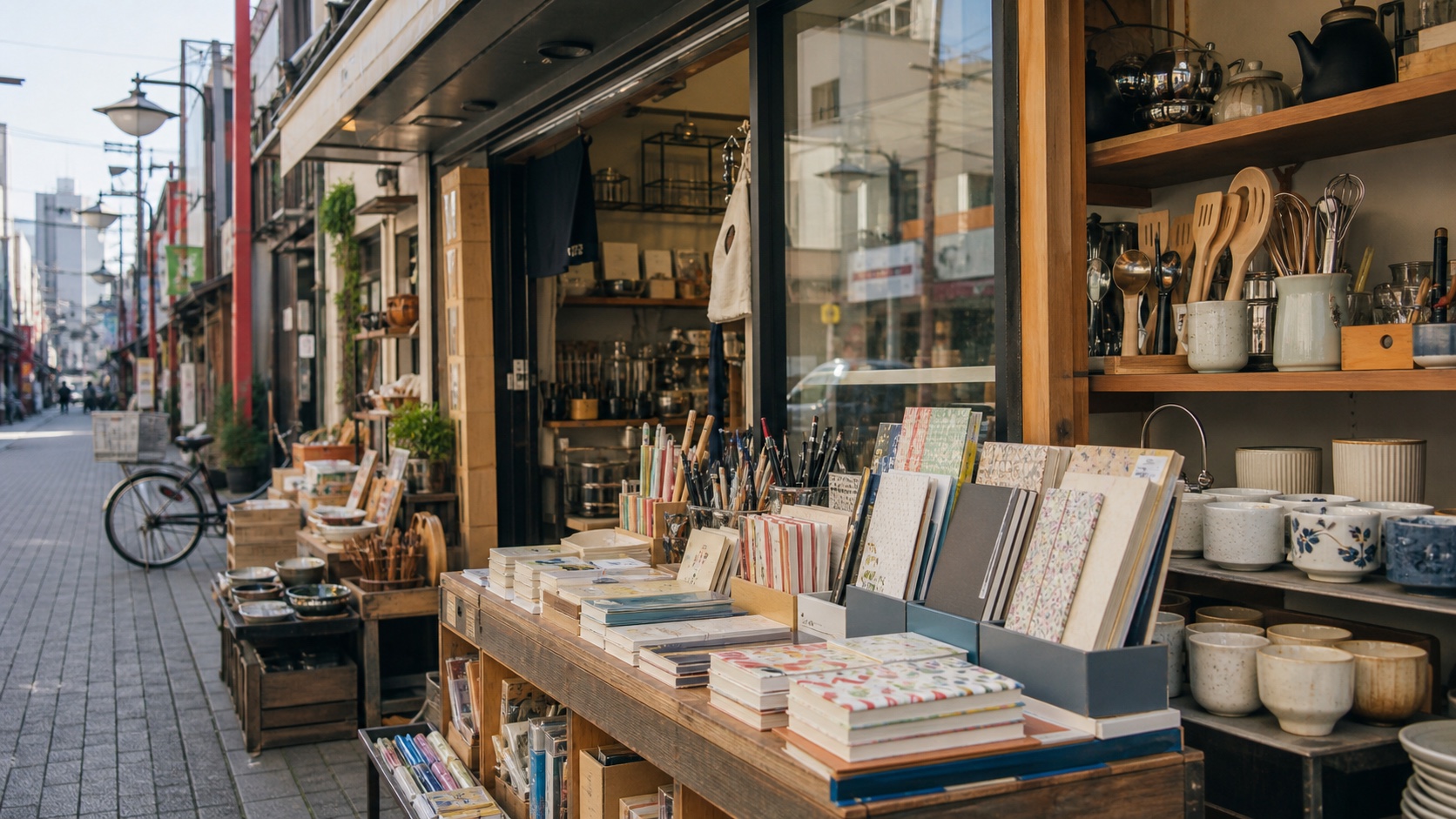
GO TOKYO describes Kappabashi as a kitchenware district of roughly 160 shops used by professionals and home cooks, with knives, ceramics, lacquerware, cooking tools, restaurant equipment, and food samples. Its current Ginza guide highlights long-established stationery shopping alongside department stores and design-focused retail. Individual stores control hours, stock, tax-free service, shipping, and knife sales.
If you only do one thing: write a short buy list with a size, material, and maximum price before entering the first store.
Who this route is for
This route is useful for cooks, designers, journal users, artists, gift buyers, and travelers who prefer functional souvenirs. It also works on a second or third Tokyo day when the group has already seen major sights. It is not ideal for a tight departure day, a visitor carrying large luggage, or a group whose members want unrelated fashion and character-goods districts.
The plan assumes ordinary retail shopping, not wholesale purchasing or professional export. A shop may sell to the public but still have limited English, limited tax-free handling, or no international shipping. Fragile ceramics and edged tools require more planning than notebooks or pens.
| Shopping goal | Best first area | Main check |
|---|---|---|
| Japanese knives and cooking tools | Kappabashi | Blade type, care, transport, and after-sales service |
| Ceramics and tableware | Kappabashi | Food safety, dimensions, weight, and packing |
| Pens, paper, journals, and design gifts | Ginza | Refills, paper size, ink rules, and stock |
| Mixed gifts with an easy dinner | Ginza only | Budget and department-store closing times |
Start in Kappabashi with a product sequence
GO TOKYO places Kappabashi within walking distance of Asakusa and identifies Tawaramachi Station as a convenient access point. The useful district extends along a main road and side streets, so a pin marked “Kappabashi” is not a single store. Save two or three candidate shops by product type and begin with the item that requires the most explanation.
For a knife, ask what the blade is designed to cut, whether it is single- or double-beveled, how to sharpen it, how to prevent corrosion, and whether the handle suits the dominant hand. For ceramics, record diameter, height, microwave and dishwasher guidance, and whether a replacement can be ordered. For restaurant tools, confirm voltage, gas compatibility, measurements, and home-use suitability before treating professional equipment as a souvenir.
Do not assume every shop follows the district's general hours. GO TOKYO tells visitors to check the facility or shop for updated opening and closing information. Many specialist businesses keep different weekly holidays, and a late-afternoon arrival can remove the best part of the district.
Use Ginza for stationery and a calmer finish
GO TOKYO's current Ginza Dori page highlights Itoya as a long-established stationery destination and describes Ginza as a district with department stores, galleries, food halls, and stores at several price levels. Use Ginza for pens, notebooks, paper, ink, desk tools, design objects, and gifts that are easier to compare in one building or short walking area.
Check whether a pen uses a proprietary refill, whether a notebook follows a familiar international size, and whether bottled ink can travel safely in checked luggage. Fountain-pen nibs and paper feel personal; a famous model is not automatically the right choice. Test only where the shop permits and ask staff before opening packaged stock.
Ginza can absorb an entire day, so set a finish rule. Once the planned products are bought, use a department-store food floor or dinner nearby instead of adding another remote shopping district. This keeps fragile purchases out of crowded evening trains.
Combine the two areas without wasting the day
A practical sequence is hotel storage, Kappabashi, lunch near Asakusa or Ueno, one transfer to Ginza, stationery shopping, then dinner or the hotel. The exact route depends on the first and last shop, not the district names. Use the station entrance that reduces walking with purchases, and avoid a route that changes trains only to save a few theoretical minutes.
Allow more time than a sightseeing map suggests. Comparing knives, requesting tax-free handling, wrapping ceramics, or arranging delivery can take longer than browsing. When the group separates, choose a meeting point outside the narrowest shop and agree on a fixed time.
| Time available | Recommended plan | Remove first |
|---|---|---|
| About 3 hours | One district and one product category | The cross-city transfer |
| Half day | Kappabashi plus nearby Asakusa, or Ginza alone | Unplanned department-store browsing |
| Full day | Kappabashi, one transfer, Ginza | A third shopping district |
| Departure day | Station-area shopping only | Knives and fragile ceramics |
Handle knives and fragile purchases as transport decisions
Do not carry a purchased knife in hand luggage. Ask the shop to protect the blade and package the item, then check the airline, airport-security, customs, and destination-country rules that apply to your journey. Keep the receipt and product information. A shop's willingness to sell an item does not prove that it can be imported at the destination.
For ceramics and glass, inspect the item before wrapping, photograph the maker or product label with permission, and keep small pieces separated. Ask whether the store offers domestic delivery to the hotel or international shipping, who bears loss or damage risk, and whether insurance is included. Do not place heavy cookware above fragile purchases in the suitcase.
Plan the shopping day before luggage forwarding. A suitcase already sent to the airport cannot carry a late knife or ceramic purchase. A foldable secondary bag helps only when airline limits and security rules still permit the contents.
Use tax-free shopping only when it fits the purchase
GO TOKYO notes that many stores offer tax-free shopping to eligible international visitors, but participation and procedure vary. Carry the original passport, confirm eligibility before payment, and let the store explain the current process. Do not assume a copy, photograph, or hotel-held passport will work.
Tax-free savings should not determine the product. Compare the final price, warranty, returns, repair access, shipping, and currency conversion. Consumables and general goods can be handled differently under current national rules, and Japan's tax-free system is changing. Use the National Tax Agency or Japan Tourism Agency and the individual store as the final sources.
Keep receipts and do not remove required packaging merely to save suitcase space. If the purchase is inexpensive, a simple taxable transaction may be faster and clearer.
Common mistakes and better fixes
| Common mistake | Better action |
|---|---|
| Visiting Kappabashi late without shop checks | Start with the specialist store and verify its own hours. |
| Buying a knife by appearance | Match blade, hand, care, sharpening, and transport. |
| Adding Akihabara, Shibuya, and Ginza | Keep the day to two compatible districts. |
| Assuming every shop is tax-free | Ask before payment and carry the original passport. |
| Packing fragile goods at the last minute | Plan wrapping, weight, and airline limits before buying. |
What to verify on official sources
Verify each shop's exact opening day, hours, stock, appointment requirement, payment, tax-free participation, engraving, shipping, return policy, and language support. For knives, verify airline, airport-security, customs, and import rules. For electric equipment, verify voltage, frequency, plug, warranty, and local certification.
Use GO TOKYO to understand the districts, then use the shop and public authority for the transaction. Recheck shortly before travel because retail tenants and opening patterns change.
Related tools and next steps
- Trip Planner — keep shopping in one geographic sequence.
- Budget Calculator — include shipping, baggage, and customs costs.
- Tax-free shopping and packing guide — verify the current procedure.
- Tokyo region guide — place the route beside your hotel and other plans.
Official sources
- GO TOKYO: Kappabashi Kitchenware Town (checked 2026-08-30)
- GO TOKYO: Ginza Dori (checked 2026-08-30)
- GO TOKYO: What to Buy (checked 2026-08-30)
- GO TOKYO: Shopping in Tokyo (checked 2026-08-30)
Plan your next step
FAQ
Can tourists buy Japanese kitchen knives in Kappabashi?
Many shops sell to the public, but stock, service, and rules vary. Ask about blade use and care, keep it packaged, and verify airline, security, customs, and import rules.
Can I visit Kappabashi and Ginza in one day?
Yes, when you start with specialist Kappabashi shops, make one deliberate transfer, and limit Ginza to a defined stationery or gift list.
Where should I shop for Japanese stationery in Tokyo?
Ginza is a convenient first choice for established stationery and design stores. Verify the individual store, product stock, and opening hours.
Is every Kappabashi shop tax-free?
No. Participation and eligibility vary. Ask before payment and carry the original passport if you intend to use tax-free shopping.
How should I pack Japanese ceramics?
Inspect before wrapping, separate pieces, protect rims and handles, keep heavy items below fragile ones, and consider insured shipping for valuable work.
Should I add Asakusa to the shopping route?
It can fit a half or full day because Kappabashi is nearby, but keep the specialist shopping block protected and remove Ginza if time becomes tight.