
Rural Japan Bus and Taxi Backup Plan
Plan rural Japan transport by the last usable bus, cash and IC-card acceptance, taxi availability, reservation rules, weather, and a safe fallback.
At a glance
- Best for
- Winter
- Main decision
- Which spending range fits the route
- Time needed
- 15-30 minutes for a planning pass
- Official checks
- Opening hours, transport schedules, weather, reservations
- Related tool
- Japan Costs And Tips
write the final return bus and the fallback that still works after it.
Quick answer
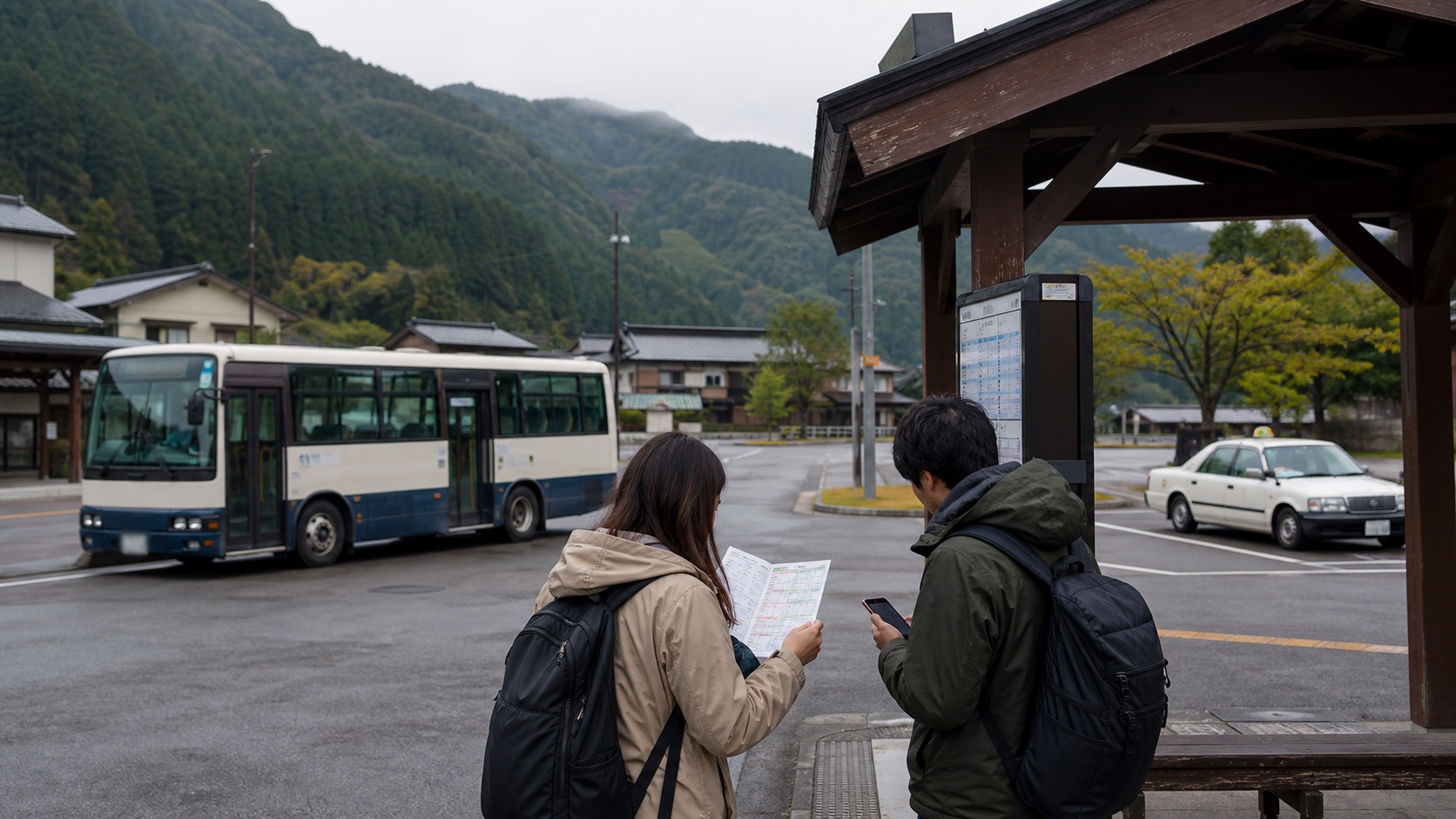
In rural Japan, plan the day around the last usable return, not the first arrival. Save the exact outbound and return timetable, identify whether the service needs a reservation, confirm the bus-stop direction, carry a payment backup, and decide what you will do if the connection is missed. A taxi is only a backup when a local company confirms availability, service area, and pickup method.
JNTO's current public-transport guide says rural services require more planning because trains and buses can be limited. It also notes that bus boarding and payment methods vary: some routes use numbered tickets and distance-based fares, while others use flat fares, and not all buses accept IC cards.
If you only do one thing: write the final return bus and the fallback that still works after it.
Who should use this guide
This guide is for travelers visiting mountain villages, national parks, trailheads, onsen towns, islands, coastal viewpoints, rural museums, and festival venues without a car. It is especially useful in Tohoku, Shikoku, Kyushu, Hokkaido, the Japanese Alps, and other regions where a destination can have several services in the morning but few late returns.
The method also helps families, travelers with luggage, and anyone connecting a rural bus to a reserved train. It is not a live timetable. The operator's official page, reservation system, and notices control the actual journey.
| Route type | Main risk | Minimum backup |
|---|---|---|
| Local route bus | Sparse service or different weekend timetable | Earlier return plus cash and stop photograph |
| Reserved highway bus | Sold-out seats or missed boarding point | Reservation record and rail/overnight alternative |
| Demand bus or shared taxi | Advance booking cutoff | Confirmed pickup and cancellation instructions |
| Ordinary taxi | No vehicle or service outside the local area | Prearranged company and price range |
Read the timetable as an operating document
Record the route name, operator, stop name, direction, day type, departure, arrival, reservation rule, and publication or update date. Japanese timetables commonly separate weekdays from weekends and holidays. Seasonal buses may operate only on selected dates, and a tourism page can outlive the service it once described.
Use the operator's official timetable for the final decision. A mapping app is useful for discovery, but it can misunderstand a temporary suspension, reservation-only segment, renamed stop, or seasonal calendar. Save the official page and a screenshot for offline reference, then recheck shortly before travel.
If two stops have similar names, compare the Japanese characters, platform map, and direction. Photograph the return stop when you arrive.
Understand boarding and payment before the bus arrives
JNTO describes two common local-bus patterns. A distance-based bus may board at the rear, issue a numbered ticket, display the fare by ticket number, and collect the exact fare at the front when you exit. A flat-fare bus may board and pay differently. IC-card tapping can also require both entry and exit.
Look for the IC symbol rather than assuming Suica or another nationwide card works. Carry small yen notes and coins. Exchange machines may change money but are not guaranteed to accept every denomination, and the fare box may not provide change in the way a shop register does.
On reserved buses, a digital ticket, paper ticket, or booking name may be required. Store the confirmation where it remains accessible without mobile data.
Build the connection backward
Start with the transport you cannot miss: the final bus, last train, reserved shinkansen, ferry, or hotel dinner. Add walking, restroom, ticket purchase, luggage, and weather time before the connection. In a small town, a ten-minute map walk can take longer with snow, rain, darkness, or an unsigned exit.
Use an earlier return when the rural leg feeds a high-cost reservation. If the only bus reaches the station minutes before a booked train, either move the train, shorten the visit, or stay locally. Timetable precision does not remove operational uncertainty.
A day trip is unsuitable when the return depends on a single late service and no viable taxi or room exists.
Make a taxi backup real
Do not treat a taxi icon on a map as a vehicle. Rural taxis may wait at a station only around train arrivals, finish early, serve a limited area, or prioritize reservations. Ride-hailing coverage varies. Ask a local operator or accommodation whether a taxi can be booked for the exact pickup, date, time, passenger count, luggage, and destination.
Save the company name and phone number in Japanese and international format, plus a Japanese written pickup address. Confirm whether payment is cash, card, or another method. For long rural journeys, ask for an estimated fare or fixed tourism-taxi option before relying on it.
A hotel shuttle is not a public taxi. Confirm reservation, pickup point, eligible guests, first and last run, and what happens after delay.
Use local tourism transport tools carefully
Official Tohoku tourism resources provide regional route searches, model tours, bus information, tourism taxis, and area passes. These are useful discovery layers because rural transport is spread across many operators. After choosing a route, continue to the operator for the final timetable and reservation.
Regional passes can simplify payment but do not create additional services. Check the exact operator and route coverage. A pass that includes the train to a gateway city may not include the local bus to the attraction.
Tourist taxis and guided buses can be strong alternatives when several low-frequency sites would otherwise require fragile transfers. Compare the total group cost with ordinary taxis, car rental, and an overnight stay.
Prepare for weather and service disruption
Mountain rain, snow, wind, road closures, festivals, and construction can delay or suspend rural transport. Check the Japan Meteorological Agency and local operator notices before leaving the base. A bus may run while the trail, ropeway, ferry, or attraction is closed, producing a technically successful trip with little value.
Carry water, a layer, medication, and enough battery for communication, but do not use preparation as a reason to ignore official closure advice. If the return service is uncertain, turn back while a normal alternative still exists.
Know the nearest staffed station, visitor center, accommodation, and public phone or Wi-Fi point. Share the route with someone in the group.
Common mistakes and better fixes
| Common mistake | Better action |
|---|---|
| Trusting only a map app | Verify the operator timetable and notices. |
| Assuming every bus accepts an IC card | Check the symbol and carry cash. |
| Using the last bus as the preferred return | Choose an earlier service when a connection matters. |
| Calling any taxi after a missed bus | Confirm a local company and service area in advance. |
| Ignoring weekend and seasonal calendars | Match the timetable to the exact travel date. |
What to verify on official sources
Verify route, operator, stop, direction, exact date, timetable version, reservation, fare, payment, luggage, accessibility, weather notices, and service disruption. For a taxi, verify pickup, availability, capacity, price basis, payment, and cancellation. For a hotel or attraction shuttle, verify eligibility and booking.
Regional tourism sites are planning aids. The transport operator and local authority are the final sources for service.
Related tools and next steps
- Trip Planner — store the last return and fallback with each rural day.
- Japan transport hub — compare rail, bus, taxi, and driving.
- Budget Calculator — include a reserved taxi or overnight fallback.
- Tohoku guide — choose realistic regional bases.
Official sources
- JNTO: How to travel by train and bus in Japan (checked 2026-08-30)
- Travel to Tohoku: regional transport planning (checked 2026-08-30)
- Travel to Tohoku: JR Bus Tohoku operator information (checked 2026-08-30)
Plan your next step
FAQ
Do rural buses in Japan accept Suica or other IC cards?
Some do and some do not. Check the IC symbol for the exact operator and route, and carry a cash backup.
Can I trust Google Maps for a rural Japan bus?
Use it for discovery, then verify the exact date, timetable, reservation rule, and service notice on the operator's official page.
Should I plan to take the last bus?
Only when the consequence of missing it is acceptable and a real fallback exists. An earlier return is safer before a reserved connection.
Can I call a taxi if the bus does not arrive?
Not reliably. Rural availability and service areas vary, so prearrange or confirm a local company before depending on a taxi.
How do I pay on a distance-based local bus?
You may take a numbered ticket when boarding and pay the displayed fare at the front when exiting. Follow the route's posted method.
What is the safest rural day-trip fallback?
An earlier return, a confirmed taxi, or a local overnight stay is safer than a plan that depends on one final low-frequency service.