
Kyoto Bus Crowd Avoidance: A Train-First Transport Plan
Reduce Kyoto transport delays by choosing rail or subway first, shifting visit times, using official congestion tools, sending luggage ahead, and treating buses as targeted last-mile links.
At a glance
- Best for
- First-time
- Main decision
- Which route or pass is worth using
- Time needed
- 15-25 minutes after you know hotel area
- Official checks
- Current timetables, fares, luggage rules, service alerts
- Related tool
- Japan Itinerary Hub
compare the direct bus with a rail-first route before leaving the hotel.
Quick answer
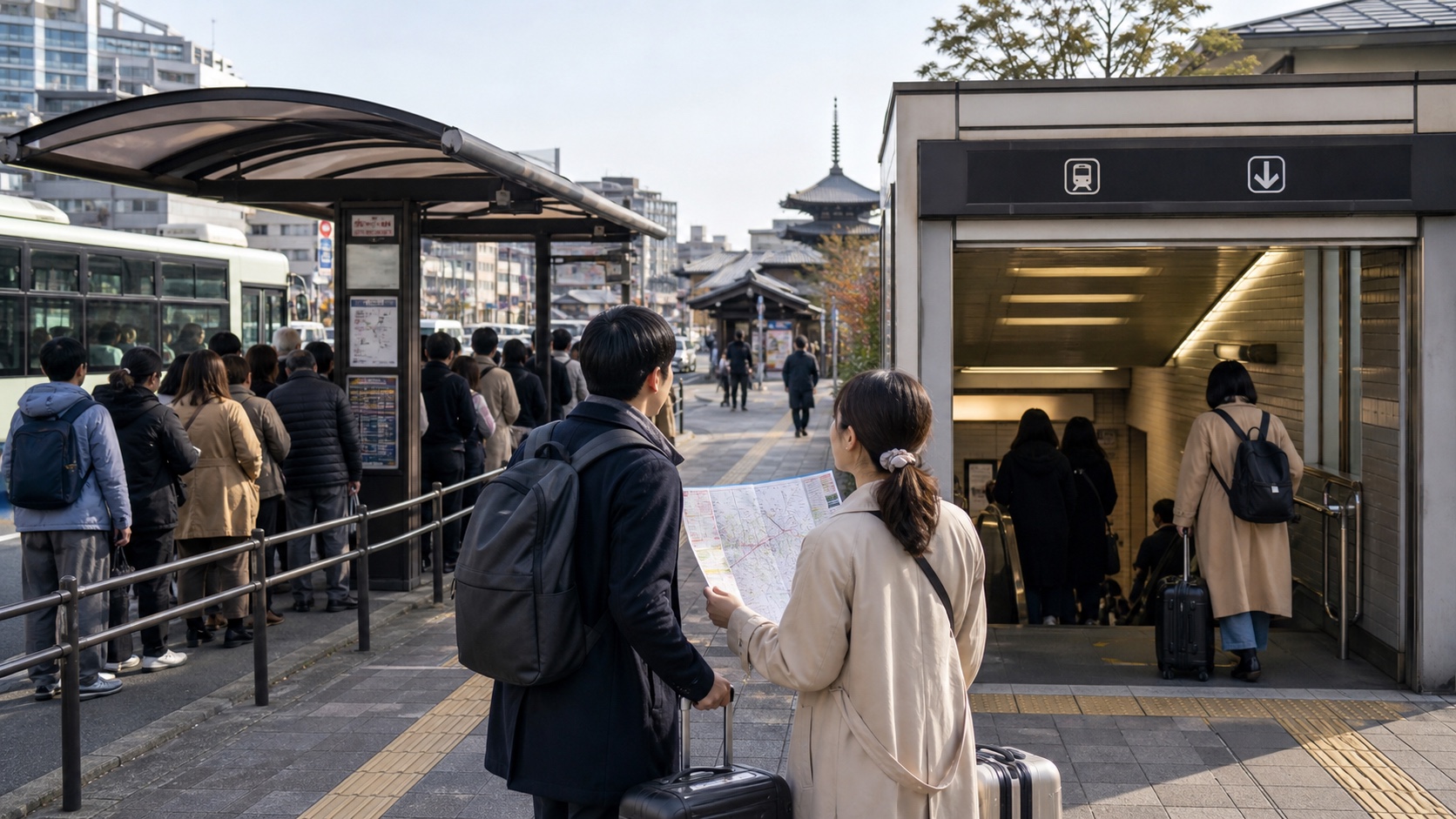
Use rail or subway for the longest reliable part of a Kyoto journey, then walk or use a short bus link only where it adds real value. Shift famous sights away from their busiest periods, check Kyoto's official congestion forecast and route tools, and keep luggage out of sightseeing buses. A direct bus is not always the fastest route when roads and stops are crowded.
Kyoto City's official getting-around page warns that general route searches can underestimate congestion and points travelers to local route tools. Its congestion forecast combines predicted crowd levels and selected live information. Current services, fares, boarding methods, passes, and special routes must be checked on official operator pages.
If you only do one thing: compare the direct bus with a rail-first route before leaving the hotel.
Who should use this plan
This guide is for first-time Kyoto visitors, families, older travelers, groups with luggage, peak-season visitors, and anyone connecting Kyoto Station with Higashiyama, Arashiyama, Fushimi, Gion, Okazaki, or northern temples. It helps distinguish unavoidable last-mile travel from a bus habit.
It is not a live timetable. Construction, festivals, weather, road congestion, vehicle capacity, and temporary routing can change the result. Accessibility also varies by station, stop, and vehicle.
| Destination pattern | Start by testing | Why |
|---|---|---|
| Near a rail or subway station | Rail plus walking | Avoid road delay and boarding queues |
| Temple beyond rail | Rail plus short bus or taxi | Reduce time on congested roads |
| Several sights in one district | One arrival, then walk | Avoid repeated boarding and transfers |
| Heavy luggage | Storage, delivery, or taxi | Protect passenger space and movement |
Design each day as one geographic cluster
Choose one Kyoto area and connect nearby sights on foot. A day that jumps from Arashiyama to Kiyomizu, then to Kinkaku-ji and Fushimi Inari creates long cross-city movements and depends heavily on crowded transport. A district day needs fewer boarding decisions and recovers better from delays.
Use an early or late visit only when the official opening, safety, and local rules support it. The congestion forecast can show how conditions vary by place, time, and weather, but it is a planning signal rather than a reservation.
Place a flexible cafe, garden, museum, or neighborhood walk in the middle. This absorbs delay without threatening the last admission at every stop.
Use trains and subway as the main trunk
Kyoto has JR, subway, private railways, trams, and buses. The best trunk depends on the exact destination. Use rail to bypass road congestion, then walk from the nearest practical station or take a short last-mile connection.
Do not choose a route only because it has fewer transfers. A simple rail transfer can be more predictable than a direct bus through crowded streets. Compare platform access, walking, stairs, and the needs of the group.
Kyoto City's official transport page includes current maps, tickets, route-planning resources, and destination access. Check the operator for the exact service and pass coverage.
Use buses for targeted links, not every movement
A bus can be the correct final link for a destination with weak rail access. Check the stop number, route, direction, boarding door, payment, and destination display before joining the queue. Kyoto Station has several bus boarding areas, and similar route numbers or destinations can cause mistakes.
Allow vehicles to pass when full rather than forcing luggage or a group into the doorway. Move inside as directed, prepare payment, and keep backpacks controlled. Give priority seats to those who need them.
Special sightseeing or limited-stop services may change routes and rules. A blog's old boarding method is not the source; use Kyoto City and the operator.
Shift time and place using official tools
Kyoto's official congestion forecast provides area and time indications for selected popular places and may include live-camera information. Use it to compare an earlier or later visit and to choose a less crowded alternative nearby. Predictions update and can change with weather.
Kyoto Smart Navi and other official tools can support route search, live information, luggage services, toilets, and local etiquette. Save the pages before leaving, but keep a screenshot or station name for weak connectivity.
If a famous area is already crowded, do not simply move the same crowd onto the next bus. Use a museum, market, garden, or district that matches the day's geography.
| Problem | First response | Backup |
|---|---|---|
| Long bus queue at Kyoto Station | Check rail or subway trunk | Delay the district or use a targeted taxi |
| Road delay near a popular sight | Exit at a useful rail stop and walk | Stay within the current district |
| Group has large luggage | Store or send it before sightseeing | Use a licensed taxi |
| Forecast shows heavy crowding | Shift the visit time | Choose an official nearby alternative |
Remove luggage from the problem
Kyoto City tools list coin-locker, storage, and hands-free information around Kyoto Station. Use hotel storage, a confirmed locker, delivery, or a licensed taxi before boarding a sightseeing bus with a large suitcase.
Locker capacity and size are not guaranteed. Check availability and operating hours, and keep passports, medication, electronics, and overnight essentials with you. Luggage forwarding requires the correct destination, acceptance, cutoff, and delivery date.
Small daypacks should come off the back in crowded vehicles. The goal is not merely courtesy; it makes boarding safer and reduces missed stops.
Plan for families and mobility needs
A train-first route may still contain stairs, long platforms, and steep streets. Check lifts, accessible exits, restrooms, seating, stroller policies, and the final path. A shorter distance on a map can be harder than a slightly longer step-free route.
For children, reduce transfers and keep food, toilets, and rest within the district. For older travelers, a targeted taxi from the nearest rail station can be better than standing through a long bus route. Use licensed taxis and current official guidance.
Ask the attraction about its own accessible entrance. Transport access does not guarantee an accessible temple path or garden.
Choose passes after the route
Kyoto offers transport passes, but coverage and value depend on the exact operators and journeys. A pass does not create space on a crowded bus and can encourage unnecessary rides. Build the rail-first route, then compare individual fares with the current pass.
Check whether the chosen private railway, JR segment, subway, bus, or special service is included. Verify purchase location, validity, child rules, and whether an IC card is simpler for a mixed route.
Do not spend prime sightseeing time crossing the station to save a small fare. Convenience and route fit matter.
Common mistakes and better fixes
| Common mistake | Better action |
|---|---|
| Choosing the direct bus automatically | Compare a rail-first trunk and last-mile walk. |
| Crossing Kyoto for unrelated sights | Keep each day to one geographic cluster. |
| Boarding with large luggage | Use storage, delivery, or a taxi. |
| Trusting a generic map arrival time | Use Kyoto's tools and allow road-delay margin. |
| Buying a pass before planning | Choose the route, then price current coverage. |
What to verify on official sources
Verify route, stop, direction, platform, boarding method, fare, pass coverage, accessibility, final service, construction, festival diversion, and weather. Check the Kyoto congestion forecast close to the visit and use the operator for actual service.
Official tools improve decisions but do not guarantee a vehicle, seat, admission, or uncrowded street.
Related tools and next steps
- Trip Planner — group Kyoto by district.
- Japan transport hub — compare train, bus, taxi, and walking.
- Where to stay in Kyoto — reduce repeated cross-city travel.
- Kansai region guide — connect regional rail days.
Official sources
- Kyoto City: Getting Around Kyoto (checked 2026-08-30)
- Kyoto City: Maps and Tools (checked 2026-08-30)
- Kyoto Travel Congestion Forecast (checked 2026-08-30)
Plan your next step
FAQ
Are trains better than buses for Kyoto sightseeing?
Often for the main trunk, especially near rail-served areas. Use a short bus, walk, or taxi only for the remaining last mile.
How can I check Kyoto crowd levels?
Use Kyoto City’s official congestion forecast and selected live information close to the visit, then keep an alternative in the same area.
Should I take luggage on a Kyoto city bus?
Avoid large luggage when possible. Use hotel storage, lockers, delivery, or a licensed taxi and keep daypacks controlled.
Is a direct bus always faster?
No. Road traffic and boarding queues can make a rail-first route more predictable even when it includes a transfer or walk.
Should I buy a Kyoto transport pass?
Build the route first, then compare current fare and operator coverage. A pass does not reduce congestion.
What is the best way to plan Kyoto Station buses?
Confirm the exact boarding area, route, direction, stop, and current service before joining a queue; Kyoto Station has multiple bus locations.