
Kumano Kodo Nakahechi First Overnight Plan
Choose a realistic first Nakahechi walking segment, overnight village, luggage plan, and exit using current Tanabe City Kumano Tourism Bureau guidance.
At a glance
- Best for
- First-time
- Main decision
- Which spending range fits the route
- Time needed
- 15-30 minutes for a planning pass
- Official checks
- Opening hours, transport schedules, weather, reservations
- Related tool
- Japan Costs And Tips
book the overnight village and identify the last usable bus before committing to a walking segment.
Quick answer
A first Kumano Kodo overnight should be planned around one walkable Nakahechi segment, one confirmed bed, and one workable exit. Do not begin by asking how much of the pilgrimage route can fit into 24 hours. Begin by asking whether your arrival time, fitness, luggage, daylight, and bus connection support the same route.
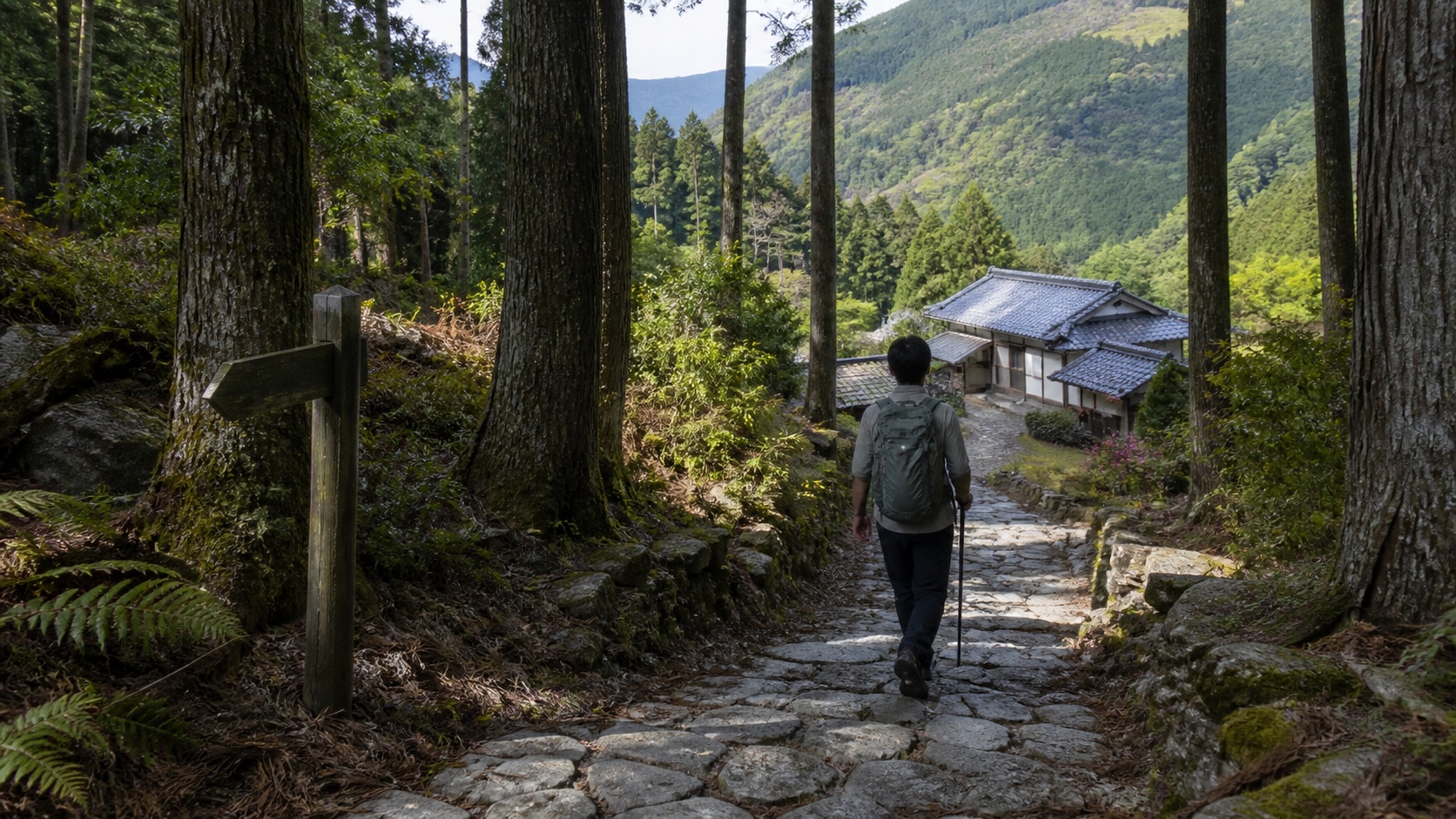
For a gentle introduction, walk from Takijiri-oji to Takahara. The Tanabe City Kumano Tourism Bureau rates this as about 3.7 kilometers and roughly two hours, but the climb is meaningful and wet stone can slow the pace. For a full first walking day, the official suggested-walk material places Takijiri to Chikatsuyu at roughly 16 kilometers and around six hours. That longer plan requires an early trail start, trail-ready footwear, food and water, and lodging already booked.
If you only do one thing: book the overnight village and identify the last usable bus before committing to a walking segment.
Who this plan is for
This guide is for independent travelers who want an authentic first experience on the Nakahechi without pretending that one night equals a full pilgrimage. It suits active first-time walkers, couples who can keep a similar pace, and travelers connecting Kii-Tanabe with Yunomine Onsen, Kawayu Onsen, Hongu, or a longer Kumano route.
The plan is not a good fit for anyone arriving at the trailhead late, walking with a suitcase, recovering from an injury, or relying on a single unverified bus. Families and mixed-fitness groups should prefer the shorter Takahara overnight or use buses to protect the day. A traveler who needs guaranteed step-free access should speak with the official booking and information service before treating a mountain segment as accessible.
| First-night plan | Best for | Main risk to solve |
|---|---|---|
| Takijiri to Takahara | Short first day or later arrival | The opening climb is steeper than the short distance suggests. |
| Takijiri to Chikatsuyu | Fit walkers with an early start | Six hours is a planning estimate, not a guaranteed finish time. |
| Bus-assisted village stay | Mixed fitness or unstable weather | Confirm the current timetable and exact stop before departure. |
| Multi-night continuation | Walkers continuing toward Hongu | Accommodation, meal, luggage, and next-day exit all need advance booking. |
Choose the first night before the trail
Takahara and Chikatsuyu create very different first days. Takahara is the sensible answer when the trip reaches Kii-Tanabe around midday, when the group has not recently walked mountain trails, or when a shorter opening day will protect the following morning. Its small scale is part of the appeal, but that also means a room, meal, or transport fallback cannot be assumed.
Chikatsuyu gives the first day more narrative shape: several hours of forest, oji sites, climbs and descents, followed by a village stop. It is the better choice for walkers who can reach Takijiri early and carry only a day pack. The official difficulty ratings are route-planning aids, not promises. Rain, heat, fatigue, photography, and a slower companion all change the finish time.
Reserve through the Kumano Travel community booking system or directly with an accommodation that clearly confirms meals, check-in, and luggage arrangements. Rural dinner service may be tied to the lodging reservation. Arriving without a meal plan is not the same as arriving in a city hotel district.
Step-by-step first overnight
Step 1: Sleep in Kii-Tanabe before the walk when possible. This protects the morning bus, gives time to collect current maps, and reduces the temptation to begin the trail late after a long Osaka or Kyoto connection.
Step 2: Save the official segment map offline. Download only the map pages needed for the chosen section, then note the trailhead, accommodation village, bus stops, and realistic exit. Mobile signal should be treated as helpful, not guaranteed.
Step 3: Travel to Takijiri with a margin. Check the current bus timetable close to the travel date. Holiday and seasonal conditions matter, and the useful connection is the one that leaves enough daylight after arrival.
Step 4: Walk at the slowest safe group pace. The opening section rises quickly. Pause before fatigue becomes a balance problem, especially on damp stone or roots. Do not use another hiker's recorded speed as your deadline.
Step 5: Reconfirm the next morning before leaving. Check weather, trail notices, luggage pickup, breakfast, and onward buses. A one-night plan is successful when the second day remains flexible, not when every optional kilometer survives.
Luggage, food, water, and footwear
Use the official luggage shuttle and storage directory to arrange bags before walking. Some services require advance booking and operate only between specified accommodations or areas. Write the provider, pickup place, destination, deadline, and contact in one note. A verbal assumption that the next inn will receive a bag is not a booking.
Carry water, a compact meal or dependable snacks, sun and rain protection, a phone battery, a small first-aid kit, and a printed or offline map. The Nakahechi is a historic route through real mountain terrain, not a continuous shopping street. Lodging meal arrangements and trail food should be solved before the day begins.
Wear footwear already tested on inclines and wet surfaces. New boots can be as disruptive as unsuitable shoes. Trekking poles can help some walkers on descents, but they do not replace balance, conservative pacing, or a decision to shorten the route.
Weather and exit decisions
Check the Japan Meteorological Agency forecast and Tanabe City Kumano Tourism Bureau notices. Heavy rain can make stone, roots, and stream crossings more difficult. Summer heat and humidity can be as limiting as rain; shorter daylight in other seasons changes the safe start time.
Agree on a turnaround or shortening rule before leaving. If the group reaches an intermediate point substantially later than planned, use the next safe exit rather than trying to recover time by rushing downhill. If an official notice closes or discourages a section, do not create an unofficial detour through private land.
| Warning sign | Better action |
|---|---|
| Late trailhead arrival | Switch to Takahara or a bus-assisted overnight. |
| Persistent heavy rain | Check official notices and use road transport rather than improvising. |
| Group pace below plan | Shorten at a known exit while daylight remains. |
| Pain, dizziness, or poor balance | Stop, assess, and seek the safest available exit. |
Common mistakes
The first mistake is choosing a famous endpoint before checking how the bus and lodging connect. The second is carrying every travel bag because forwarding feels complicated. The third is treating the official walking time as a deadline. The fourth is planning dinner after arrival in a small village. The fifth is downloading a route from a personal blog without checking current trail notices.
The practical fix is one page of decisions: start bus, walking segment, overnight, meal, luggage provider, weather fallback, exit bus, and emergency contact. That page is more valuable on the trail than a list of optional sights.
What to verify on official sources
Within a week of travel, open the Tanabe City Kumano Tourism Bureau pages for Nakahechi maps, difficulty ratings, suggested walks, luggage shuttle and storage, Takahara, and Chikatsuyu. Recheck accommodation messages and current local bus information. On the morning of the walk, check weather and any trail notice again.
Use the distances and times in this guide only to choose a plan. The current official pages, your booking confirmations, and conditions on the day control the trip.
Related tools and next steps
- Trip Planner — place Kii-Tanabe and the overnight village into the wider Kansai route.
- Luggage Planner — separate the trail pack from forwarded bags.
- Season Packing Planner — prepare for rain, heat, or cooler shoulder seasons.
- Kansai guide — connect the walk with Osaka, Kyoto, or Wakayama.
Official sources
- Tanabe City Kumano Tourism Bureau: Nakahechi (checked 2026-08-30)
- Official difficulty ratings (checked 2026-08-30)
- Official suggested walks (checked 2026-08-30)
- Official luggage shuttle and storage directory (checked 2026-08-30)
Plan your next step
FAQ
Is one overnight enough for the Kumano Kodo Nakahechi?
One night is enough for a focused introduction, not the complete route. Choose one official segment, book the overnight village, and keep the next morning flexible.
Should a beginner stay in Takahara or Chikatsuyu?
Takahara is the safer first choice for a shorter opening day. Chikatsuyu better suits fit walkers who can start early and are prepared for roughly six hours of trail time.
Can I walk from Takijiri to Chikatsuyu after arriving from Kyoto?
It is risky unless the connection reaches Takijiri early. Sleeping in Kii-Tanabe first usually creates a more reliable start and protects daylight.
Do I need to carry my suitcase?
No. Use a confirmed luggage shuttle, storage service, or hotel arrangement and walk with a day pack. Check booking deadlines and the exact delivery destination.
Are the official walking times guaranteed?
No. They are planning estimates. Weather, fitness, pack weight, stops, and trail conditions can lengthen the day.
Where should I check trail conditions and maps?
Use the Tanabe City Kumano Tourism Bureau Nakahechi, map, difficulty, and suggested-walk pages. Save the relevant segment offline and recheck notices before departure.