
Japan Station Hotel vs Neighborhood Stay: How to Choose
Choose between a hotel beside a major station and a quieter neighborhood base by testing real transfers, luggage, arrival time, room size, evening plans, accessibility, and total cost.
At a glance
- Best for
- Family
- Main decision
- Which base reduces time, cost, and luggage friction
- Time needed
- 20-30 minutes before booking hotels
- Official checks
- Hotel location, cancellation rules, room size, station access
- Related tool
- Where To Stay Hub
map the hotel door to the exact platform with luggage before booking.
Quick answer
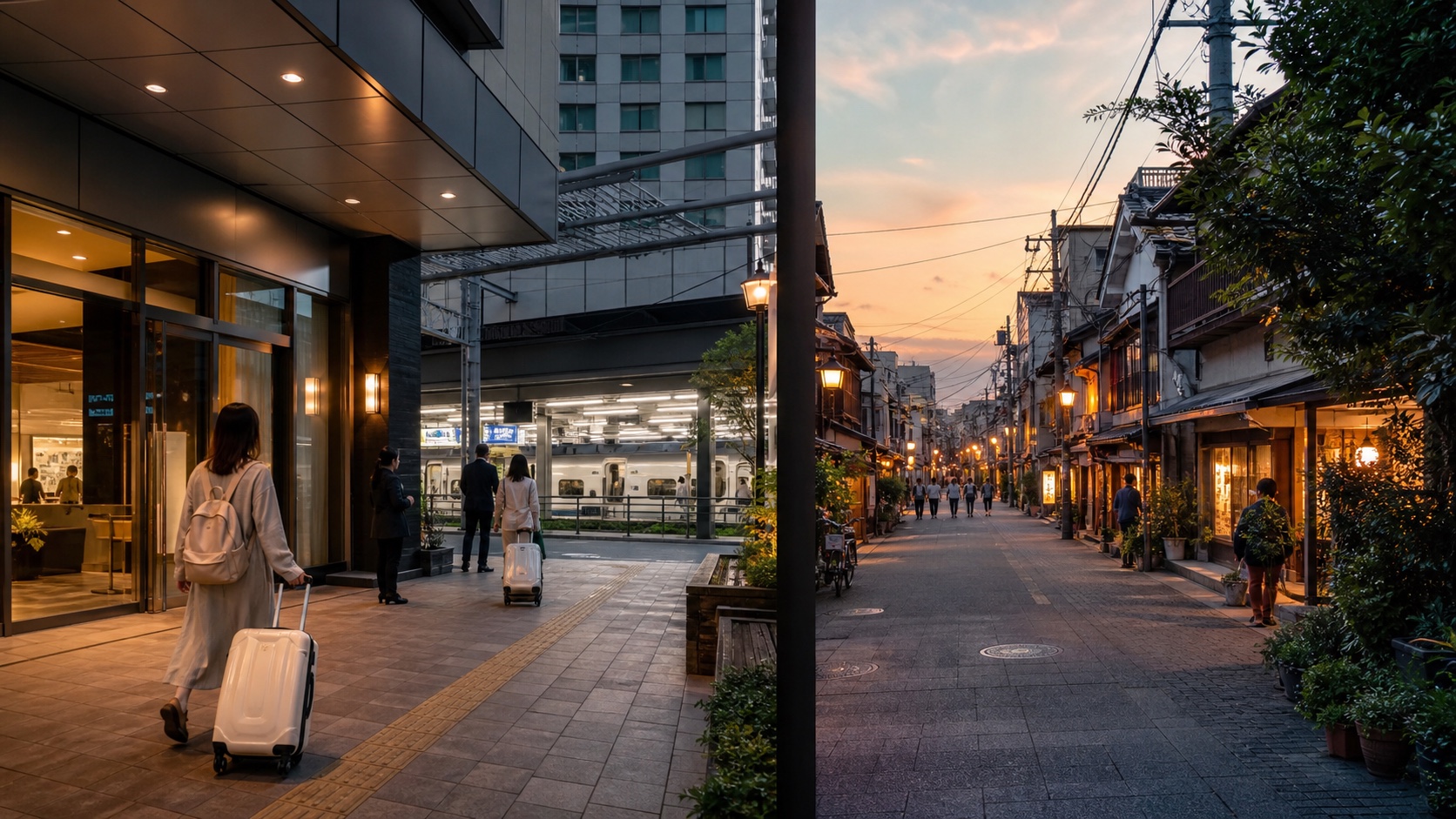
Choose a station hotel when the trip has an early departure, late arrival, frequent day trips, heavy luggage, limited mobility, or several one-night stays. Choose a neighborhood hotel when the same city is the base for several nights and evening atmosphere, local food, room value, or a quieter return matters more than the shortest platform access. Compare the actual hotel entrance with the exact train or bus you will use; “near the station” is too vague.
JNTO explains that Japanese business hotels are often located beside stations for convenience, while rooms can be compact and pricing can reflect the location. Its accommodation guidance also emphasizes that hotel types, room sizes, amenities, and family capacity vary. The best base is the one that reduces the hardest repeated movement, not the one with the most famous station name.
If you only do one thing: map the hotel door to the exact platform with luggage before booking.
Who should use this decision guide
This guide is for travelers comparing a station complex, a nearby business hotel, a quieter residential district, a nightlife area, or a traditional neighborhood in the same city. It is especially useful in Tokyo, Kyoto, Osaka, Fukuoka, Sapporo, Nagoya, Hiroshima, and regional gateways where “station area” can include several exits and large underground passages.
The framework does not rank individual hotels. Property details, construction, accessibility, taxes, check-in, and transport can change. Use the hotel and transport operator for the final decision.
| Trip pattern | Likely better base | Reason to test |
|---|---|---|
| Late arrival or early departure | Station or airport-link hotel | Final service, exit, and reception hours |
| Several regional day trips | Main rail gateway | Exact lines and platform walking |
| Four or more city nights | Neighborhood aligned with daily plans | Evening comfort and repeated local transfers |
| Family or large luggage | Property with verified room and access | Lift route, beds, floor space, and laundry |
Measure door-to-platform, not map distance
A hotel advertised as two minutes from a station may be two minutes from one entrance and much farther from the shinkansen, airport train, or bus terminal. Large stations can require stairs, ticket gates, underground navigation, and long platform walks. Measure the route at the time and in the direction you will use it.
Check whether the hotel entrance remains accessible after an underground mall closes, whether lifts serve the chosen route, and whether a covered path is available. A street-level hotel slightly farther away can be easier than a building connected through a complicated concourse.
For an unstaffed station or a small neighborhood stop, confirm ticket, IC-card, and last-service arrangements. Convenience depends on the whole journey.
Give station hotels their real advantages
Station hotels reduce risk when a journey starts early, ends late, or changes cities frequently. They can simplify luggage storage before check-in or after checkout, make a missed alarm less costly, and reduce exposure to rain, snow, heat, or unfamiliar streets. They also work well for day trips radiating from one rail hub.
The tradeoffs can include smaller rooms, transport noise, busy entrances, higher demand, less neighborhood character, and a premium for convenience. A hotel beside Tokyo Station is not automatically convenient for western Tokyo, and a Kyoto Station base is not automatically faster for every temple district.
Check soundproofing, room orientation, window type, station construction, and whether breakfast or reception starts early enough. “Station hotel” is a location category, not a service guarantee.
Give neighborhood stays their real advantages
A neighborhood base can offer calmer evenings, local restaurants, larger rooms at the same budget, laundromats, parks, supermarkets, and a more comfortable return after sightseeing. It can also reduce daily travel when the itinerary concentrates in one side of a large city.
The risk is hidden friction: a transfer to the main station, a steep walk, a dark or quiet final block, limited late dining, no lift, or a bus that stops early. Visit the street virtually, check the nearest convenience store and evening meal options, and map the route from the station exit to the property.
Do not equate “residential” with silent or “nightlife area” with unsafe. Read current property and area information, then decide based on the group's tolerance for activity, crowds, and walking.
Use arrival and departure nights differently
The first night after a long-haul flight should minimize the chance of becoming stranded, lost, or hungry. Choose a base that works with the actual airport arrival, immigration, baggage, transfer, last service, and reception. A beautiful neighborhood is poor value if reaching it requires a fragile late connection.
The final night should protect the airport or long-distance departure. That may mean moving to a station or airport-link area, but an extra hotel change has its own cost. Compare the early transfer from the existing hotel with the time and effort of changing hotels one day earlier.
A split stay makes sense only when it removes a major risk or supports a genuinely different part of the trip. Do not move hotels merely to sample another district.
Test luggage, room, and family reality
JNTO notes that business-hotel rooms can be compact and may not suit large suitcases or more than two guests. Check floor area, bed width, bed count, child-sharing policy, bathroom layout, luggage storage, elevator, laundry, and whether connecting or adjacent rooms are actually guaranteed.
For a family, the shortest station walk can be less important than enough beds, a table, laundry, food options, and a safe evening route. For mobility needs, ask the hotel for a step-free route from the specific station exit and verify accessible-room details directly. “Barrier-free” can describe only part of the property.
Luggage forwarding can reduce the advantage of a station hotel, but it requires acceptance at both properties, cutoff times, address accuracy, and an overnight essentials bag.
Compare total trip cost, not nightly rate
Add local transport, breakfast, laundry, luggage storage, luggage forwarding, taxis after the last service, room upgrades, city taxes, and the value of time. A cheaper neighborhood room may remain better even with two daily train rides; a station premium may be justified when it prevents several taxis or protects a reserved departure.
| Cost or friction | Station hotel | Neighborhood stay |
|---|---|---|
| Nightly room price | May include a location premium | May buy more space or amenities |
| Daily transport | Lower for regional rail days | Lower when activities cluster nearby |
| Luggage effort | Often simpler but verify exits | May need forwarding or taxi |
| Evening value | Convenient but possibly commercial | Potentially calmer or more local |
Make the decision in six steps
Step 1: list the actual arrival and departure services. Step 2: count regional day trips and city-side activities. Step 3: map hotel door to the exact platform with luggage. Step 4: verify room, beds, lift, laundry, and storage. Step 5: compare total cost and evening quality. Step 6: keep the base that reduces the group's hardest repeated movement.
If the result is close, prefer fewer hotel changes. Repacking, checkout, luggage transfer, and waiting for a new room consume more time than a simple train ride.
Save the Japanese property name and address, the nearest exit, and an offline map. This is useful for taxis and after-dark arrivals.
Common mistakes and better fixes
| Common mistake | Better action |
|---|---|
| Choosing by straight-line distance | Map door, entrance, gates, lifts, and platform. |
| Paying for a famous station unrelated to the route | Count the lines and districts actually used. |
| Ignoring room size with large luggage | Verify floor area, storage, and bed layout. |
| Moving hotels for atmosphere alone | Split only when it removes a major risk or transfer. |
| Assuming a late check-in is automatic | Confirm reception, notice requirements, and final transport. |
What to verify on official sources
Verify room type, bed configuration, floor area, child policy, accessibility, breakfast, laundry, luggage storage, forwarding, check-in, late arrival, cancellation, taxes, construction, and noise with the hotel. Verify station exits, lifts, service hours, reserved trains, and airport links with transport operators.
JNTO provides accommodation context, but the property and operator control the booking and journey. Recheck shortly before travel.
Related tools and next steps
- Region Finder — match the base to the route.
- Budget Calculator — compare total stay and transport cost.
- Luggage forwarding plan — reduce moving-day friction.
- Where to stay hub — compare city-specific bases.
Official sources
- JNTO: Accommodation in Japan (checked 2026-08-30)
- JNTO: Travel Planning FAQ (checked 2026-08-30)
- JNTO: Japan Travel Planning (checked 2026-08-30)
Plan your next step
FAQ
Is it always better to stay near a train station in Japan?
No. A station base is strongest for arrivals, departures, luggage, and regional day trips. A neighborhood can be better for several nights focused in one area.
How close should a Japan hotel be to the station?
Use door-to-platform walking with the correct entrance, gates, lifts, and train. A simple ten-minute route can outperform a confusing two-minute claim.
Are Japanese business-hotel rooms small?
Many are compact, especially near major stations. Verify floor area, bed dimensions, suitcase space, and maximum occupancy for the exact room.
Should I change hotels for my final night?
Only when it materially protects an early airport or rail departure. Compare that benefit with repacking, transfer time, and another check-in.
What matters most for a family hotel base?
Confirmed beds, room space, lifts, laundry, evening food, and the repeated daily route often matter more than the most famous station.
Can luggage forwarding make a neighborhood hotel easier?
Yes, when both properties accept the service and the timing fits. Keep overnight essentials and confirm addresses, cutoff, and delivery date.