
Hokkaido Winter Transport: Daily Status and Backup Plan
Check JR Hokkaido, airport, bus, road, and weather information in the right order, then protect connections with realistic winter buffers and an overnight fallback.
At a glance
- Best for
- Winter
- Main decision
- Which base reduces time, cost, and luggage friction
- Time needed
- 20-30 minutes before booking hotels
- Official checks
- Hotel location, cancellation rules, room size, station access
- Related tool
- Where To Stay Hub
protect the flight or fixed reservation with an earlier transfer or a last-night base that still works if one service is canceled.
Quick answer
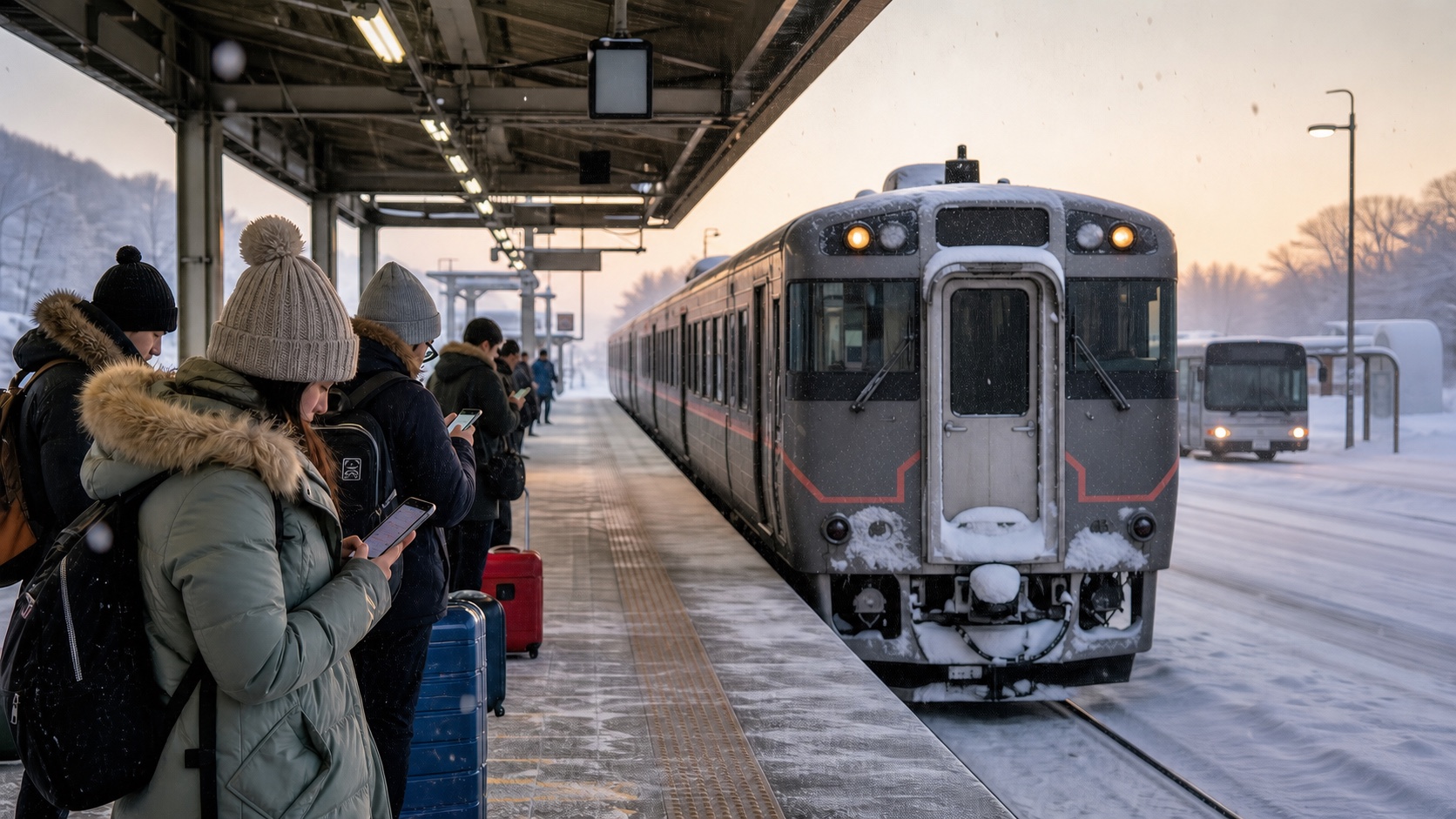
Check transport in layers: Japan Meteorological Agency forecast and warnings, the exact operator's service status, the departure station or airport notice, and the next usable alternative. Do this the evening before and again before leaving the hotel. In Hokkaido winter, a legal connection on a normal timetable is not necessarily a resilient connection.
JR Hokkaido provides English operation information by area, including the Sapporo and Airport Train area. Hokkaido's official tourism site also emphasizes the island's scale and the need to check individual transport providers. Snow removal, wind, low visibility, and downstream rolling-stock or crew effects can change service beyond the location where snow is falling.
If you only do one thing: protect the flight or fixed reservation with an earlier transfer or a last-night base that still works if one service is canceled.
Who should use this guide
This guide is for winter visitors using New Chitose Airport, Sapporo, Otaru, Asahikawa, Furano, Niseko, Hakodate, eastern Hokkaido, or rural bus and rail connections. It is especially important for skiers, families, drivers unfamiliar with snow, and travelers connecting separate flights or prepaid activities.
It does not predict a disruption and does not replace staff instructions. The operating railway, bus company, airline, airport, road authority, and local government control the journey. This guide helps travelers decide what to check and what action to take when the official answer changes.
| Trip component | Primary status source | Useful backup question |
|---|---|---|
| JR train | JR Hokkaido operation information | What is the next operating train or authorized alternative? |
| Airport and flight | Airline and airport official status | Can the ticket change, and is an overnight required? |
| Local or resort bus | The named bus or resort operator | Is reservation required and where is the boarding point? |
| Rental car | Road authority, police, JMA, and rental company | Should the trip be delayed, shortened, or canceled? |
Understand what an operation status can and cannot tell you
A status page may describe a line area, a particular train, expected delay, suspension, restart estimate, or planned cancellation. It can change after you read it. A train-location display is useful but may differ from actual operation, as JR Hokkaido notes on its own service.
Read the timestamp and affected segment. “Sapporo area” does not prove that a later connection in eastern Hokkaido operates. A service shown as normal now may still miss a tight transfer after a delayed incoming train.
Save the exact train number or service name, not only the departure time. Ask staff or the official channel about the full chain when a reserved limited express connects to a rural bus or flight.
Use a three-check winter routine
The evening before: check JMA weather and warnings, planned operator notices, airport status, and any bus reservation. Decide whether to move earlier or stay closer to the fixed event.
Before leaving the hotel: check the exact train, airline, bus, and route again. Confirm that the station entrance and local path are usable with luggage. Allow time to walk more slowly on snow and ice.
At the transfer: read platform and gate information and keep the next alternative visible. If a delay threatens the chain, speak to staff before the connection departs. Do not wait for a travel app to solve a ticket, seat, or accommodation consequence.
Protect New Chitose Airport connections
The rail trip between Sapporo and New Chitose Airport is convenient, but the flight plan should not depend on one last acceptable train. Check both JR Hokkaido and the airline. Airport access can be affected even when the terminal is open, and a flight can change for conditions elsewhere.
For an early international flight or separate-ticket connection, consider the final night near the airport or an earlier transfer. Verify hotel shuttle operation directly; snow can affect the shuttle as well. Add rental-car return, fuel, inspection, shuttle, terminal movement, bag drop, and security.
If the airline changes or cancels a flight, use its official rebooking process. Travel insurance and separate suppliers follow their own terms.
Do not treat a bus as an automatic rail replacement
A highway, local, ski, or resort bus may use the same weather-exposed corridor. It may require a reservation, have limited seats, use a different stop, suspend independently, or carry luggage under specific rules. Search by the exact operator named on the official timetable.
When rail is disrupted, ask whether the operator has arranged an authorized substitute. Do not buy an unrelated ticket based on a social post and assume reimbursement. Preserve receipts and announcements when an insurer or supplier may request evidence.
For rural routes, identify the last service and a possible overnight town before departure. A taxi may not be available or affordable over long winter distances.
Use conservative road decisions
Winter driving requires suitable tires, experience, visibility, and willingness to stop. A rental booking does not mean conditions are safe for the traveler. Check official weather, road closure, police, and rental-company advice. Reduce the route before fatigue, darkness, or a warning forces the decision.
Navigation time is not a winter duration promise. Add snow removal, slower speed, parking, visibility, rest, and the possibility of turning back. Do not use unmaintained shortcuts. Keep fuel above a comfortable margin and carry clothing appropriate for waiting outside the vehicle.
If driving confidence is low, choose rail, a scheduled bus, a tour, or a smaller geographic plan. The best backup can be removing the destination.
Build buffers around fixed reservations
A fixed flight, cruise, prepaid tour, ski lesson, or limited train deserves more buffer than a flexible museum. Move the flexible item, not the critical connection. On a multi-region trip, avoid scheduling the longest winter transfer on the same day as an international departure.
Two nights in a base allow weather to move an outdoor day. An open-jaw flight can reduce backtracking, but separate tickets can create self-transfer risk. Read the protection and baggage terms before purchase.
| Connection | Weak plan | Stronger winter plan |
|---|---|---|
| Sapporo to international flight | Last acceptable same-day train | Earlier transfer or airport-area final night |
| Rural train to reserved bus | Minimum timetable connection | Earlier train and operator contact saved |
| Long drive to prepaid activity | Navigation estimate only | Nearby base, reduced route, and cancellation terms |
| Island or remote winter segment | Single departure with no spare night | Weather buffer and an acceptable mainland alternative |
What to do when service changes
First, confirm the change on the operator page or with staff. Second, protect people: warmth, medication, food, charging, and a safe indoor place. Third, identify the next operating route and whether the ticket can be changed. Fourth, contact the hotel, tour, rental company, or airline before its deadline. Fifth, preserve official notices and receipts.
A restart estimate is not a boarding guarantee. Do not leave a safe station for an uncertain road transfer unless the responsible operator or authority confirms the plan. If no safe same-day route exists, book an appropriate overnight and simplify the next day.
Use translation support when needed, but keep the exact place and service names visible in Japanese.
Common mistakes and better fixes
| Common mistake | Better action |
|---|---|
| Checking only a general route app | Read the actual operator and JMA status. |
| Assuming a bus must replace a canceled train | Confirm operator, reservation, capacity, stop, and weather exposure. |
| Using the final acceptable airport train | Move earlier or use an airport-area final night. |
| Driving because rail is disrupted | Check road conditions, skill, vehicle, visibility, and official advice first. |
| Waiting to contact a hotel or tour | Notify the supplier before the check-in or cancellation deadline. |
What to verify on official sources
Verify the exact train or line, timestamp, affected segment, restart estimate, reservation change, alternative transport, station access, bus status, flight, airport access, road warning, hotel shuttle, and supplier cancellation. Check JMA for weather and warnings and the operator for service.
Do not preserve a fixed list of winter cancellations in an itinerary. Bookmark current official pages and reread them at each decision point.
Related tools and next steps
- Trip Planner — add buffers and an overnight fallback.
- Airport or city final night — protect the departure.
- Weather and emergency alerts — prepare official warning sources.
- Hokkaido region guide — reduce cross-region winter movement.
Official sources
- JR Hokkaido: Train Operation Information (checked 2026-08-30)
- JR Hokkaido: Official English Site (checked 2026-08-30)
- HOKKAIDO LOVE!: Official Transportation Guide (checked 2026-08-30)
- Japan Meteorological Agency: Weather and Warnings (checked 2026-08-30)
Plan your next step
FAQ
Where can I check JR Hokkaido train delays?
Use JR Hokkaido official Train Operation Information and confirm the exact area, line, service, timestamp, and affected segment.
Should I stay near New Chitose Airport before an early flight?
Consider it when the flight is early, the group has heavy luggage, or one disrupted city transfer would create unacceptable risk. Verify the actual hotel and shuttle.
Will a bus replace a canceled Hokkaido train?
Not automatically. Confirm whether the railway arranged a substitute or whether a separate operator has space, a suitable stop, and normal operation.
Can I rent a car when trains are disrupted by snow?
Only after checking road conditions, official advice, vehicle equipment, winter-driving ability, visibility, rental availability, and a safe reduced route.
How often should I check winter transport status?
Check the evening before, before leaving the hotel, and again at each important transfer. Recheck after any warning or delay.
What records should I keep after a cancellation?
Save official notices, ticket changes, staff instructions, supplier messages, and receipts needed by the airline, hotel, tour, or insurer.